





Running a marketing campaign without measuring results is like driving without a speedometer—you may be moving, but you do not know whether you are heading in the right direction. Performance marketing metrics help businesses understand what is working, what is wasting budget, and where campaigns need improvement.
Clicks, impressions, likes, and followers can provide useful context, but they do not always tell you whether your marketing is generating leads, sales, revenue, or profit. The real value of performance marketing comes from connecting advertising activity with measurable business outcomes.
Whether you run an e-commerce store, a B2B company, a startup, or a local business, understanding the right digital marketing metrics can help you make smarter decisions and improve your campaign performance.
In this guide, we will explore the most important marketing performance metrics, how they are calculated, what they tell you, and which KPIs matter most for different campaign objectives.
What Are Performance Marketing Metrics?
Performance marketing metrics are measurable indicators used to evaluate the effectiveness of marketing campaigns based on specific outcomes.
Depending on the campaign, those outcomes could include:
- Website conversions
- Qualified leads
- Sales
- Revenue
- App installations
- Product purchases
- Sign-ups
- Phone calls
- Form submissions
- Return on advertising spend
The most useful metrics do more than show activity. They help answer questions such as:
Are we attracting the right audience? Are people converting? How much does each customer cost? Are our campaigns profitable?
Which Performance Marketing Metrics Should You Track?
There is no single metric that can explain the entire performance of a campaign. Different advertising metrics answer different questions.
| Metric | Formula | What It Tells You |
| Conversion Rate | Conversions ÷ Visitors × 100 | How effectively traffic converts |
| CPA | Ad Spend ÷ Conversions | Cost to acquire a conversion |
| ROAS | Revenue ÷ Ad Spend | Revenue generated from advertising |
| CAC | Total Acquisition Cost ÷ New Customers | Cost to acquire a customer |
| CTR | Clicks ÷ Impressions × 100 | How attractive an ad is |
| CPC | Ad Spend ÷ Clicks | Average cost of each click |
| CLV/LTV | Average Customer Value × Customer Lifespan | Long-term customer value |
| ROI | (Return − Investment) ÷ Investment × 100 | Overall profitability |
| CPL | Ad Spend ÷ Leads | Cost of generating a lead |
| AOV | Revenue ÷ Orders | Average value of each order |
The important point is that these metrics should be interpreted together, rather than individually.
1. Conversion Rate (CVR)
What is Conversion Rate?
Conversion rate measures the percentage of users who complete a desired action after visiting your website, landing page, or campaign destination.
Formula:
Conversion Rate = Conversions ÷ Total Visitors × 100
Example:
Suppose 1,000 people visit your landing page and 50 submit a form.
Your conversion rate is:
50 ÷ 1,000 × 100 = 5%
Why Does It Matter?
A campaign can generate thousands of visitors, but if very few take action, the traffic may not be valuable.
A low conversion rate could indicate problems with:
- Landing page design
- Offer
- Pricing
- Website speed
- Targeting
- Trust signals
- Call-to-action
- User experience
If CVR Is Poor
Test different headlines, offers, CTAs, landing-page layouts, forms, and audience segments. Make sure your landing page matches the promise made in the advertisement.
2. Cost Per Acquisition (CPA)
What is CPA?
Cost per acquisition tells you how much you spend to generate one conversion or acquisition.
Formula:
CPA = Total Ad Spend ÷ Number of Conversions
Example:
If you spend ₹20,000 and generate 100 purchases:
₹20,000 ÷ 100 = ₹200 CPA
Why Does It Matter?
CPA is one of the most important performance marketing metrics because it connects advertising spend directly to results.
A ₹200 CPA could be excellent for one business and unprofitable for another. The acceptable CPA depends on your margins, customer value, and business model.
If CPA Is Too High
Review:
- Audience targeting
- Ad creative
- Conversion rate
- Landing page
- Bidding strategy
- Offer
- Campaign structure
Reducing CPA is not always about getting cheaper clicks. Sometimes improving the conversion rate has a much bigger impact.
3. Return on Ad Spend (ROAS)
What is ROAS?
ROAS measures the revenue generated for every rupee spent on advertising.
Formula:
ROAS = Revenue Attributed to Ads ÷ Advertising Spend
Example:
You spend ₹50,000 on ads and generate ₹2,00,000 in tracked revenue.
ROAS = ₹2,00,000 ÷ ₹50,000 = 4
That means you generated ₹4 in revenue for every ₹1 spent on advertising.
Why Does It Matter?
ROAS is particularly important for e-commerce and revenue-focused campaigns because it connects advertising expenditure with sales.
However, ROAS is not the same as profit. Product costs, salaries, shipping, platform fees, and other expenses still need to be considered.
If ROAS Is Poor
Look at product profitability, audience quality, conversion rate, average order value, ad creative, and campaign targeting.
4. Customer Acquisition Cost (CAC)
What is CAC?
Customer Acquisition Cost measures the total cost involved in acquiring a new customer.
Unlike CPA, CAC can include more than advertising spend.
Formula:
CAC = Total Sales and Marketing Costs ÷ Number of New Customers
Example:
If a company spends ₹1,00,000 across advertising, sales tools, marketing salaries, and related acquisition activities and gains 100 new customers:
CAC = ₹1,00,000 ÷ 100 = ₹1,000
Why Does It Matter?
CAC helps businesses understand whether their overall customer acquisition model is sustainable.
If CAC Is Too High
Identify which acquisition channels are expensive, improve lead quality, increase conversion rates, and focus more budget on channels producing profitable customers.
5. Click-Through Rate (CTR)
What is CTR?
CTR measures the percentage of people who click an advertisement after seeing it.
Formula:
CTR = Clicks ÷ Impressions × 100
Example:
An ad receives 10,000 impressions and 300 clicks.
CTR = 300 ÷ 10,000 × 100 = 3%
Why Does It Matter?
CTR provides insight into how effectively your ad captures attention and encourages users to click.
A low CTR can indicate:
- Weak creative
- Poor messaging
- Irrelevant targeting
- Unclear offer
- Weak call-to-action
If CTR Is Low
Test different hooks, visuals, headlines, offers, and audience segments. But remember: a high CTR does not automatically mean a successful campaign.
6. Cost Per Click (CPC)
What is CPC?
Cost per click tells you the average amount paid for each advertising click.
Formula:
CPC = Total Ad Spend ÷ Total Clicks
Example:
If you spend ₹5,000 and receive 1,000 clicks:
CPC = ₹5,000 ÷ 1,000 = ₹5
Why Does It Matter?
CPC helps marketers understand the cost of generating traffic from paid advertising.
But cheap clicks are not necessarily good clicks.
If one campaign produces ₹5 clicks that never convert while another produces ₹15 clicks that generate customers, the second campaign may be much more valuable.
7. Customer Lifetime Value (CLV/LTV)
What is CLV?
Customer Lifetime Value estimates how much revenue or profit a customer can generate throughout their relationship with your business.
A Simple Formula:
CLV = Average Purchase Value × Purchase Frequency × Customer Lifespan
Example:
A customer spends ₹2,000 per purchase, buys four times per year, and remains a customer for three years.
CLV = ₹2,000 × 4 × 3 = ₹24,000
Why Does It Matter?
CLV gives businesses a longer-term perspective.
A customer who costs ₹2,000 to acquire may appear expensive if you only consider the first purchase. But if that customer generates ₹24,000 over several years, the acquisition cost may be reasonable.
If CLV Is Low
Focus on customer retention, repeat purchases, loyalty programs, upselling, cross-selling, and customer experience.
8. Return on Investment (ROI)
What is ROI?
ROI measures the overall financial return generated from an investment.
Formula:
ROI = (Return − Investment) ÷ Investment × 100
Example:
If you invest ₹1,00,000 in marketing and generate ₹1,50,000 in profit attributable to that investment:
ROI = (₹1,50,000 − ₹1,00,000) ÷ ₹1,00,000 × 100 = 50%
Why Does It Matter?
ROI provides a broader view of profitability than advertising metrics such as CTR or CPC.
Businesses should ultimately care about profitable growth—not just activity.
9. Cost Per Lead (CPL)
What is CPL?
Cost Per Lead measures how much a business spends to generate one lead.
Formula:
CPL = Total Marketing Spend ÷ Number of Leads
Example:
If you spend ₹30,000 and generate 300 leads:
CPL = ₹30,000 ÷ 300 = ₹100 per lead
Why Does It Matter?
CPL is particularly important for lead-generation campaigns.
However, a low CPL does not always mean high performance. If your leads are poor quality and rarely become customers, a cheap lead can still be expensive for the business.
If CPL Is High
Improve targeting, lead forms, ad messaging, landing pages, and audience qualification.
10. Impressions and Reach
What Are Impressions?
Impressions represent the number of times an advertisement or piece of content is displayed.
What Is Reach?
Reach represents the number of unique people who saw the content.
For example, an ad could have:
- 50,000 impressions
- 30,000 people reached
The difference suggests that some people saw the ad more than once.
Why Do They Matter?
Impressions and reach are especially useful for brand awareness campaigns.
However, they should not be treated as proof of sales or profitability.
11. Average Order Value (AOV)
What is AOV?
Average Order Value measures the average amount customers spend per transaction.
Formula:
AOV = Total Revenue ÷ Number of Orders
Example:
If your store generates ₹5,00,000 from 1,000 orders:
AOV = ₹5,00,000 ÷ 1,000 = ₹500
Why Does It Matter?
Increasing AOV can improve campaign economics without necessarily increasing the number of customers.
Businesses can experiment with:
- Product bundles
- Cross-selling
- Upselling
- Minimum-order discounts
- Volume offers
12. Revenue and Profit
Revenue shows how much money the business generates from sales. Profit shows what remains after relevant costs are deducted.
This distinction is critical.
For example, a campaign may generate ₹10 lakh in revenue but have extremely high product, shipping, operational, and advertising costs.
Therefore, revenue alone should not determine whether a campaign is successful.
The ultimate goal is sustainable, profitable growth.
Which Metrics Matter Most for Different Campaigns?
Not every campaign needs to prioritize the same KPIs.
Lead-Generation Campaigns
For lead generation, focus on:
- CPL
- Conversion rate
- CPA
- Lead quality
- Cost per qualified lead
- CAC
- Lead-to-customer conversion rate
- Revenue generated from leads
A campaign producing 1,000 low-quality leads may be worse than one producing 200 highly qualified prospects.
E-Commerce Campaigns
For e-commerce, important metrics include:
- ROAS
- CPA
- Conversion rate
- AOV
- Revenue
- Profit
- CAC
- CLV
- Cart abandonment rate
The relationship between AOV, CPA, ROAS, and profit can reveal whether scaling a campaign makes financial sense.
Brand Awareness Campaigns
Brand campaigns generally focus more on:
- Reach
- Impressions
- Frequency
- Video views
- Engagement
- Brand searches
- Website traffic
- Recall or awareness indicators
For awareness campaigns, immediate sales may not be the only objective. But businesses should still establish meaningful indicators of progress.
Performance Marketing Metrics vs Vanity Metrics
Not every number deserves equal attention.
Vanity metrics can look impressive but may not directly contribute to business decisions.
Examples include:
- Follower count
- Likes
- Generic impressions
- Total video views
- Page views without context
These numbers are not useless. They can provide supporting information.
The problem occurs when businesses use them as the primary definition of success.
For example, gaining 10,000 followers sounds impressive. But if those followers never engage, visit your website, become leads, or purchase products, the business impact may be limited.
Actionable metrics such as CPA, conversion rate, CAC, ROAS, revenue, and profit are usually more useful for performance-focused decision-making.
How Different Metrics Work Together
The biggest mistake is analyzing each metric in isolation.
Consider this example:
Your campaign has:
- High CTR
- Low CPC
- High website traffic
- Low conversion rate
- High CPA
At first glance, the campaign may look successful because people are clicking the ads.
But the low conversion rate tells another story.
The problem may be the landing page, offer, audience quality, or user experience.
Think of the customer journey as a chain:
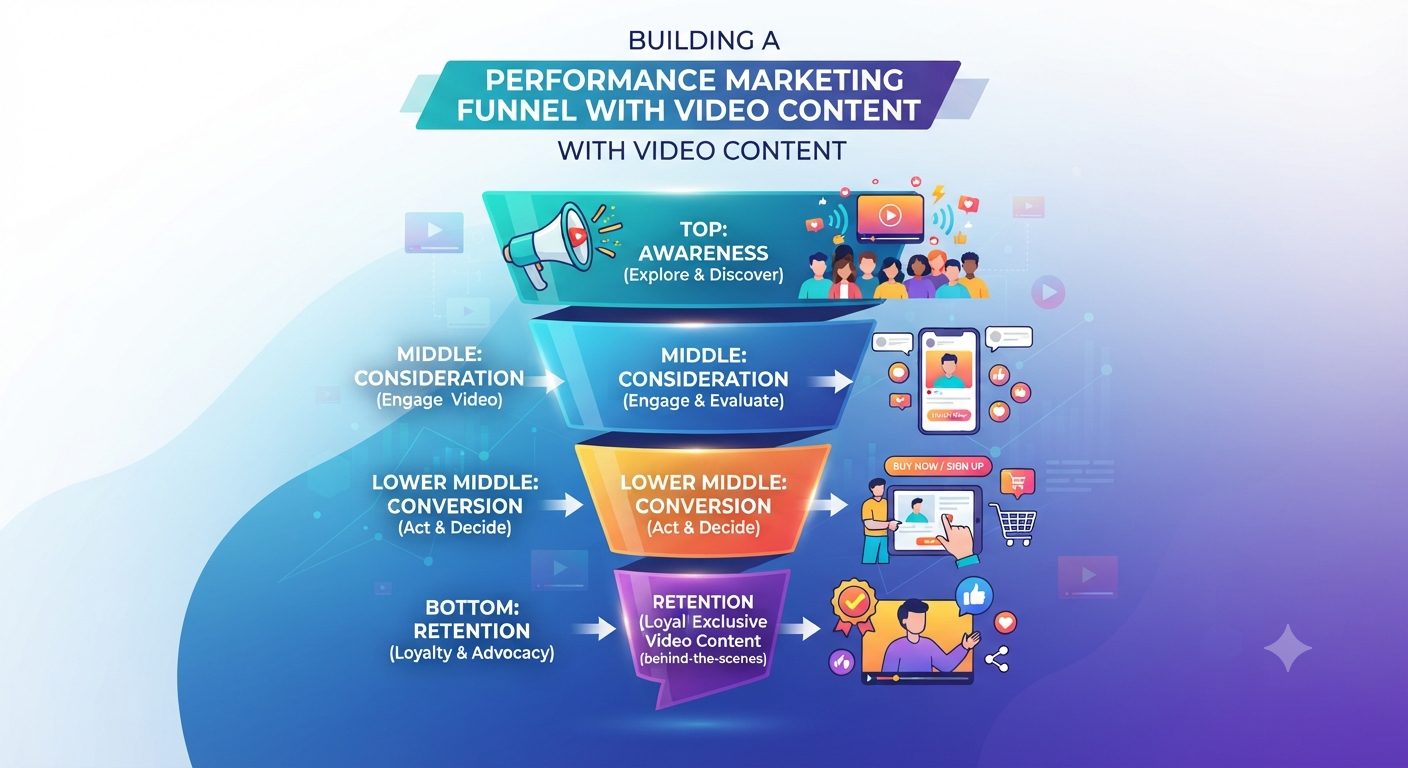
Impressions → Clicks → Website Visits → Conversions → Customers → Revenue → Profit
Each stage has different metrics.
A strong campaign moves people efficiently through the entire funnel—not just the first stage.
How to Choose the Right KPIs for Your Campaign
Before launching a campaign, ask:
1. What is the primary objective?
Is it awareness, leads, sales, app installs, or revenue?
2. What action defines success?
Define the actual conversion you want users to complete.
3. What is the acceptable cost?
Set realistic CPA, CPL, or CAC targets based on your economics.
4. What happens after the conversion?
For lead campaigns, track whether leads become qualified opportunities and customers.
5. What does profitability look like?
Consider revenue, margins, CLV, and operational costs—not advertising metrics alone.
Your primary KPI should reflect the business goal, while secondary metrics explain why the campaign is or is not performing.
Common Mistakes Businesses Make When Measuring Marketing Performance
Focusing Only on Clicks
Clicks are useful, but they do not guarantee conversions or revenue.
Optimizing for the Cheapest Leads
Low CPL can hide poor-quality leads.
Ignoring Conversion Tracking
Without accurate conversion tracking, campaign data can become misleading.
Looking at ROAS Without Profit
High ROAS does not automatically mean high profit.
Comparing Different Campaign Objectives
A brand-awareness campaign should not be judged using exactly the same KPIs as a direct-response sales campaign.
Ignoring Customer Lifetime Value
Businesses may stop profitable campaigns because the first purchase does not immediately justify acquisition costs.
Changing Campaigns Too Frequently
Constant changes can make it difficult to identify what is actually working.
Tools for Tracking Marketing Performance
Accurate measurement requires reliable tracking.
Google Analytics
Google Analytics can help businesses understand website traffic, user behavior, conversions, acquisition sources, and customer journeys.
Google Ads
Google Ads provides advertising data such as impressions, clicks, CTR, CPC, conversions, conversion value, and campaign-level performance.
Meta Ads Manager
Meta Ads Manager provides detailed information about campaigns running across Meta platforms, including delivery, reach, impressions, clicks, conversions, and cost metrics.
CRM Platforms
A CRM can connect marketing leads with sales outcomes. This is especially valuable for B2B businesses because generating a lead is only the beginning of the customer journey.
Together, these tools can create a clearer picture of the entire marketing funnel.
How DigiPromoters Approaches Campaign Performance
A successful digital marketing strategy should not be based on activity alone. Businesses need to understand whether their marketing is contributing to meaningful outcomes.
As a digital marketing agency, DigiPromoters focuses on a measurable, data-driven approach to marketing. Rather than treating clicks or impressions as the final destination, campaign data can be used to identify opportunities for better targeting, stronger creatives, improved conversion paths, and more efficient spending.
Whether a business is investing in performance marketing, SEO, PPC advertising, or social media marketing, the right measurement framework makes it easier to understand what is working and where improvement is needed.
Frequently Asked Questions
1. What are the most important performance marketing metrics?
The most important metrics depend on the campaign objective. Generally, conversion rate, CPA, ROAS, CAC, CLV, ROI, CPL, revenue, and profit are among the most valuable metrics for performance-focused campaigns.
2. What is a good conversion rate?
There is no universal conversion rate that is considered good for every business. It depends on the industry, traffic source, offer, audience, device, and conversion type. Compare your results with historical performance and relevant benchmarks.
3. What is the difference between CPA and CAC?
CPA generally measures the cost of generating a specific conversion, while CAC measures the broader cost of acquiring a new customer and can include sales and marketing expenses beyond advertising.
4. Is ROAS more important than ROI?
Not necessarily. ROAS focuses specifically on revenue generated from advertising spend, while ROI considers the broader return relative to investment. ROAS is particularly useful for ad optimization, while ROI provides a wider profitability perspective.
5. Why is CTR important in digital marketing?
CTR indicates how often people click after seeing an advertisement. It can provide insight into the relevance and attractiveness of an ad, but it should be analyzed alongside conversion and business outcome metrics.
6. Are impressions a useful marketing metric?
Yes. Impressions are useful for understanding ad exposure and campaign delivery, particularly for awareness campaigns. However, impressions alone do not prove that a campaign generated meaningful business results.
7. Which metrics should an e-commerce business track?
E-commerce businesses should typically monitor conversion rate, CPA, ROAS, CAC, AOV, revenue, profit, and CLV. Looking at these metrics together provides a much stronger understanding of campaign performance than focusing on clicks or traffic alone.
Conclusion: Focus on Outcomes, Not Just Activity
The most valuable performance marketing metrics are not necessarily the numbers that look the most impressive in a report. They are the metrics that help you understand whether your marketing is producing meaningful business results.
CTR and CPC can tell you about advertising efficiency. Conversion rate can show whether your website or landing page turns visitors into customers or leads. CPA and CPL can reveal acquisition costs. ROAS can show advertising revenue efficiency, while CAC and CLV provide a broader view of customer economics. Ultimately, revenue and profit determine whether your marketing is creating sustainable business value.
The key is to avoid judging campaigns based on one number.
Measure the complete journey: from impressions and clicks to conversions, customers, revenue, and profit.
When marketing decisions are supported by accurate conversion tracking and the right KPIs, businesses can allocate budgets more confidently, identify problems earlier, and continuously improve campaign performance.
If you need help building a measurable digital marketing strategy, optimizing paid campaigns, improving conversions, or understanding your marketing data, professional support from a data-driven digital marketing agency can help turn campaign numbers into actionable growth opportunities.
The goal is not simply to generate more activity. The goal is to generate better outcomes.