


Introduction
Running an advertisement is easy. Getting that advertisement to turn strangers into leads, customers, and repeat buyers is much harder.
This is where a performance marketing funnel becomes valuable.
Instead of treating every ad as a direct sales pitch, businesses can use different types of video content marketing at different stages of the customer journey. A short video can introduce a problem, an educational video can build interest, a testimonial can reduce hesitation, and a retargeting ad can bring an interested visitor back to complete an action.
When performance marketing and video marketing work together, businesses can create a measurable journey from first interaction to conversion.
A well-planned video marketing funnel does not simply ask, “How many people watched this video?” It asks better questions: Did the right people see it? Did they engage? Did they visit the website? Did they become leads? Did those leads become customers?
This guide explains how to build a performance marketing funnel with video content, what to publish at each stage, which metrics to track, and how to continuously improve campaign performance.
What Is a Performance Marketing Funnel?
Performance marketing is a measurable approach to digital advertising where campaigns are evaluated based on specific business outcomes, such as clicks, leads, purchases, registrations, or sales.
A marketing funnel represents the stages a potential customer moves through before and after taking an important business action.
When the two are combined, a performance marketing funnel gives businesses a structured way to attract prospects, build interest, encourage conversions, and measure results.
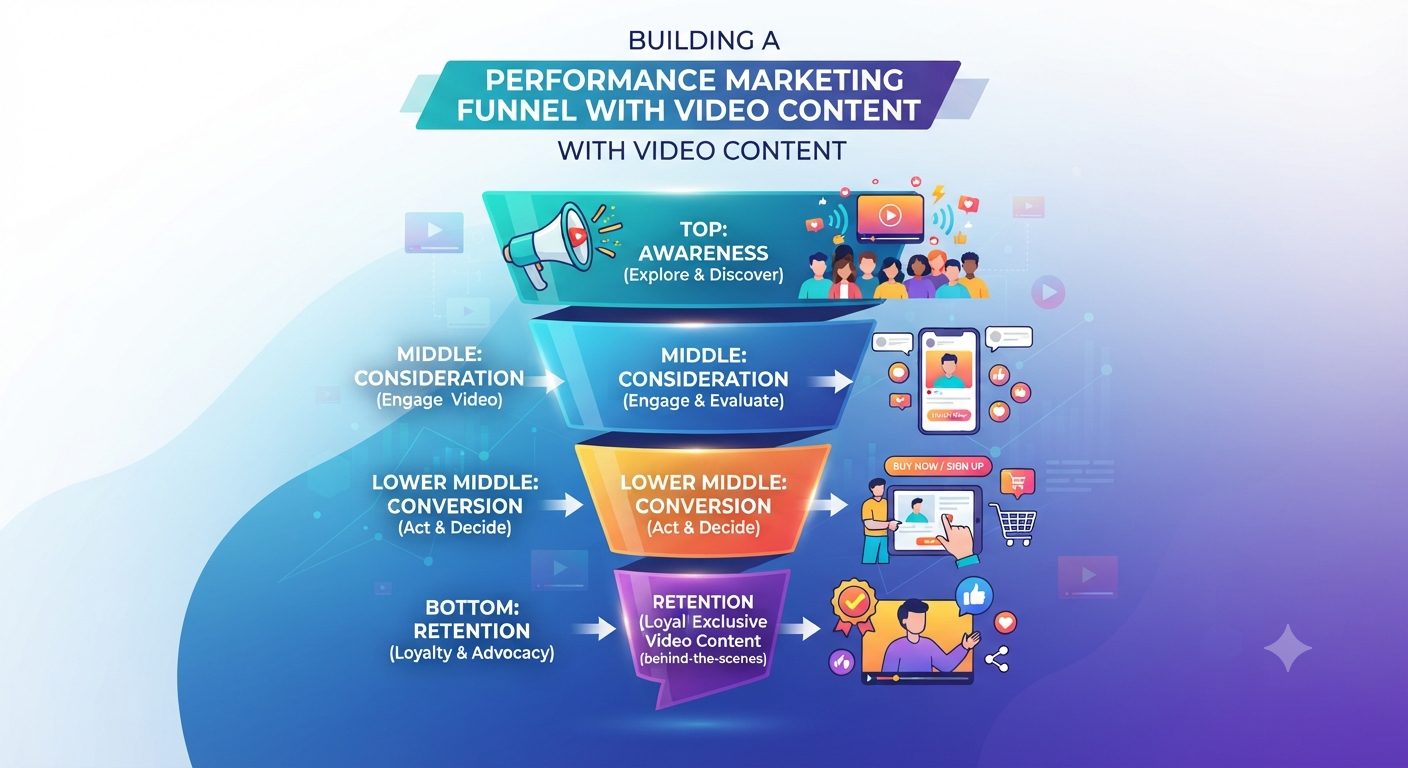
A simple funnel might look like this:
Awareness → Consideration → Conversion → Retargeting → Retention & Advocacy
For example, imagine someone searching for a digital marketing agency.
They might first see a short educational video about why businesses struggle to generate leads. Later, they may see a case-study video showing how an agency improved a client’s campaign. After visiting the agency’s website but not submitting a form, they could receive a retargeting video offering a free consultation.
Each interaction has a different purpose.
The advantage is that businesses can measure what happens at each stage instead of treating the entire campaign as one activity.
Why Video Content Works in Performance Marketing
Video is particularly useful because it can communicate a problem, solution, demonstration, or customer experience in a relatively short format.
Effective video content can help businesses:
- Capture attention in crowded social feeds
- Explain complicated products or services more clearly
- Demonstrate how something works
- Show real people and customer experiences
- Address common objections
- Build familiarity with a brand
- Give prospects a reason to visit a website
- Encourage users to take a specific action
However, simply adding video to an advertising campaign does not guarantee better results.
The video needs to match the customer’s level of awareness.
Someone discovering a brand for the first time usually needs a different message from someone who has already visited the pricing page.
That is why conversion-focused video content should be planned around the funnel rather than created as isolated advertisements.
The Different Stages of a Performance Marketing Funnel
1. Awareness Stage – Get Attention
At the top of the funnel, people may not know your brand or may not even be actively looking for your product or service.
The objective is to earn attention and introduce a relevant problem, idea, or solution.
Useful video formats include:
- Short-form videos
- Instagram Reels
- Educational videos
- Problem-focused videos
- Brand introduction videos
- Attention-grabbing video ads
- Quick industry tips
For example, a digital marketing agency could create a short video explaining:
“Getting website traffic but no leads? Here are three reasons why.”
The objective isn’t necessarily to make a sale immediately. It is to attract people who have the problem the business solves.
Key KPIs:
Video views, reach, watch time, view-through rate, engagement, and audience growth.
At this stage, don’t judge the entire campaign by conversions alone. The quality of the audience being attracted also matters.
2. Consideration Stage – Build Interest
Once people recognize a problem and know that your business exists, the next objective is to give them enough information to consider your solution.
This is where deeper video content becomes useful.
Examples include:
- Product demonstrations
- Service explainers
- Testimonials
- Comparison videos
- Case studies
- FAQ videos
- Behind-the-scenes videos
- Expert-led educational content
Suppose a person watched an awareness video from a digital marketing agency. They could later be shown a case-study video explaining how the agency approached a lead-generation campaign.
This second interaction provides evidence and context.
Useful metrics include:
- Video engagement
- Watch time
- Click-through rate
- Website visits
- Landing-page views
- Content interactions
- Cost per engaged visitor
The goal is to identify people showing meaningful interest rather than simply collecting views.
3. Conversion Stage – Turn Interest Into Action
At the conversion stage, the audience is closer to making a decision.
The content should therefore be more specific and action-oriented.
Effective formats can include:
- Offer-based video ads
- Product demonstrations
- Customer testimonials
- Before-and-after videos
- Service walkthroughs
- Consultation videos
- Limited-time promotional videos
A strong conversion video should make three things clear:
What is being offered?
Why should the customer care?
What should they do next?
The CTA could be:
- Book a consultation
- Request a quote
- Start a free trial
- Get a demo
- Contact the team
- Submit an enquiry
- Shop now
Video alone isn’t enough. The landing page must support the same message.
If an advertisement promises a specific service but sends visitors to a generic homepage, the customer journey can become confusing.
Conversion tracking should also be configured so the business can determine which campaigns, audiences, and creatives are actually producing results.
4. Retargeting Stage – Bring Visitors Back
Not everyone converts on their first visit.
Someone might watch 75% of a video, visit the website, look at a service page, and leave without submitting a form.
That doesn’t necessarily mean the campaign failed.
This is where a paid advertising funnel can use retargeting.
Businesses can create audiences based on actions such as:
- Watching a certain percentage of a video
- Visiting the website
- Viewing a product or service
- Engaging with Instagram or Facebook content
- Visiting a landing page
- Starting but not completing a form
Instead of showing the same introductory advertisement again, businesses can change the message.
For example:
First video: “Why your business needs a predictable lead-generation system.”
Retargeting video: “Still looking for a way to generate qualified leads? See how our process works.”
This creates a more relevant customer experience.
5. Retention & Advocacy Stage
The funnel doesn’t have to end when someone becomes a customer.
Existing customers can also be engaged through video.
Examples include:
- Product tutorials
- How-to videos
- Customer success stories
- New service announcements
- Loyalty offers
- Educational content
- Referral campaigns
A satisfied customer can also become an advocate.
For example, a business could ask customers to share a short video testimonial describing their experience.
This content can later support future customer acquisition funnels by providing authentic social proof.
How to Match Video Content to Each Funnel Stage
| Funnel Stage | Audience Mindset | Video Type | Main Goal | Example CTA |
| Awareness | “I have a problem.” | Reels, educational videos, problem-focused ads | Capture attention | Learn More |
| Consideration | “What are my options?” | Demos, case studies, FAQs, testimonials | Build trust | See How It Works |
| Conversion | “Should I choose this?” | Offer videos, testimonials, demonstrations | Generate action | Book a Call |
| Retargeting | “I was interested but didn’t act.” | Objection-handling and reminder videos | Recover lost prospects | Get Started |
| Retention | “I already use this.” | Tutorials, tips, customer stories | Increase satisfaction and advocacy | Refer a Friend |
How to Build a Video-Based Performance Marketing Funnel
1. Define the Business Goal
Start with the outcome, not the video.
Decide whether the campaign is designed to generate:
- Leads
- Purchases
- App installations
- Consultation bookings
- Website enquiries
- Product trials
Your objective determines the funnel structure and metrics.
2. Identify the Target Audience
Define who you want to reach.
Consider:
- Location
- Age range
- Business type
- Interests
- Buying behavior
- Problems
- Awareness level
A specific audience usually makes it easier to create relevant messaging.
3. Map Customer Pain Points
Understand what the customer is struggling with.
For a digital marketing agency, pain points could include:
- Poor lead quality
- Low website conversions
- Expensive advertising
- Weak social media presence
- Lack of measurable results
- Low search visibility
Each pain point can become a video topic.
4. Create Videos for Different Funnel Stages
Don’t create one video and expect it to perform everywhere.
Build a small creative system:
Awareness: Problem + insight
Consideration: Education + proof
Conversion: Solution + offer + CTA
Retargeting: Objection + proof + reminder
5. Choose Advertising Platforms
Select platforms based on where your audience spends time and how they consume content.
For example:
- Meta can be useful for social-first video campaigns.
- Instagram is suitable for Reels and mobile-first creative.
- YouTube can support educational, demonstration, and intent-driven video campaigns.
- Google Ads can help capture users actively searching for solutions.
- LinkedIn can be particularly relevant for B2B campaigns.
The best platform is not automatically the one with the largest audience. It is the one that fits your customer, objective, creative, and economics.
6. Set Up Audience Targeting
Create audiences appropriate to each stage.
For example:
Cold audience → Awareness content
Engaged audience → Consideration content
Website visitors → Conversion or retargeting content
Existing customers → Retention content
7. Create Matching Landing Pages
The landing page should continue the story started by the advertisement.
Keep the headline, offer, benefits, and CTA consistent with the video.
8. Set Up Conversion Tracking
Track meaningful actions such as:
- Form submissions
- Purchases
- Calls
- Consultation bookings
- Sign-ups
- Lead submissions
Without reliable tracking, it becomes difficult to know which part of a performance marketing campaign is actually working.
9. Launch Campaigns
Start with a manageable number of audiences and creative variations.
Don’t make the campaign unnecessarily complicated from day one.
10. Analyze Performance
Look beyond surface-level engagement.
Ask:
- Which videos attract qualified users?
- Which audiences click?
- Which landing pages convert?
- Which campaigns generate affordable leads?
- Which leads eventually become customers?
11. Retarget Engaged Users
Create different retargeting groups based on behavior.
Someone who watched 25% of a video may need more education than someone who watched 95% and visited your website.
12. Test and Optimize
Test variables such as:
- Hook
- Opening visual
- Video length
- CTA
- Offer
- Audience
- Landing page
- Testimonial versus demonstration
- Different problem statements
Optimization should be based on business results, not assumptions.
Which Platforms Can You Use?
Meta Ads
Meta platforms can support awareness, engagement, lead-generation, sales, and retargeting campaigns using formats such as Reels, Stories, Feed videos, and other placements.
Instagram works particularly well for short-form, mobile-first content. Reels can introduce problems, demonstrate products, share tips, or communicate a brand’s personality.
YouTube Ads
YouTube is useful when businesses need more space to explain products, services, demonstrations, educational topics, or customer stories.
Google Ads
Google Ads can complement video campaigns by reaching people actively searching for a product or service. Combining awareness-oriented video with search campaigns can help businesses address different parts of the customer journey.
LinkedIn Ads
For B2B companies, LinkedIn can be useful for reaching professional audiences based on characteristics such as job role, industry, or company-related attributes.
The right platform depends on the target audience, business model, campaign objective, budget, and creative format.
Important Performance Marketing Metrics for Video Campaigns
Different stages require different measurements.
Awareness Metrics
Focus on whether the content is attracting and holding attention.
Useful metrics include:
- Video views
- Watch time
- View-through rate
- Reach
- Engagement rate
Consideration Metrics
At this stage, measure whether viewers are taking meaningful next steps.
Look at:
- CTR
- Website visits
- Landing-page views
- Engagement
- Cost per engaged visitor
Conversion Metrics
Now business outcomes become more important.
Track:
- Conversion rate
- Cost per lead
- CPL
- CPA
- Number of qualified leads
- Purchases
- ROAS
Retention Metrics
For existing customers, consider:
- Repeat purchases
- Customer engagement
- Referral activity
- Customer response to campaigns
A high number of video views doesn’t automatically mean a successful campaign. A video that generates fewer views but produces qualified leads may be far more valuable to a business.
Common Mistakes to Avoid
Using the Same Video for Every Funnel Stage
A first-time viewer and an existing prospect have different needs. Create content for their specific stage.
Focusing Only on Views
Views are useful, but they don’t tell the complete business story. Connect video engagement with clicks, leads, sales, and other meaningful actions.
Weak CTAs
If viewers don’t know what to do next, even a good video can lose potential customers.
Targeting Everyone
Broad targeting isn’t always wrong, but the message still needs to be relevant to a defined customer group.
Sending Traffic to Poor Landing Pages
A strong video cannot compensate for a confusing or slow landing page.
Not Installing Conversion Tracking
Without accurate tracking, campaign optimization becomes guesswork.
Ignoring Retargeting
People who have already shown interest can be valuable audiences. Don’t automatically treat them like completely new prospects.
Not Testing Creatives
One creative should not be expected to work forever. Test different hooks, visuals, messages, and CTAs.
Making Every Video Too Promotional
Educational and problem-solving content can help establish credibility before asking the viewer to buy.
Optimizing for Vanity Metrics
Likes and views can be useful signals, but business decisions should ultimately connect to meaningful outcomes.
Example: A Simple Video Performance Marketing Funnel
Consider a digital marketing agency targeting small and medium-sized businesses.
Stage 1: Awareness
The agency runs a short video:
“Your business doesn’t necessarily need more traffic. It may need a better conversion system.”
The video explains three common reasons website visitors don’t become leads.
Stage 2: Consideration
People who engage with the content see a longer educational video explaining how the agency approaches paid advertising, landing pages, and lead tracking.
Stage 3: Proof
Users who continue engaging are shown a case-study or testimonial video.
It explains the client’s original problem, the campaign approach, and the type of outcome achieved.
Stage 4: Retargeting
People who visited the agency’s website but didn’t enquire receive a retargeting video addressing common concerns such as budget, campaign setup, or lead quality.
Stage 5: Conversion
The prospect is shown a clear CTA:
“Book a consultation to discuss your current marketing goals.”
They land on a focused page containing the offer, relevant information, a form, and contact options.
Stage 6: Follow-Up
After becoming a lead, the prospect can receive useful educational content and personalized follow-up.
The important point is that every video has a different job.
Best Practices for Better Results
Start With a Strong Hook
The first few seconds need to give viewers a reason to continue.
Try:
- A direct question
- A common customer problem
- A surprising observation
- A quick demonstration
- A clear promise of useful information
Make Videos Mobile-Friendly
Use clear visuals, readable text, strong framing, and captions where appropriate.
Keep Short-Form Content Focused
Don’t try to explain everything in one Reel.
One video can solve one problem or communicate one key idea.
Use Strong CTAs
Make the next step obvious.
Add Captions
Captions can help communicate the message when users aren’t listening to audio and can improve accessibility.
Test Multiple Creative Angles
Instead of producing five nearly identical videos, test genuinely different approaches.
For example:
- Educational
- Problem-focused
- Testimonial
- Demonstration
- Objection-handling
Segment Your Audiences
A person who watched most of a video is different from someone who only saw a few seconds.
Use behavioral signals where appropriate to create more relevant follow-up campaigns.
Align Ads and Landing Pages
The promise made in the video should be reflected immediately on the landing page.
Continuously Optimize
A performance marketing strategy should evolve based on campaign data.
Pause weak creatives when appropriate, develop variations of strong performers, test new audiences, and improve the conversion experience.
How DigiPromoters Can Help
Building an effective funnel requires more than producing attractive videos. The content, advertising, targeting, landing pages, tracking, and optimization need to work together.
DigiPromoters helps businesses approach digital marketing with a focus on measurable growth and customer acquisition.
Our services can include:
- Performance marketing
- Meta Ads
- Google Ads
- Social media marketing
- Video advertising
- Retargeting campaigns
- SEO
- Conversion-focused digital marketing
Whether the goal is generating leads, increasing online visibility, improving paid advertising performance, or creating a stronger customer journey, the right strategy starts by understanding the audience and business objective.
Frequently Asked Questions
What is a performance marketing funnel?
A performance marketing funnel is a structured customer journey that uses measurable marketing activities to move prospects from awareness to consideration, conversion, and potentially retention. Each stage has specific content, audiences, objectives, and KPIs.
How does video fit into a performance marketing funnel?
Video can support every stage of the funnel. Short educational videos can attract new audiences, demonstrations and testimonials can build consideration, offer-focused videos can encourage conversions, and retargeting videos can bring interested prospects back.
What is a video marketing funnel?
A video marketing funnel uses different video content for different stages of the customer journey. Instead of showing every viewer the same message, businesses use videos designed for awareness, consideration, conversion, and retention.
Are video ads good for lead generation?
Video ads can contribute to lead generation when the audience, message, offer, landing page, and conversion process are aligned. Their effectiveness should be evaluated using meaningful business metrics such as qualified leads and cost per acquisition rather than views alone.
What metrics should I track for video advertising?
The most useful metrics depend on the funnel stage. Awareness campaigns may focus on reach, watch time, and view-through rate. Conversion campaigns should place greater emphasis on CTR, conversion rate, CPL, CPA, qualified leads, purchases, and ROAS.
What is retargeting in a video marketing funnel?
Retargeting means showing relevant advertising to people who have already interacted with your brand. Depending on the campaign setup, this can include people who watched videos, visited your website, viewed products or services, or engaged with social content.
How long should a marketing video be?
There is no universal ideal length. The video should be long enough to communicate its message without unnecessary information. A short awareness video may need only a brief explanation, while a case study or product demonstration may require more time.
Can small businesses use a performance marketing funnel?
Yes. A small business doesn’t need a complicated funnel to begin. It can start with one awareness video, one consideration asset, a focused conversion offer, basic retargeting, and reliable conversion tracking, then expand based on results.
Conclusion
A successful performance marketing funnel is not simply a collection of advertisements. It is a connected customer journey.
Video can help businesses attract attention at the awareness stage, educate prospects during consideration, build confidence through proof, encourage action during conversion, and reconnect with people through retargeting.
The key is to give every video a specific purpose.
Instead of asking only, “How many people watched this video?”, ask:
“What did the viewer do next?”
When video content, paid advertising, audience targeting, landing pages, conversion tracking, and optimization work together, businesses can build a more measurable digital marketing funnel focused on real outcomes.
If your business wants to turn video content and paid advertising into a structured customer acquisition system, DigiPromoters can help you plan, launch, and optimize a performance-focused digital marketing strategy.
Ready to build a smarter marketing funnel? Get in touch with DigiPromoters to discuss your business goals.