

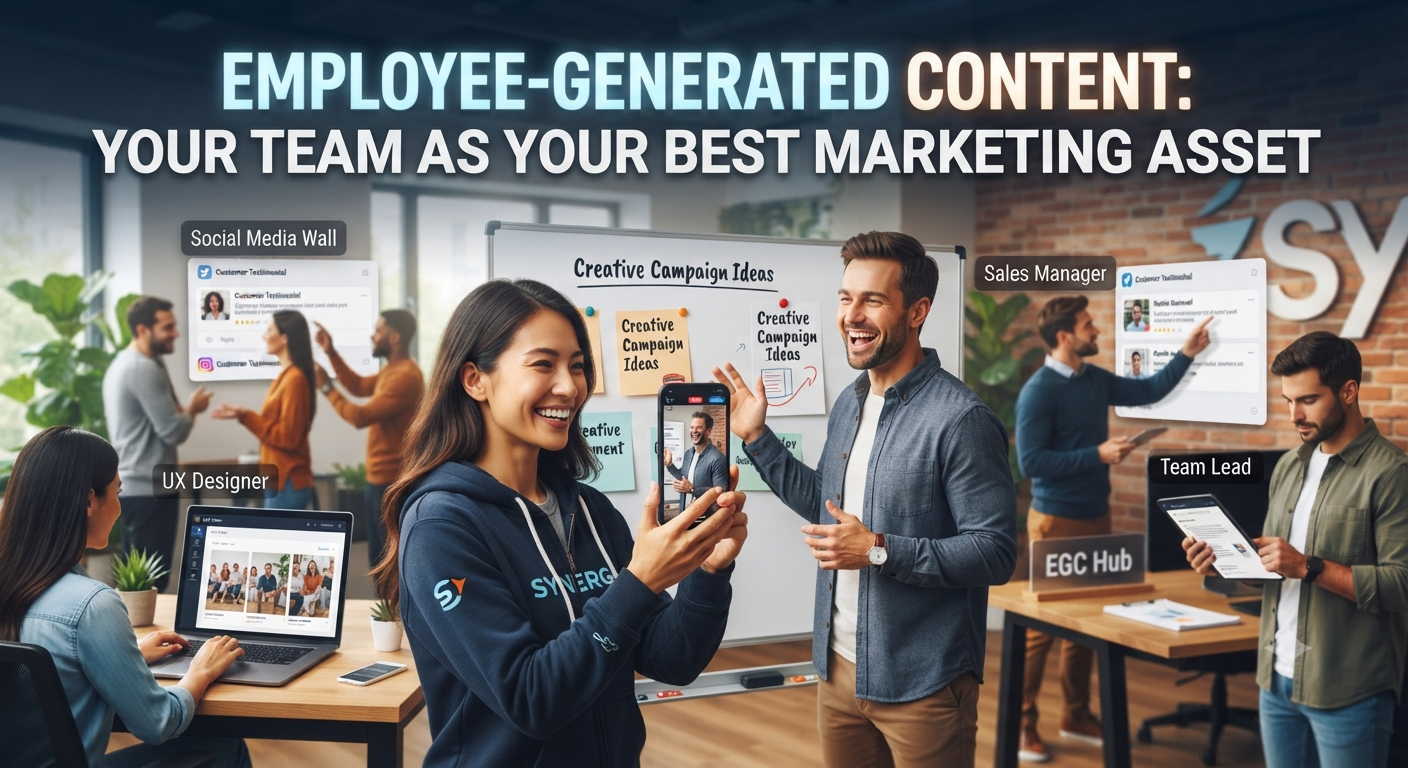
What if one of your most valuable marketing assets is already working inside your company?
Your employees understand your products, services, customers, culture, and day-to-day operations better than most outside creators ever could. When they share that knowledge through social media, videos, posts, photos, or professional insights, they can help make your brand feel more human and trustworthy.
This is the idea behind employee-generated content (EGC).
Employee-generated content is becoming an increasingly useful part of modern social media marketing, particularly as audiences look for authentic brand experiences instead of content that feels overly promotional.
From an employee explaining how a product works to a team member sharing a behind-the-scenes moment, EGC can give businesses a way to showcase the people behind the brand.
For businesses, the opportunity goes beyond social media engagement. A thoughtful employee-generated content strategy can support brand awareness, employer branding, audience trust, recruitment, content marketing, and customer relationships.
In this guide, we will explore what employee-generated content is, why it matters, how businesses can create an EGC strategy, what employees can post, common mistakes to avoid, and how DigiPromoters can help businesses turn their teams into authentic brand voices.
What Is Employee-Generated Content?
Employee-generated content (EGC) is content created or contributed by a company’s employees and shared through the company’s marketing channels, employees’ personal social media accounts, or both.
It can take many forms, including:
- Short-form videos
- Instagram Reels
- LinkedIn posts
- Behind-the-scenes photos
- Product demonstrations
- Employee testimonials
- Educational videos
- Company event content
- Workplace stories
- Customer-service insights
- Industry opinions
- Day-in-the-life content
- Team introductions
- Expert tips
- Recruitment content
For example, imagine a digital marketing agency.
Instead of publishing only a graphic saying:
“SEO is important for your business.”
An SEO executive could record a 30-second video explaining:
“Here are three reasons your business may not be appearing in local Google searches.”
The information is still marketing.
But the delivery feels more personal because a real person from the company is sharing expertise.
Employee-Generated Content vs User-Generated Content
Employee-generated content and user-generated content are related, but they are not the same.
Employee-generated content is created by people who work for the company.
User-generated content (UGC) is created by customers, users, or other people outside the company who interact with the brand.
For example:
| Content Type | Creator | Example |
| Employee-generated content | Employee | Employee explaining a product |
| User-generated content | Customer | Customer reviewing the product |
| Influencer content | Creator/influencer | Influencer demonstrating the product |
| Brand content | Marketing team/agency | Professionally designed campaign |
A strong content marketing strategy can use all four.
The advantage of EGC is that employees can bring first-hand knowledge and real expertise that an external creator may not have.
Why Employee-Generated Content Matters in 2026
Social media audiences are increasingly exposed to branded content, advertisements, influencer promotions, and AI-assisted content.
As a result, businesses need ways to communicate expertise while still sounding human.
Employee-generated content can help bridge that gap.
A team member can explain:
- How your product is made
- Why a particular feature matters
- How a service works
- What customers commonly ask
- What happens behind the scenes
- What the company believes about an industry issue
- What a typical workday looks like
This gives audiences a window into the business.
Sprout Social’s 2026 research on social media content found that consumers surveyed across the US, UK, and Australia identified human-generated content as their top content priority for brands. Its research also reported that employees were viewed as an authentic source of brand content by surveyed consumers.
The exact results will vary by audience, industry, and platform, but the broader takeaway is useful: human voices can make brand communication feel more relatable.
Your Employees Can Become Brand Storytellers
Marketing is no longer limited to advertisements.
People want to understand:
- Who is behind the company?
- What does the business actually do?
- Who makes the product?
- What does the workplace look like?
- What expertise does the team have?
- What does the company stand for?
- How does the company solve customer problems?
Employees can answer these questions naturally.
For example, an interior design company could feature:
Designer:
“Here are three things I check before finalizing a modular kitchen layout.”
A restaurant could feature:
Chef:
“Here’s why we prepare this ingredient differently for this dish.”
A software company could feature:
Developer:
“Here’s a feature our customers frequently ask us about.”
A digital marketing agency could feature:
SEO specialist:
“Here’s one local SEO mistake that can make it harder for your business to appear in Google searches.”
These videos are marketing content, but they also demonstrate expertise.
How Employee-Generated Content Builds Brand Authenticity
Brand authenticity is not created simply by using casual language.
It comes from showing the real people, processes, expertise, and experiences behind a business.
An employee can make a brand feel less like a logo and more like a group of people.
For example, compare:
Traditional approach:
“Choose our digital marketing services to grow your business.”
With:
Employee-led approach:
“I work on SEO campaigns every day, and one mistake I see small businesses make repeatedly is…”
The second approach immediately introduces a person and a point of view.
That does not automatically make it more effective, but it creates a different type of communication.
The Benefits of Employee-Generated Content
A well-planned EGC strategy can provide several benefits.
1. It Humanizes the Brand
People work with people.
Showing employees can make a business feel more approachable and transparent.
2. It Demonstrates Expertise
Your employees already have specialized knowledge.
A designer can explain design.
An accountant can explain financial processes.
An SEO specialist can explain search optimization.
A chef can explain food preparation.
This creates expert-led content without having to constantly rely on external creators.
3. It Creates More Content Opportunities
Content teams frequently face the same problem:
“What should we post today?”
Employees can provide an almost unlimited source of topics.
Every customer question, project, process, mistake, lesson, and industry insight can potentially become content.
4. It Supports Employer Branding
EGC is not only useful for attracting customers.
It can also help potential employees understand the company culture.
Employees can show:
- Team activities
- Office life
- Learning opportunities
- Company events
- Work routines
- Celebrations
- Projects
- Employee experiences
This can make recruitment communication more informative and personal.
5. It Can Strengthen Employee Advocacy
When employees voluntarily share company-related content, they can extend the brand’s reach beyond the company’s own social profiles.
However, employee advocacy should be voluntary and supported by clear guidelines. Employees should never feel forced to promote the company through their personal accounts.
What Types of Employee-Generated Content Can Businesses Create?
There is no single EGC format.
Different businesses can experiment with different content types.
Employee Introduction Videos
Introduce team members.
For example:
“Meet our SEO specialist.”
Then answer:
- What do you do?
- What do you enjoy about your work?
- What is one common customer mistake?
- What is one marketing tip you would give businesses?
Day-in-the-Life Content
Show what a normal working day looks like.
Examples:
- “A day in the life of an SEO executive”
- “A day at our design studio”
- “What a restaurant kitchen looks like before opening”
- “How our team prepares a client campaign”
Expert Tips
This is one of the most useful EGC formats.
Ask employees to explain one specific topic in 20–60 seconds.
For example:
“3 things to check before running Google Ads.”
Behind-the-Scenes Content
Show what customers normally do not see.
This could include:
- Product preparation
- Design processes
- Meetings
- Packaging
- Testing
- Photography
- Brainstorming
- Client project preparation
Employee Stories
Personal stories can make company communication more relatable.
Examples:
- “How I started working in digital marketing”
- “What I learned during my first year here”
- “The biggest lesson I learned from a client project”
- “Why I chose this career”
Industry Commentary
Employees with relevant expertise can comment on trends and changes in their industry.
For example, a marketing professional might explain how changing search behavior affects businesses.
This can help position employees as knowledgeable voices rather than simply company representatives.
How to Build an Employee-Generated Content Strategy
Posting random employee videos is not the same as having an EGC strategy.
A strategy gives the content a clear purpose.
Step 1: Identify the Right Employees
Not every employee needs to become a content creator.
Look for people who:
- Have strong subject knowledge
- Communicate clearly
- Enjoy sharing ideas
- Are comfortable on camera
- Understand the company’s values
- Interact regularly with customers
- Have interesting professional experiences
Some employees may prefer writing instead of video.
That is completely fine.
EGC does not have to mean “everyone must make Reels.”
Step 2: Choose Content Pillars
Create a few recurring categories.
For example:
Expertise
Tips, explanations, tutorials, industry insights.
People
Employee introductions, stories, experiences.
Behind the Scenes
Projects, processes, meetings, workplace moments.
Culture
Events, celebrations, team activities.
Customer Insights
Common questions, problems, solutions, lessons.
This gives employees direction without making every post identical.
Step 3: Create Simple Content Guidelines
Employees should know:
- What topics they can discuss
- Which company information is confidential
- What brand tone to use
- Which claims require approval
- What visual guidelines apply
- How customer privacy should be handled
- Whether content needs review before publishing
The goal is to create boundaries—not scripts for every sentence.
Step 4: Make Participation Easy
If the process takes too much time, participation will decline.
Instead of asking an employee to:
- Write a script
- Set up equipment
- Record multiple takes
- Edit the video
- Add captions
- Write a caption
- Create hashtags
the marketing team can handle much of the production.
The employee may only need to provide the expertise.
Step 5: Repurpose the Content
One employee interview can become several pieces of content.
For example:
10-minute interview
→ 3 short Reels
→ 1 LinkedIn post
→ 5 quote graphics
→ 1 blog section
→ 3 Instagram Stories
→ 1 FAQ
This makes EGC more scalable.
How to Encourage Employees to Participate
The biggest challenge is often not content creation.
It is participation.
Employees may think:
- “I don’t know what to say.”
- “I’m not comfortable on camera.”
- “What if I make a mistake?”
- “I don’t have enough time.”
- “I’m not a content creator.”
Businesses can reduce these concerns.
Give Employees Topics
Don’t simply say:
“Make a video about marketing.”
Instead:
“Explain one SEO mistake you see small businesses make.”
Specific prompts are easier.
Let Employees Choose Their Format
Some employees prefer:
- Video
- LinkedIn posts
- Photos
- Interviews
- Written articles
- Podcasts
- Presentations
Allowing different formats can increase participation.
Don’t Expect Perfection
If employees are forced to record 15 takes for a 30-second video, the content may lose the natural quality that made EGC valuable in the first place.
Correct genuine errors, but don’t remove every human element.
Employee-Generated Content for Different Platforms
EGC can work across multiple platforms, but the format should change according to the audience and platform.
Useful formats include:
- Reels
- Stories
- Behind-the-scenes videos
- Employee introductions
- Quick tips
- Workplace content
Employee expertise can be particularly useful for:
- Industry insights
- Professional experiences
- Company culture
- Career stories
- Case-study lessons
- Leadership perspectives
YouTube
Employees can create:
- Tutorials
- Product demonstrations
- Educational videos
- Interviews
- Expert explainers
- Behind-the-scenes videos
TikTok
Where appropriate for the brand and target audience, employees can create:
- Short educational videos
- Industry humor
- Product demonstrations
- Workplace moments
- Trend-adapted content
The platform should follow the audience and business objective—not the other way around.
Employee-Generated Content and Social Media ROI
The purpose of EGC should not simply be to make a brand look active.
It should contribute to business goals.
Depending on the campaign, businesses can track:
- Reach
- Engagement
- Shares
- Saves
- Profile visits
- Website traffic
- Leads
- Conversions
- Recruitment applications
- Cost per lead
- Customer inquiries
For example, if an employee’s educational video generates strong engagement and website visits, the business can create more content around that topic.
If another content category consistently receives little response, the strategy can be adjusted.
This creates a data-driven employee-generated content strategy rather than relying on assumptions.
Common Employee-Generated Content Mistakes
1. Forcing Employees to Become Influencers
Employees are not automatically influencers.
Their role is to share expertise and authentic experiences—not to build a personal creator career for the company.
2. Making Every Employee Say the Same Script
If every employee sounds identical, the content loses its human quality.
Provide talking points instead of forcing everyone to use identical wording.
3. Ignoring Privacy and Confidentiality
Employees should never reveal:
- Confidential client information
- Private customer details
- Internal financial information
- Passwords
- Sensitive business plans
- Unreleased products
Create clear guidelines before launching an EGC program.
4. Making Participation Mandatory
Employees should understand expectations around their role, but personal social media participation should not be treated casually.
Businesses should distinguish between content created as part of someone’s job and posting on an employee’s personal account.
5. Chasing Virality
Not every employee video needs millions of views.
A 1,000-view video that generates relevant leads can be more useful to a business than a viral video that attracts an unrelated audience.
6. Forgetting the Audience
The employee may be the face of the content, but the audience should remain the focus.
Ask:
“Why would someone want to watch this?”
If the answer is unclear, improve the topic before recording.
Employee-Generated Content vs Influencer Marketing
Influencer marketing and EGC can work together, but they serve different purposes.
Influencers bring an external audience and creator identity.
Employees bring internal expertise and direct knowledge of the company.
For example:
A skincare company could partner with a beauty creator to demonstrate its product.
At the same time, a product-development employee could explain how the formula was designed.
The creator provides an outside perspective.
The employee provides an inside perspective.
Both can contribute to the brand’s content ecosystem.
How AI Changes Employee-Generated Content
AI can make EGC production easier, but it should not replace the human perspective that makes the content valuable.
AI can help with:
- Topic research
- Content calendars
- Video captions
- Transcription
- Editing assistance
- Content repurposing
- Headline ideas
- Social media copy
But the actual expertise, experience, opinion, and personality should come from the employee.
A useful principle is:
Use AI to assist the workflow, not to manufacture the human experience.
How DigiPromoters Can Help With Employee-Generated Content
Building an employee-generated content program requires more than asking employees to record videos.
Businesses need a system for identifying topics, creating content, maintaining consistency, publishing, and measuring results.
DigiPromoters can help businesses develop a social media strategy that incorporates employee expertise into a broader digital marketing plan.
Our approach can include:
- Social media strategy
- Employee content planning
- Content pillars
- Short-form video concepts
- Content calendars
- LinkedIn content strategy
- Instagram content strategy
- Video editing direction
- Content repurposing
- Social media advertising
- Performance tracking
- Brand messaging
The goal is not to turn every employee into a full-time content creator.
It is to identify the knowledge already present inside your organization and turn that knowledge into useful content for the right audience.
FAQs
What is employee-generated content?
Employee-generated content (EGC) is marketing content created or contributed by a company’s employees. It can include videos, social media posts, photos, expert insights, testimonials, behind-the-scenes content, and employee stories.
Why is employee-generated content important?
Employee-generated content can humanize a brand, demonstrate employee expertise, provide new content ideas, support employer branding, and create more relatable communication with customers.
What are some examples of employee-generated content?
Examples include employee Reels, LinkedIn posts, behind-the-scenes videos, employee introductions, day-in-the-life videos, expert tips, product demonstrations, company-event content, and industry commentary.
What is the difference between EGC and UGC?
EGC is created by employees of a company, while UGC is created by customers or other users. Both can provide authentic perspectives, but employees bring direct knowledge of the company and its products or services.
How can businesses encourage employees to create content?
Businesses can provide clear content prompts, simple guidelines, flexible formats, recording support, and an easy approval process. Employees should not be expected to become professional content creators.
Can employee-generated content improve social media engagement?
EGC can create more human and relatable communication, which may encourage engagement. Results depend on factors such as content quality, relevance, audience, platform, consistency, and topic.
Should employees post company content on their personal social media accounts?
Personal-account participation should generally be voluntary and governed by clear company guidelines. Businesses should distinguish between employees creating content as part of their role and employees voluntarily sharing content through personal accounts.
How can employee-generated content support employer branding?
Employees can showcase workplace culture, career experiences, team activities, learning opportunities, and day-to-day work. This can give prospective employees a more realistic view of the organization.
Final Thoughts
Your company’s biggest marketing opportunity may not always be an expensive advertising campaign or a large influencer partnership.
Sometimes, it is the person already sitting at the desk next to you.
Employees understand the business from the inside. They know the questions customers ask, the problems they solve, the processes they follow, and the expertise they have developed.
When that knowledge is transformed into useful, genuine content, it can make a brand more understandable and human.
Employee-generated content is not about replacing professional marketing. It is about adding real people and real expertise to it.
The strongest approach is usually a combination of professional brand content, customer-generated content, creator partnerships, and employee voices.
If your business wants to turn its team’s expertise into a consistent social media presence, DigiPromoters can help you build an employee-generated content strategy that connects authentic storytelling with measurable marketing goals.
Your team already knows your brand. Let them help tell its story.