

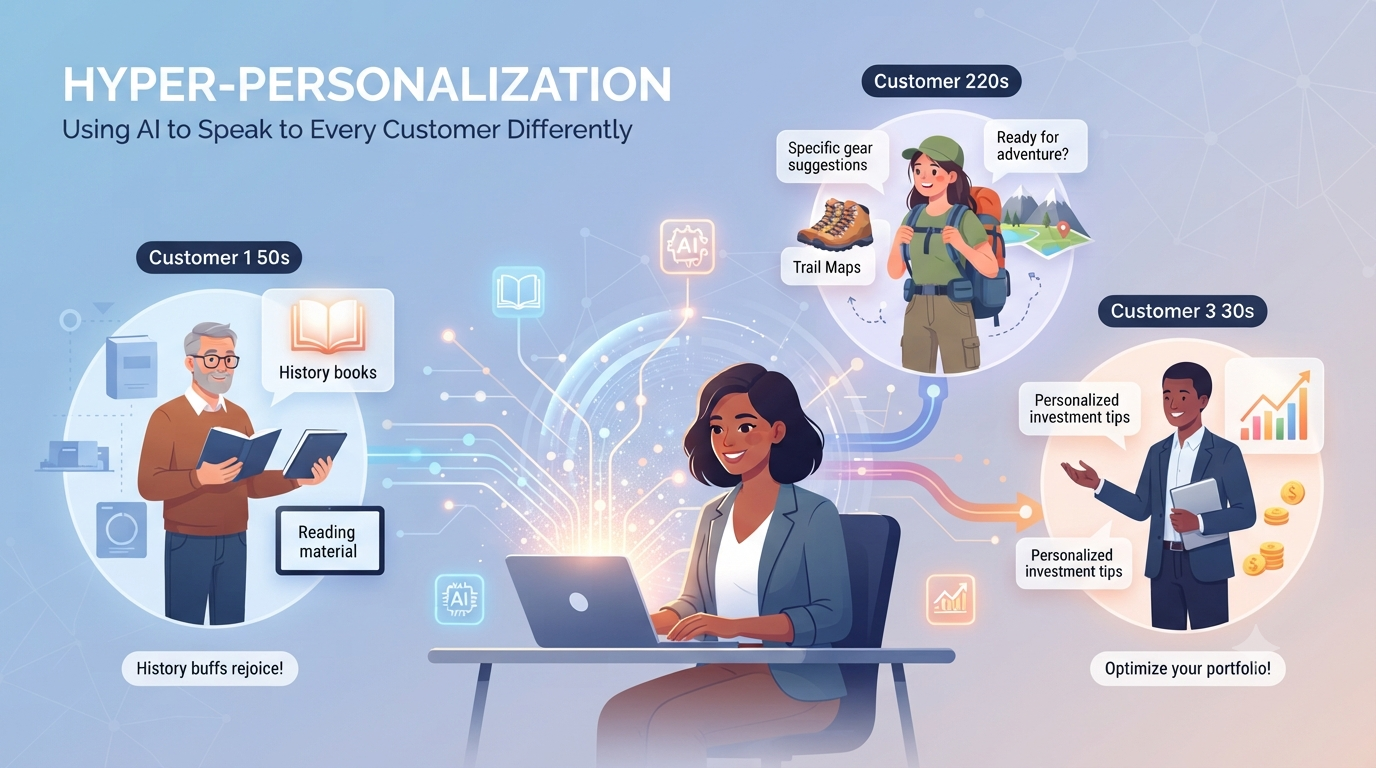
Customers are no longer satisfied with marketing messages that feel like they were written for everyone.
A customer visiting an e-commerce website may want running shoes, while another visitor is looking for formal footwear. A SaaS user may need onboarding guidance, while an experienced customer may be more interested in advanced features. Sending exactly the same message to both people may not be the most relevant approach.
This is where hyper-personalization comes in.
Powered by artificial intelligence (AI), machine learning, customer data, automation, and real-time behavioral insights, hyper-personalization allows businesses to create marketing experiences that are more relevant to individual customers or very specific customer segments.
Instead of simply saying:
“Here are our latest products.”
A brand can potentially deliver a more relevant message based on a customer’s interests, previous interactions, purchase history, browsing behavior, location, lifecycle stage, or preferences—provided the business has the appropriate data, consent, and technology to do so.
For modern businesses, this creates an important opportunity: use AI to make marketing more relevant without making it feel intrusive.
What Is Hyper-Personalization?
Hyper-personalization is the use of customer data, AI, automation, and real-time signals to deliver highly relevant marketing messages, recommendations, offers, and experiences to individual customers or narrowly defined audience segments.
Traditional personalization might use information such as:
- First name
- Location
- Industry
- Previous purchase
Hyper-personalization can combine multiple signals, such as:
- Browsing behavior
- Purchase history
- Product preferences
- Website interactions
- Email engagement
- Search behavior
- Customer lifecycle stage
- Previous conversations
- Content interests
- Real-time actions
AI can then help analyze these signals and determine what type of content, product, recommendation, or message may be most relevant.
Simple Example
Traditional marketing:
“Hi Rahul, check out our latest shoes.”
Personalized marketing:
“Hi Rahul, looking for another pair for your morning runs? Explore our latest lightweight running shoes.”
The second message uses more context.
Hyper-personalization takes this concept further by dynamically adapting the experience based on multiple signals.
Personalization vs Hyper-Personalization
The two concepts are related but not identical.
| Personalization | Hyper-Personalization |
| Usually uses a few customer attributes | Can combine many behavioral and contextual signals |
| Often based on known information | Can incorporate real-time behavior |
| Example: “Hi Priya” | Example: recommendation based on recent product interactions |
| Often rule-based | Can use AI and machine learning |
| Usually works with customer segments | Can work at an individual or micro-segment level |
| Less dynamic | More dynamic and adaptive |
For example, a clothing brand may personalize emails by gender or previous purchase category.
A hyper-personalized system could potentially consider recent browsing behavior, previous purchases, preferred styles, price range, engagement, seasonality, and customer lifecycle stage to determine what products or content to display.
Why Is Hyper-Personalization Important in Digital Marketing?
Consumers interact with brands across multiple touchpoints.
A customer might:
- See an Instagram advertisement.
- Visit the website.
- Read a blog.
- View a product.
- Leave the website.
- Receive an email.
- Return through Google Search.
- Complete a purchase.
If every interaction is treated independently, the experience can feel disconnected.
AI-powered personalization can help businesses connect these interactions and create more relevant customer journeys.
Potential benefits include:
- More relevant content
- Better customer experiences
- Improved engagement
- More useful product recommendations
- Better lead nurturing
- More efficient marketing automation
- Stronger customer retention
- More relevant advertising
- Better customer segmentation
However, hyper-personalization is not automatically effective. Poor data, excessive targeting, irrelevant recommendations, or intrusive personalization can damage the customer experience.
The objective should be relevance, not surveillance.
How AI Powers Hyper-Personalization
AI can process large amounts of customer information much faster than traditional manual segmentation.
A basic marketing system might divide customers into:
- New customers
- Existing customers
- High-value customers
- Inactive customers
An AI-powered system can potentially identify more detailed patterns.
For example:
Customers who viewed product A twice, purchased product B previously, opened two recent emails, and have not purchased for 60 days may respond differently from first-time visitors.
AI can analyze these patterns and help marketers determine which content or offer may be appropriate.
Common AI Technologies Behind Hyper-Personalization
Machine Learning
Machine learning can identify patterns in customer behavior and make predictions based on historical data.
Natural Language Processing
NLP helps AI understand and generate human language.
It can support:
- Personalized emails
- Chatbots
- Customer-service responses
- Content recommendations
- Search experiences
Recommendation Engines
Recommendation systems analyze customer behavior and product relationships to suggest potentially relevant products or content.
Predictive Analytics
Predictive models can estimate the likelihood of future actions, such as:
- Purchase
- Churn
- Conversion
- Repeat purchase
- Engagement
These predictions should be treated as probabilities or decision-support signals rather than guaranteed outcomes.
What Data Does Hyper-Personalization Use?
AI needs information to produce useful personalization.
Depending on the business and applicable privacy requirements, data may include:
First-Party Data
Information collected directly through a company’s own channels.
Examples:
- Website interactions
- Purchases
- Account information
- Email subscriptions
- Lead forms
- Customer preferences
Behavioral Data
Information about interactions with digital channels.
Examples:
- Pages viewed
- Products clicked
- Videos watched
- Emails opened
- Content downloaded
Transactional Data
Information related to purchases or transactions.
Examples:
- Products purchased
- Purchase frequency
- Order value
- Subscription status
Contextual Data
Information about the current situation.
Examples:
- Device
- Website context
- Time
- Page being viewed
- Referral source
Businesses should only use information in ways permitted by applicable laws, platform rules, privacy policies, and customer permissions.
Examples of Hyper-Personalization in Digital Marketing
Hyper-personalization is not limited to large e-commerce companies.
It can be used across industries.
1. E-Commerce
Imagine an online fashion store.
A customer:
- Viewed running shoes
- Compared three products
- Previously purchased sportswear
- Frequently visits the men’s running category
The website could show relevant running products rather than a generic homepage experience.
AI could also help recommend complementary products such as:
- Running socks
- Sports watches
- Performance clothing
The recommendation should still be based on legitimate signals and appropriate data practices.
2. SaaS Businesses
A SaaS company may have different customers with different needs.
A new user may receive:
“Start here: Complete these three steps to set up your account.”
An experienced user may instead receive:
“Explore these advanced automation features.”
The content changes according to the customer’s stage in the product journey.
3. Digital Marketing Agencies
A digital marketing agency can personalize lead nurturing based on the service a prospect has shown interest in.
For example:
A visitor reads several SEO articles and submits a consultation form.
Instead of sending generic digital marketing content, the follow-up journey could focus on:
- SEO strategy
- Technical SEO
- Keyword research
- Content strategy
- Organic traffic measurement
Another prospect interested in paid advertising could receive content about:
- PPC campaigns
- Conversion tracking
- Landing pages
- ROAS
- Lead generation
The result is a more relevant customer journey.
4. Local Businesses
Hyper-personalization can also support local businesses.
Suppose a customer previously contacted an interior design company about a modular kitchen.
Future communication could focus on:
- Kitchen design ideas
- Material options
- Storage solutions
- Budget planning
- Installation timelines
Instead of sending unrelated content about every service the company offers.
Hyper-Personalization in Email Marketing
Email is one of the most practical areas for personalization.
Basic personalization:
“Hi Ananya, thanks for joining us.”
More advanced personalization could consider:
- What content the subscriber reads
- Which products they viewed
- Previous purchases
- Engagement frequency
- Customer lifecycle stage
For example:
New Subscriber
“Here are three guides to help you get started.”
Product Viewer
“Still exploring our running collection? Here are three options based on what you viewed.”
Existing Customer
“Your previous purchase pairs well with these accessories.”
The goal is not to send more emails.
It is to send more relevant emails.
Hyper-Personalization in E-Commerce
E-commerce is one of the most visible applications of AI personalization.
A recommendation engine can analyze relationships between:
- Customers
- Products
- Categories
- Purchases
- Browsing behavior
This can support features such as:
“Recommended for You”
Products based on previous interactions.
“You May Also Like”
Related products based on browsing or purchasing patterns.
“Frequently Bought Together”
Complementary products frequently purchased together.
Personalized Search
Search results can potentially be adjusted based on relevant customer context.
Dynamic Offers
Different customer segments may receive different offers when the business has a legitimate reason and appropriate permissions.
AI-Powered Chatbots and Hyper-Personalization
AI chatbots can also contribute to personalized customer experiences.
A traditional chatbot may answer:
“Here are our services.”
An AI-powered assistant can potentially use the conversation context to understand the user’s intent.
For example:
Customer:
“I need SEO for my local business.”
The chatbot can respond with information about:
- Local SEO
- Google Business Profile optimization
- Local keyword research
- Reviews
- Location-based content
The conversation becomes more relevant because the system understands the customer’s request.
However, businesses should clearly communicate when customers are interacting with AI and provide appropriate escalation options where human assistance is necessary.
Hyper-Personalization and Paid Advertising
AI can also influence advertising workflows.
Advertising platforms already use machine learning to help with areas such as:
- Audience matching
- Delivery optimization
- Conversion optimization
- Creative testing
- Bidding
- Recommendations
Businesses can complement platform-level AI with their own first-party customer insights.
For example, a business may distinguish between:
- New leads
- Qualified leads
- Existing customers
- Repeat customers
Instead of evaluating every lead equally, the business can use CRM information and conversion data to understand which audiences generate meaningful business outcomes.
This is particularly useful for performance marketing because a lead is not necessarily the same as a customer.
Hyper-Personalization and CRM
A CRM—or Customer Relationship Management system—is one of the most important foundations for personalization.
A CRM can organize information such as:
- Contact details
- Lead source
- Previous interactions
- Sales stage
- Purchase history
- Customer status
- Communication history
AI can then help identify patterns within this information.
For example:
“Which leads are showing strong engagement but have not yet booked a consultation?”
Or:
“Which existing customers have not interacted with the brand recently?”
These insights can help marketers create more relevant campaigns.
Hyper-Personalization and Customer Journey Mapping
Every customer does not start from the same place.
A typical customer journey may look like:
Awareness → Consideration → Conversion → Retention → Advocacy
A first-time visitor may need educational content.
A qualified lead may need:
- Case studies
- Pricing information
- Product demonstrations
- Consultation opportunities
An existing customer may need:
- Support
- Cross-sell recommendations
- Loyalty benefits
- Product education
Hyper-personalization allows businesses to adapt communication to the customer’s stage rather than sending the same message to everyone.
AI Can Help Create Personalized Content at Scale
Creating individual content manually for thousands of customers would be difficult.
AI can help marketers create variations of:
- Email copy
- Product descriptions
- Ad copy
- Landing-page content
- Recommendations
- Subject lines
- Customer-service responses
For example, a brand could create different messaging for:
New customers
“Welcome! Here’s how to get started.”
Returning customers
“Welcome back. Here’s what’s new since your last visit.”
High-engagement prospects
“Ready to take the next step? Explore our advanced solutions.”
Human review remains important, especially for brand voice, factual accuracy, sensitive information, and compliance.
Hyper-Personalization vs Mass Marketing
Mass marketing communicates one message to a large audience.
For example:
“Our new collection is here. Shop now.”
Personalized marketing might communicate:
“Explore the new running collection based on your interests.”
Hyper-personalization takes the concept further by dynamically adapting the message, content, recommendation, or experience using multiple relevant signals.
However, mass marketing still has a role.
A brand launching a major product, building awareness, or communicating a broad announcement may intentionally use one message for a large audience.
The right approach depends on the objective.
How to Build a Hyper-Personalization Strategy
Businesses should not start by buying an AI tool.
Start with the customer.
Step 1: Define the Customer Journey
Map the major stages:
- Discover
- Research
- Compare
- Convert
- Use
- Return
- Recommend
Identify where personalization could improve the experience.
Step 2: Identify Available Data
Audit:
- Website data
- CRM
- Advertising platforms
- Purchase records
- Customer-service information
Understand which data is actually reliable and appropriately collected.
Step 3: Create Useful Segments
Start with practical groups such as:
- New visitors
- Returning visitors
- Leads
- Customers
- Repeat customers
- Inactive customers
Then move toward more advanced segmentation as your data and technology mature.
Step 4: Choose High-Impact Use Cases
Do not personalize everything.
Start with one or two areas such as:
- Product recommendations
- Email campaigns
- Lead nurturing
- Website recommendations
- Customer support
Step 5: Connect Your Systems
Where appropriate, connect:
Website + CRM + Analytics + Email + Advertising + Customer Data
The exact architecture depends on the business.
Step 6: Test the Experience
Compare personalized experiences with existing ones.
Useful metrics may include:
- Conversion rate
- Engagement rate
- Revenue per visitor
- Email click-through rate
- Lead-to-customer rate
- Customer retention
- Average order value
Step 7: Improve Continuously
AI personalization is not a “set it and forget it” strategy.
Review:
- Data quality
- Model performance
- Customer feedback
- Conversion results
- Privacy practices
- Brand consistency
Privacy: The Most Important Part of Hyper-Personalization
Hyper-personalization can become uncomfortable when customers feel that a business knows too much about them.
The line between relevant and creepy personalization matters.
For example:
Helpful:
“Because you viewed our running shoes, here are similar products.”
Potentially uncomfortable:
“We noticed you visited our running shoes page at 11:43 PM from your phone.”
The second message reveals unnecessary detail.
Businesses should follow principles such as:
- Collect only necessary information.
- Be transparent about data use.
- Obtain consent where required.
- Respect user choices.
- Secure customer information.
- Avoid sensitive inferences without appropriate justification.
- Give customers control where required.
- Follow applicable privacy laws and platform policies.
Personalization should make the customer feel understood, not watched.
Common Mistakes in AI-Powered Personalization
1. Personalizing Everything
Not every interaction needs AI.
Sometimes a simple, useful message is better.
2. Using Poor-Quality Data
AI cannot magically fix inaccurate customer information.
Bad data → poor insights → poor personalization.
3. Ignoring Context
A customer who purchased a product yesterday may not need another advertisement for the same product today.
4. Making Incorrect Predictions
AI recommendations are predictions, not facts.
Businesses should monitor performance and provide ways to correct inaccurate personalization.
5. Forgetting Human Oversight
AI-generated marketing content should be reviewed for:
- Accuracy
- Tone
- Brand consistency
- Bias
- Privacy
- Sensitive claims
6. Measuring Only Clicks
A personalized campaign can increase clicks without increasing meaningful business results.
Measure outcomes such as:
- Qualified leads
- Sales
- Revenue
- Retention
- Customer satisfaction
The Role of Human Creativity in AI Personalization
AI can analyze data and generate variations quickly.
But strategy still requires human judgment.
A marketer needs to understand:
- Brand positioning
- Customer psychology
- Business objectives
- Creative direction
- Cultural context
- Ethical boundaries
The strongest approach is not:
AI instead of marketers.
It is:
AI + customer data + marketing expertise + human judgment.
How DigiPromoters Can Help With AI-Powered Personalization
At DigiPromoters, we understand that effective digital marketing is about more than reaching a large audience.
Businesses need to reach the right audience with the right message at the right stage of the customer journey.
Our digital marketing approach can support businesses across:
- SEO
- Performance marketing
- Paid advertising
- Social media marketing
- Website optimization
- Analytics and tracking
- Lead generation
- Conversion optimization
- Content marketing
These services can work together to create a stronger foundation for personalization.
For example:
SEO → Website Traffic → Customer Data → CRM → Segmentation → Personalized Content → Conversion → Retention
DigiPromoters can help businesses identify opportunities for personalization, improve digital touchpoints, connect marketing data, and build customer journeys that are more relevant and measurable.
If your business wants to explore how AI, customer data, automation, and digital marketing can work together, contact DigiPromoters to discuss a practical personalization strategy for your business.
The Future of Hyper-Personalization
AI is making it possible for businesses to create increasingly relevant customer experiences at scale.
The next stage of digital marketing will likely involve greater integration between:
- AI
- CRM systems
- First-party data
- Marketing automation
- Analytics
- Content
- Advertising
- Customer service
But technological capability should not be the only consideration.
The businesses that use personalization effectively will need to balance three things:
Relevance
Does the experience actually help the customer?
Privacy
Is the information being collected and used responsibly?
Value
Does personalization improve the customer’s experience or simply increase the number of marketing messages?
The objective is not to make every customer feel like the company knows everything about them.
The objective is to make every interaction more useful, relevant, and timely.
Conclusion
Hyper-personalization is changing how businesses approach digital marketing.
Instead of sending one generic message to everyone, businesses can use AI, customer data, automation, and behavioral insights to create experiences that are more relevant to individual customers and smaller audience segments.
From personalized emails and product recommendations to AI chatbots, CRM-based lead nurturing, targeted content, and smarter advertising, the possibilities are expanding.
But successful hyper-personalization requires more than AI.
It requires:
- High-quality customer data
- A clear marketing strategy
- Reliable analytics
- CRM integration
- Human oversight
- Strong content
- Responsible data practices
- Continuous testing
The future of personalization is not about knowing everything about a customer.
It is about using the right information responsibly to create a better customer experience.
For businesses ready to combine AI with SEO, performance marketing, content, analytics, paid advertising, and conversion optimization, DigiPromoters can help build a digital marketing strategy designed around relevance, measurable outcomes, and sustainable growth.
Frequently Asked Questions
1. What is hyper-personalization in digital marketing?
Hyper-personalization is the use of AI, customer data, behavioral signals, and automation to create highly relevant marketing messages, recommendations, and experiences for individual customers or small audience segments.
2. What is the difference between personalization and hyper-personalization?
Traditional personalization may use basic information such as a customer’s name or location. Hyper-personalization can combine multiple signals, including browsing behavior, purchase history, preferences, lifecycle stage, and real-time interactions.
3. How does AI help with hyper-personalization?
AI can analyze large amounts of customer data, identify patterns, generate content variations, make recommendations, and support predictive models that help marketers deliver more relevant experiences.
4. What are some examples of hyper-personalization?
Examples include AI-powered product recommendations, personalized email campaigns, dynamic website experiences, customized content, personalized offers, targeted lead nurturing, and AI customer-service interactions.
5. Can small businesses use hyper-personalization?
Yes. Small businesses can start with simple personalization through CRM systems, email segmentation, website forms, customer history, targeted content, and automated follow-ups. Advanced AI can be introduced as the business grows.
6. Is hyper-personalization the same as AI marketing?
No. AI marketing is a broader concept that includes many applications of artificial intelligence in marketing. Hyper-personalization is one specific application focused on creating more individualized customer experiences.
7. How does hyper-personalization improve customer experience?
It can reduce irrelevant messages and help customers discover content, products, services, or information that is more relevant to their needs.
8. Is hyper-personalization safe for customer privacy?
It can be implemented responsibly, but businesses must consider applicable privacy laws, consent requirements, platform policies, data security, transparency, and customer expectations.
9. What data is required for hyper-personalization?
Depending on the use case, businesses may use first-party data such as purchases, website interactions, email engagement, customer preferences, CRM information, and product interests. The business should only collect and use data appropriately.
10. How can hyper-personalization improve email marketing?
It can help businesses segment subscribers and customize content based on relevant factors such as previous purchases, interests, engagement, or customer lifecycle stage.
11. Does hyper-personalization require a Customer Data Platform?
Not always. A CDP can be useful for organizations with complex data requirements, but smaller businesses can begin with a CRM, analytics platform, email system, and well-defined customer segments.
12. What metrics should businesses use to measure hyper-personalization?
Depending on the objective, businesses can track conversion rate, engagement, click-through rate, revenue, average order value, lead-to-customer rate, retention, and customer satisfaction. The most useful metric should reflect the actual business goal rather than clicks alone.Customers are no longer satisfied with marketing messages that feel like they were written for everyone.
A customer visiting an e-commerce website may want running shoes, while another visitor is looking for formal footwear. A SaaS user may need onboarding guidance, while an experienced customer may be more interested in advanced features. Sending exactly the same message to both people may not be the most relevant approach.
This is where hyper-personalization comes in.
Powered by artificial intelligence (AI), machine learning, customer data, automation, and real-time behavioral insights, hyper-personalization allows businesses to create marketing experiences that are more relevant to individual customers or very specific customer segments.
Instead of simply saying:
“Here are our latest products.”
A brand can potentially deliver a more relevant message based on a customer’s interests, previous interactions, purchase history, browsing behavior, location, lifecycle stage, or preferences—provided the business has the appropriate data, consent, and technology to do so.
For modern businesses, this creates an important opportunity: use AI to make marketing more relevant without making it feel intrusive.
What Is Hyper-Personalization?
Hyper-personalization is the use of customer data, AI, automation, and real-time signals to deliver highly relevant marketing messages, recommendations, offers, and experiences to individual customers or narrowly defined audience segments.
Traditional personalization might use information such as:
- First name
- Location
- Industry
- Previous purchase
Hyper-personalization can combine multiple signals, such as:
- Browsing behavior
- Purchase history
- Product preferences
- Website interactions
- Email engagement
- Search behavior
- Customer lifecycle stage
- Previous conversations
- Content interests
- Real-time actions
AI can then help analyze these signals and determine what type of content, product, recommendation, or message may be most relevant.
Simple Example
Traditional marketing:
“Hi Rahul, check out our latest shoes.”
Personalized marketing:
“Hi Rahul, looking for another pair for your morning runs? Explore our latest lightweight running shoes.”
The second message uses more context.
Hyper-personalization takes this concept further by dynamically adapting the experience based on multiple signals.
Personalization vs Hyper-Personalization
The two concepts are related but not identical.
| Personalization | Hyper-Personalization |
| Usually uses a few customer attributes | Can combine many behavioral and contextual signals |
| Often based on known information | Can incorporate real-time behavior |
| Example: “Hi Priya” | Example: recommendation based on recent product interactions |
| Often rule-based | Can use AI and machine learning |
| Usually works with customer segments | Can work at an individual or micro-segment level |
| Less dynamic | More dynamic and adaptive |
For example, a clothing brand may personalize emails by gender or previous purchase category.
A hyper-personalized system could potentially consider recent browsing behavior, previous purchases, preferred styles, price range, engagement, seasonality, and customer lifecycle stage to determine what products or content to display.
Why Is Hyper-Personalization Important in Digital Marketing?
Consumers interact with brands across multiple touchpoints.
A customer might:
- See an Instagram advertisement.
- Visit the website.
- Read a blog.
- View a product.
- Leave the website.
- Receive an email.
- Return through Google Search.
- Complete a purchase.
If every interaction is treated independently, the experience can feel disconnected.
AI-powered personalization can help businesses connect these interactions and create more relevant customer journeys.
Potential benefits include:
- More relevant content
- Better customer experiences
- Improved engagement
- More useful product recommendations
- Better lead nurturing
- More efficient marketing automation
- Stronger customer retention
- More relevant advertising
- Better customer segmentation
However, hyper-personalization is not automatically effective. Poor data, excessive targeting, irrelevant recommendations, or intrusive personalization can damage the customer experience.
The objective should be relevance, not surveillance.
How AI Powers Hyper-Personalization
AI can process large amounts of customer information much faster than traditional manual segmentation.
A basic marketing system might divide customers into:
- New customers
- Existing customers
- High-value customers
- Inactive customers
An AI-powered system can potentially identify more detailed patterns.
For example:
Customers who viewed product A twice, purchased product B previously, opened two recent emails, and have not purchased for 60 days may respond differently from first-time visitors.
AI can analyze these patterns and help marketers determine which content or offer may be appropriate.
Common AI Technologies Behind Hyper-Personalization
Machine Learning
Machine learning can identify patterns in customer behavior and make predictions based on historical data.
Natural Language Processing
NLP helps AI understand and generate human language.
It can support:
- Personalized emails
- Chatbots
- Customer-service responses
- Content recommendations
- Search experiences
Recommendation Engines
Recommendation systems analyze customer behavior and product relationships to suggest potentially relevant products or content.
Predictive Analytics
Predictive models can estimate the likelihood of future actions, such as:
- Purchase
- Churn
- Conversion
- Repeat purchase
- Engagement
These predictions should be treated as probabilities or decision-support signals rather than guaranteed outcomes.
What Data Does Hyper-Personalization Use?
AI needs information to produce useful personalization.
Depending on the business and applicable privacy requirements, data may include:
First-Party Data
Information collected directly through a company’s own channels.
Examples:
- Website interactions
- Purchases
- Account information
- Email subscriptions
- Lead forms
- Customer preferences
Behavioral Data
Information about interactions with digital channels.
Examples:
- Pages viewed
- Products clicked
- Videos watched
- Emails opened
- Content downloaded
Transactional Data
Information related to purchases or transactions.
Examples:
- Products purchased
- Purchase frequency
- Order value
- Subscription status
Contextual Data
Information about the current situation.
Examples:
- Device
- Website context
- Time
- Page being viewed
- Referral source
Businesses should only use information in ways permitted by applicable laws, platform rules, privacy policies, and customer permissions.
Examples of Hyper-Personalization in Digital Marketing
Hyper-personalization is not limited to large e-commerce companies.
It can be used across industries.
1. E-Commerce
Imagine an online fashion store.
A customer:
- Viewed running shoes
- Compared three products
- Previously purchased sportswear
- Frequently visits the men’s running category
The website could show relevant running products rather than a generic homepage experience.
AI could also help recommend complementary products such as:
- Running socks
- Sports watches
- Performance clothing
The recommendation should still be based on legitimate signals and appropriate data practices.
2. SaaS Businesses
A SaaS company may have different customers with different needs.
A new user may receive:
“Start here: Complete these three steps to set up your account.”
An experienced user may instead receive:
“Explore these advanced automation features.”
The content changes according to the customer’s stage in the product journey.
3. Digital Marketing Agencies
A digital marketing agency can personalize lead nurturing based on the service a prospect has shown interest in.
For example:
A visitor reads several SEO articles and submits a consultation form.
Instead of sending generic digital marketing content, the follow-up journey could focus on:
- SEO strategy
- Technical SEO
- Keyword research
- Content strategy
- Organic traffic measurement
Another prospect interested in paid advertising could receive content about:
- PPC campaigns
- Conversion tracking
- Landing pages
- ROAS
- Lead generation
The result is a more relevant customer journey.
4. Local Businesses
Hyper-personalization can also support local businesses.
Suppose a customer previously contacted an interior design company about a modular kitchen.
Future communication could focus on:
- Kitchen design ideas
- Material options
- Storage solutions
- Budget planning
- Installation timelines
Instead of sending unrelated content about every service the company offers.
Hyper-Personalization in Email Marketing
Email is one of the most practical areas for personalization.
Basic personalization:
“Hi Ananya, thanks for joining us.”
More advanced personalization could consider:
- What content the subscriber reads
- Which products they viewed
- Previous purchases
- Engagement frequency
- Customer lifecycle stage
For example:
New Subscriber
“Here are three guides to help you get started.”
Product Viewer
“Still exploring our running collection? Here are three options based on what you viewed.”
Existing Customer
“Your previous purchase pairs well with these accessories.”
The goal is not to send more emails.
It is to send more relevant emails.
Hyper-Personalization in E-Commerce
E-commerce is one of the most visible applications of AI personalization.
A recommendation engine can analyze relationships between:
- Customers
- Products
- Categories
- Purchases
- Browsing behavior
This can support features such as:
“Recommended for You”
Products based on previous interactions.
“You May Also Like”
Related products based on browsing or purchasing patterns.
“Frequently Bought Together”
Complementary products frequently purchased together.
Personalized Search
Search results can potentially be adjusted based on relevant customer context.
Dynamic Offers
Different customer segments may receive different offers when the business has a legitimate reason and appropriate permissions.
AI-Powered Chatbots and Hyper-Personalization
AI chatbots can also contribute to personalized customer experiences.
A traditional chatbot may answer:
“Here are our services.”
An AI-powered assistant can potentially use the conversation context to understand the user’s intent.
For example:
Customer:
“I need SEO for my local business.”
The chatbot can respond with information about:
- Local SEO
- Google Business Profile optimization
- Local keyword research
- Reviews
- Location-based content
The conversation becomes more relevant because the system understands the customer’s request.
However, businesses should clearly communicate when customers are interacting with AI and provide appropriate escalation options where human assistance is necessary.
Hyper-Personalization and Paid Advertising
AI can also influence advertising workflows.
Advertising platforms already use machine learning to help with areas such as:
- Audience matching
- Delivery optimization
- Conversion optimization
- Creative testing
- Bidding
- Recommendations
Businesses can complement platform-level AI with their own first-party customer insights.
For example, a business may distinguish between:
- New leads
- Qualified leads
- Existing customers
- Repeat customers
Instead of evaluating every lead equally, the business can use CRM information and conversion data to understand which audiences generate meaningful business outcomes.
This is particularly useful for performance marketing because a lead is not necessarily the same as a customer.
Hyper-Personalization and CRM
A CRM—or Customer Relationship Management system—is one of the most important foundations for personalization.
A CRM can organize information such as:
- Contact details
- Lead source
- Previous interactions
- Sales stage
- Purchase history
- Customer status
- Communication history
AI can then help identify patterns within this information.
For example:
“Which leads are showing strong engagement but have not yet booked a consultation?”
Or:
“Which existing customers have not interacted with the brand recently?”
These insights can help marketers create more relevant campaigns.
Hyper-Personalization and Customer Journey Mapping
Every customer does not start from the same place.
A typical customer journey may look like:
Awareness → Consideration → Conversion → Retention → Advocacy
A first-time visitor may need educational content.
A qualified lead may need:
- Case studies
- Pricing information
- Product demonstrations
- Consultation opportunities
An existing customer may need:
- Support
- Cross-sell recommendations
- Loyalty benefits
- Product education
Hyper-personalization allows businesses to adapt communication to the customer’s stage rather than sending the same message to everyone.
AI Can Help Create Personalized Content at Scale
Creating individual content manually for thousands of customers would be difficult.
AI can help marketers create variations of:
- Email copy
- Product descriptions
- Ad copy
- Landing-page content
- Recommendations
- Subject lines
- Customer-service responses
For example, a brand could create different messaging for:
New customers
“Welcome! Here’s how to get started.”
Returning customers
“Welcome back. Here’s what’s new since your last visit.”
High-engagement prospects
“Ready to take the next step? Explore our advanced solutions.”
Human review remains important, especially for brand voice, factual accuracy, sensitive information, and compliance.
Hyper-Personalization vs Mass Marketing
Mass marketing communicates one message to a large audience.
For example:
“Our new collection is here. Shop now.”
Personalized marketing might communicate:
“Explore the new running collection based on your interests.”
Hyper-personalization takes the concept further by dynamically adapting the message, content, recommendation, or experience using multiple relevant signals.
However, mass marketing still has a role.
A brand launching a major product, building awareness, or communicating a broad announcement may intentionally use one message for a large audience.
The right approach depends on the objective.
How to Build a Hyper-Personalization Strategy
Businesses should not start by buying an AI tool.
Start with the customer.
Step 1: Define the Customer Journey
Map the major stages:
- Discover
- Research
- Compare
- Convert
- Use
- Return
- Recommend
Identify where personalization could improve the experience.
Step 2: Identify Available Data
Audit:
- Website data
- CRM
- Advertising platforms
- Purchase records
- Customer-service information
Understand which data is actually reliable and appropriately collected.
Step 3: Create Useful Segments
Start with practical groups such as:
- New visitors
- Returning visitors
- Leads
- Customers
- Repeat customers
- Inactive customers
Then move toward more advanced segmentation as your data and technology mature.
Step 4: Choose High-Impact Use Cases
Do not personalize everything.
Start with one or two areas such as:
- Product recommendations
- Email campaigns
- Lead nurturing
- Website recommendations
- Customer support
Step 5: Connect Your Systems
Where appropriate, connect:
Website + CRM + Analytics + Email + Advertising + Customer Data
The exact architecture depends on the business.
Step 6: Test the Experience
Compare personalized experiences with existing ones.
Useful metrics may include:
- Conversion rate
- Engagement rate
- Revenue per visitor
- Email click-through rate
- Lead-to-customer rate
- Customer retention
- Average order value
Step 7: Improve Continuously
AI personalization is not a “set it and forget it” strategy.
Review:
- Data quality
- Model performance
- Customer feedback
- Conversion results
- Privacy practices
- Brand consistency
Privacy: The Most Important Part of Hyper-Personalization
Hyper-personalization can become uncomfortable when customers feel that a business knows too much about them.
The line between relevant and creepy personalization matters.
For example:
Helpful:
“Because you viewed our running shoes, here are similar products.”
Potentially uncomfortable:
“We noticed you visited our running shoes page at 11:43 PM from your phone.”
The second message reveals unnecessary detail.
Businesses should follow principles such as:
- Collect only necessary information.
- Be transparent about data use.
- Obtain consent where required.
- Respect user choices.
- Secure customer information.
- Avoid sensitive inferences without appropriate justification.
- Give customers control where required.
- Follow applicable privacy laws and platform policies.
Personalization should make the customer feel understood, not watched.
Common Mistakes in AI-Powered Personalization
1. Personalizing Everything
Not every interaction needs AI.
Sometimes a simple, useful message is better.
2. Using Poor-Quality Data
AI cannot magically fix inaccurate customer information.
Bad data → poor insights → poor personalization.
3. Ignoring Context
A customer who purchased a product yesterday may not need another advertisement for the same product today.
4. Making Incorrect Predictions
AI recommendations are predictions, not facts.
Businesses should monitor performance and provide ways to correct inaccurate personalization.
5. Forgetting Human Oversight
AI-generated marketing content should be reviewed for:
- Accuracy
- Tone
- Brand consistency
- Bias
- Privacy
- Sensitive claims
6. Measuring Only Clicks
A personalized campaign can increase clicks without increasing meaningful business results.
Measure outcomes such as:
- Qualified leads
- Sales
- Revenue
- Retention
- Customer satisfaction
The Role of Human Creativity in AI Personalization
AI can analyze data and generate variations quickly.
But strategy still requires human judgment.
A marketer needs to understand:
- Brand positioning
- Customer psychology
- Business objectives
- Creative direction
- Cultural context
- Ethical boundaries
The strongest approach is not:
AI instead of marketers.
It is:
AI + customer data + marketing expertise + human judgment.
How DigiPromoters Can Help With AI-Powered Personalization
At DigiPromoters, we understand that effective digital marketing is about more than reaching a large audience.
Businesses need to reach the right audience with the right message at the right stage of the customer journey.
Our digital marketing approach can support businesses across:
- SEO
- Performance marketing
- Paid advertising
- Social media marketing
- Website optimization
- Analytics and tracking
- Lead generation
- Conversion optimization
- Content marketing
These services can work together to create a stronger foundation for personalization.
For example:
SEO → Website Traffic → Customer Data → CRM → Segmentation → Personalized Content → Conversion → Retention
DigiPromoters can help businesses identify opportunities for personalization, improve digital touchpoints, connect marketing data, and build customer journeys that are more relevant and measurable.
If your business wants to explore how AI, customer data, automation, and digital marketing can work together, contact DigiPromoters to discuss a practical personalization strategy for your business.
The Future of Hyper-Personalization
AI is making it possible for businesses to create increasingly relevant customer experiences at scale.
The next stage of digital marketing will likely involve greater integration between:
- AI
- CRM systems
- First-party data
- Marketing automation
- Analytics
- Content
- Advertising
- Customer service
But technological capability should not be the only consideration.
The businesses that use personalization effectively will need to balance three things:
Relevance
Does the experience actually help the customer?
Privacy
Is the information being collected and used responsibly?
Value
Does personalization improve the customer’s experience or simply increase the number of marketing messages?
The objective is not to make every customer feel like the company knows everything about them.
The objective is to make every interaction more useful, relevant, and timely.
Conclusion
Hyper-personalization is changing how businesses approach digital marketing.
Instead of sending one generic message to everyone, businesses can use AI, customer data, automation, and behavioral insights to create experiences that are more relevant to individual customers and smaller audience segments.
From personalized emails and product recommendations to AI chatbots, CRM-based lead nurturing, targeted content, and smarter advertising, the possibilities are expanding.
But successful hyper-personalization requires more than AI.
It requires:
- High-quality customer data
- A clear marketing strategy
- Reliable analytics
- CRM integration
- Human oversight
- Strong content
- Responsible data practices
- Continuous testing
The future of personalization is not about knowing everything about a customer.
It is about using the right information responsibly to create a better customer experience.
For businesses ready to combine AI with SEO, performance marketing, content, analytics, paid advertising, and conversion optimization, DigiPromoters can help build a digital marketing strategy designed around relevance, measurable outcomes, and sustainable growth.
Frequently Asked Questions
1. What is hyper-personalization in digital marketing?
Hyper-personalization is the use of AI, customer data, behavioral signals, and automation to create highly relevant marketing messages, recommendations, and experiences for individual customers or small audience segments.
2. What is the difference between personalization and hyper-personalization?
Traditional personalization may use basic information such as a customer’s name or location. Hyper-personalization can combine multiple signals, including browsing behavior, purchase history, preferences, lifecycle stage, and real-time interactions.
3. How does AI help with hyper-personalization?
AI can analyze large amounts of customer data, identify patterns, generate content variations, make recommendations, and support predictive models that help marketers deliver more relevant experiences.
4. What are some examples of hyper-personalization?
Examples include AI-powered product recommendations, personalized email campaigns, dynamic website experiences, customized content, personalized offers, targeted lead nurturing, and AI customer-service interactions.
5. Can small businesses use hyper-personalization?
Yes. Small businesses can start with simple personalization through CRM systems, email segmentation, website forms, customer history, targeted content, and automated follow-ups. Advanced AI can be introduced as the business grows.
6. Is hyper-personalization the same as AI marketing?
No. AI marketing is a broader concept that includes many applications of artificial intelligence in marketing. Hyper-personalization is one specific application focused on creating more individualized customer experiences.
7. How does hyper-personalization improve customer experience?
It can reduce irrelevant messages and help customers discover content, products, services, or information that is more relevant to their needs.
8. Is hyper-personalization safe for customer privacy?
It can be implemented responsibly, but businesses must consider applicable privacy laws, consent requirements, platform policies, data security, transparency, and customer expectations.
9. What data is required for hyper-personalization?
Depending on the use case, businesses may use first-party data such as purchases, website interactions, email engagement, customer preferences, CRM information, and product interests. The business should only collect and use data appropriately.
10. How can hyper-personalization improve email marketing?
It can help businesses segment subscribers and customize content based on relevant factors such as previous purchases, interests, engagement, or customer lifecycle stage.
11. Does hyper-personalization require a Customer Data Platform?
Not always. A CDP can be useful for organizations with complex data requirements, but smaller businesses can begin with a CRM, analytics platform, email system, and well-defined customer segments.
12. What metrics should businesses use to measure hyper-personalization?
Depending on the objective, businesses can track conversion rate, engagement, click-through rate, revenue, average order value, lead-to-customer rate, retention, and customer satisfaction. The most useful metric should reflect the actual business goal rather than clicks alone.