


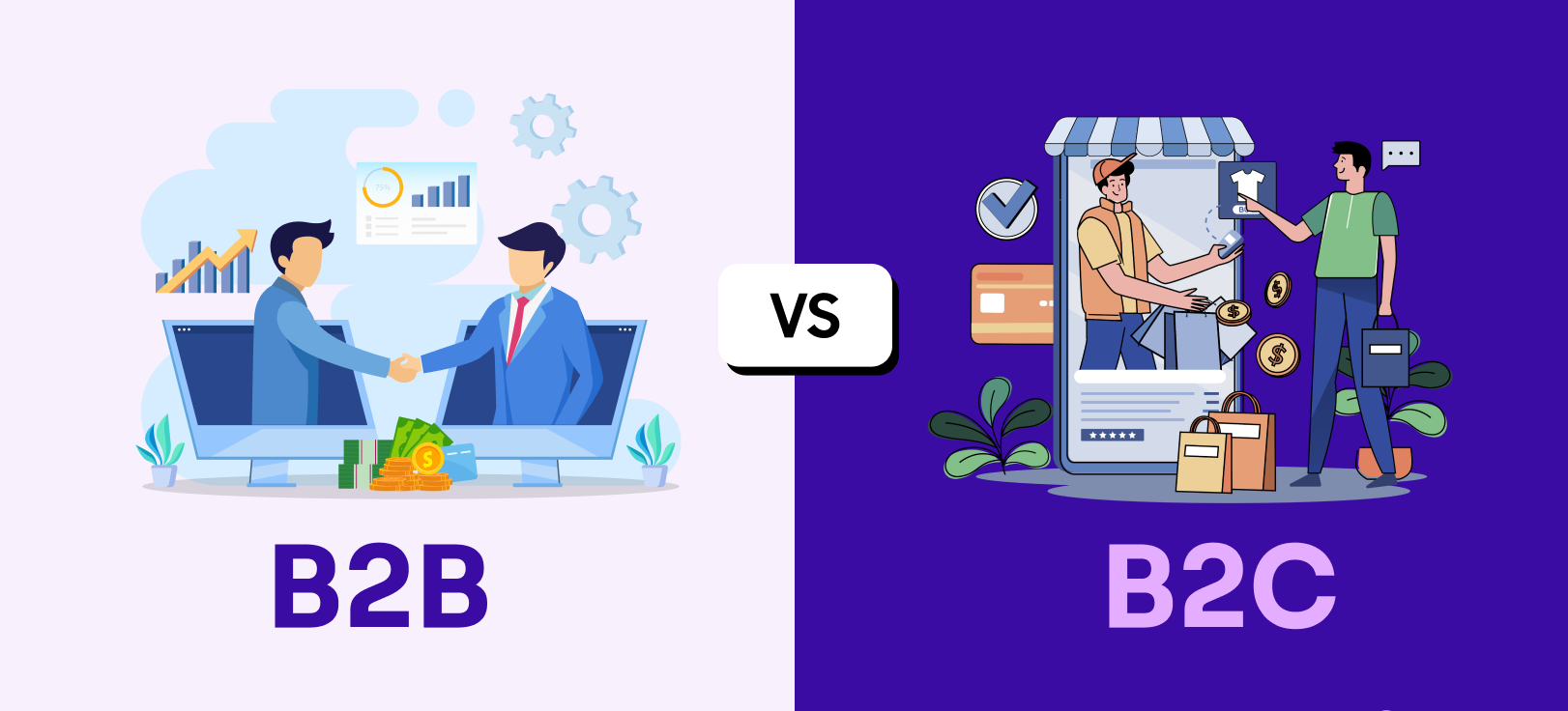
Digital marketing is not a one-size-fits-all process. The strategy that works for a software company selling to businesses may be very different from the approach used by an online fashion brand selling directly to consumers.
Understanding B2B vs B2C digital marketing is therefore essential before deciding where to invest your marketing budget, what type of content to create, which platforms to use, and how to measure success.
B2B marketing focuses on business-to-business transactions, while B2C marketing focuses on business-to-consumer purchases. Although both use channels such as SEO, social media, email marketing, content marketing, and paid advertising, the way these channels are used can differ significantly.
In this guide, we will compare B2B and B2C digital marketing across audiences, buying journeys, content, SEO, social media, advertising, email marketing, conversion strategies, budgets, and KPIs.
What Is B2B Digital Marketing?
B2B digital marketing, or business-to-business digital marketing, involves promoting products or services to other businesses.
Examples include:
- SaaS companies selling software subscriptions to organizations.
- Digital marketing agencies serving businesses.
- IT companies providing enterprise solutions.
- Manufacturers selling products to distributors.
- Business consultants offering professional services.
- Cybersecurity companies serving organizations.
The B2B buying process often involves multiple people, including users, managers, decision-makers, finance teams, and executives.
As a result, B2B marketing often emphasizes expertise, credibility, business value, efficiency, risk reduction, and long-term relationships.
A potential customer may read several articles, download a guide, attend a webinar, compare vendors, request a demonstration, and consult other stakeholders before making a purchase.
What Is B2C Digital Marketing?
B2C digital marketing, or business-to-consumer digital marketing, involves selling products or services directly to individual consumers.
Examples include:
- E-commerce brands.
- Clothing companies.
- Restaurants.
- Beauty brands.
- Fitness businesses.
- Consumer electronics companies.
- Travel businesses.
- Online education platforms.
B2C purchases can sometimes happen much faster than B2B purchases, particularly when the product is affordable and easy to understand.
B2C marketing commonly emphasizes convenience, product benefits, emotional appeal, social proof, promotions, visual content, and a simple buying experience.
However, B2C purchasing behavior varies considerably by product category. Buying a ₹500 product online is very different from choosing a ₹2 lakh home appliance or a long-term financial service.
B2B vs B2C Digital Marketing: The Key Difference
The fundamental difference is the customer and buying context.
In B2B marketing, the buyer is purchasing on behalf of a business or organization. The purchase may need to satisfy operational, financial, technical, or strategic requirements.
In B2C marketing, an individual consumer is usually purchasing for personal use.
This difference affects almost every part of the marketing strategy.
| Factor | B2B Digital Marketing | B2C Digital Marketing |
| Target customer | Businesses and professionals | Individual consumers |
| Decision-makers | Often multiple people | Usually one person or household |
| Sales cycle | Often longer | Often shorter |
| Purchase value | Frequently higher | Varies widely |
| Buying motivation | Business needs, efficiency, ROI, risk | Need, convenience, preference, emotion, price |
| Content | Educational and expertise-focused | Educational, entertaining, inspirational, product-focused |
| Relationship | Often long-term | Can be transactional or long-term |
| Lead generation | Often important | May be less important for direct e-commerce |
| Sales involvement | Frequently high | Often low for simple purchases |
| Personalization | Account, role, industry, or business need | Demographic, behavioral, interest, purchase history |
| Common channels | SEO, LinkedIn, email, webinars, search ads | SEO, Instagram, Facebook, YouTube, search ads, influencers |
| Main conversion | Lead, demo, consultation, proposal | Purchase, booking, signup |
| Key metrics | Leads, MQLs, SQLs, CAC, pipeline | Sales, conversion rate, AOV, CAC, ROAS |
These are general patterns rather than universal rules. Some B2B purchases are quick and low-cost, while some B2C purchases involve extensive research.
B2B vs B2C Marketing: Audience Differences
Understanding the audience is the foundation of both strategies.
B2B Audience
A B2B audience can involve several stakeholders.
For example, imagine a company selling project management software.
The potential buying group could include:
- A project manager who needs the software.
- An IT team evaluating security.
- A department head assessing productivity.
- A finance team reviewing costs.
- A senior executive approving the purchase.
Each person may have different concerns.
The project manager may care about usability, while IT may care about integrations and security.
Therefore, B2B marketing often needs content for different roles within the buying organization.
B2C Audience
B2C marketing usually targets individuals or households.
For example, an online clothing brand may target customers based on:
- Age.
- Location.
- Interests.
- Shopping behavior.
- Product preferences.
- Previous purchases.
The buying journey may involve fewer stakeholders, making it possible to create a simpler conversion path.
B2B vs B2C Customer Journey
The customer journey is another major difference.
Typical B2B Journey
Awareness → Research → Evaluation → Consideration → Demo/Inquiry → Proposal → Negotiation → Purchase → Retention
A potential customer may interact with a company many times before purchasing.
Typical B2C Journey
Awareness → Interest → Product Research → Consideration → Purchase → Repeat Purchase
Some B2C journeys can be even shorter:
Ad → Product Page → Checkout → Purchase
However, expensive consumer products can have longer journeys that resemble B2B buying behavior.
The key lesson is that marketers should build their funnel around actual customer behavior rather than assuming that every B2B or B2C customer follows the same path.
B2B vs B2C Content Marketing
Content marketing is important in both models, but the content format and purpose can differ.
B2B Content Marketing
B2B audiences often need information that helps them evaluate a business solution.
Useful formats include:
- Industry reports.
- Whitepapers.
- Case studies.
- Webinars.
- Research-based articles.
- Product comparisons.
- Implementation guides.
- Technical documentation.
- ROI calculators.
- Expert interviews.
For example, a cybersecurity company might publish:
“How to Build a Cybersecurity Risk Assessment Framework for a Growing Business.”
The purpose is not simply to entertain. It can demonstrate expertise while helping potential buyers understand a business problem.
B2C Content Marketing
B2C content often focuses on product discovery, education, inspiration, entertainment, and lifestyle.
Formats can include:
- Reels.
- Short-form videos.
- Product demonstrations.
- Buying guides.
- Tutorials.
- Customer stories.
- User-generated content.
- Social posts.
- Influencer collaborations.
A skincare brand, for example, might publish:
“5 Common Skincare Mistakes That Can Make Your Skin Feel Dry.”
The content can educate the audience while naturally introducing relevant products.
B2B vs B2C SEO
SEO can be valuable for both business models, but keyword intent and content depth can differ.
B2B SEO
B2B SEO often targets searches related to:
- Business problems.
- Software solutions.
- Professional services.
- Industry requirements.
- Product comparisons.
- Technical questions.
- Implementation processes.
Examples include:
- “CRM software for small businesses”
- “B2B lead generation agency”
- “cloud accounting software for startups”
- “cybersecurity services for businesses”
B2B websites often require detailed service pages, solution pages, industry pages, comparison content, case studies, and educational resources.
B2C SEO
B2C SEO may focus on:
- Product searches.
- Local searches.
- Buying guides.
- Reviews.
- Comparisons.
- Informational questions.
- Category pages.
Examples include:
- “best running shoes for beginners”
- “digital camera under ₹50,000”
- “best cafes near me”
- “women’s formal dresses online”
For e-commerce brands, category and product-page optimization can be particularly important.
B2B vs B2C SEO: A Simple Comparison
| SEO Element | B2B | B2C |
| Keyword intent | Business and solution-focused | Product, service, local, or informational |
| Content depth | Often detailed | Varies by product and search intent |
| Conversion | Demo, form, call, consultation | Purchase, booking, signup |
| Buying journey | Often longer | Often shorter |
| Local SEO | Useful for local B2B services | Very important for many local B2C businesses |
| Product SEO | Relevant for B2B products | Often critical for e-commerce |
B2B vs B2C Social Media Marketing
Social media should be selected based on audience behavior rather than assumptions about which platform is universally “best.”
B2B Social Media Marketing
B2B companies may use LinkedIn for professional audiences, while other platforms can be appropriate depending on the industry.
Effective B2B content may include:
- Industry insights.
- Expert opinions.
- Case studies.
- Company expertise.
- Educational videos.
- Product demonstrations.
- Research findings.
- Employee expertise.
B2B social media often contributes to awareness, credibility, relationship building, and website traffic rather than producing an immediate sale from every post.
B2C Social Media Marketing
B2C brands often have more opportunities to use visually engaging content.
Common formats include:
- Reels.
- Product videos.
- Tutorials.
- Before-and-after content.
- Influencer content.
- Customer-generated content.
- Offers.
- Product launches.
For example, a fashion brand could use short-form video to demonstrate different ways to style the same product.
B2B vs B2C Email Marketing
Email marketing is useful in both models, but the communication style and customer journey can differ.
B2B Email Marketing
B2B campaigns may include:
- Lead nurturing.
- Product education.
- Webinar invitations.
- Case studies.
- Industry newsletters.
- Sales follow-ups.
- Product demonstrations.
A prospect who downloads a B2B guide might receive a series of educational emails before being invited to schedule a consultation.
B2C Email Marketing
B2C campaigns may focus on:
- Product recommendations.
- New arrivals.
- Promotions.
- Abandoned-cart reminders.
- Seasonal campaigns.
- Loyalty programs.
- Personalized offers.
B2C email often aims to encourage a relatively direct action such as purchasing or returning to the website.
B2B vs B2C Paid Advertising
Paid advertising can support both strategies, but campaign structure should reflect customer intent.
B2B Paid Advertising
B2B campaigns may focus on:
- Lead generation.
- Demo requests.
- Consultation bookings.
- Whitepaper downloads.
- Webinar registrations.
- Search campaigns targeting business-intent keywords.
B2B advertisers should pay attention to lead quality rather than simply maximizing lead volume.
A campaign generating 100 irrelevant leads may be less useful than one generating 20 qualified prospects.
B2C Paid Advertising
B2C advertising may focus on:
- Product sales.
- Website purchases.
- App installs.
- Bookings.
- Signups.
- Brand awareness.
Creative testing is often important because consumers can respond differently to product images, videos, offers, testimonials, and different messaging.
B2B vs B2C Conversion Optimization
Conversion rate optimization (CRO) means improving the customer experience so that a larger proportion of relevant visitors complete the intended action.
B2B Conversion Elements
B2B websites may benefit from:
- Clear service descriptions.
- Demo forms.
- Consultation CTAs.
- Case studies.
- Testimonials.
- Industry-specific pages.
- Trust signals.
- FAQs.
- Security information.
- Detailed product specifications.
A B2B visitor may need substantial information before submitting a form.
B2C Conversion Elements
B2C websites may prioritize:
- Clear pricing.
- Product photographs.
- Reviews.
- Ratings.
- Delivery information.
- Returns policy.
- Product availability.
- Simple checkout.
- Multiple payment options.
- Strong product CTAs.
Reducing unnecessary friction is important in both models.
B2B vs B2C Branding
Branding matters in both B2B and B2C marketing, but the emphasis may differ.
B2B brands often need to communicate:
- Expertise.
- Reliability.
- Credibility.
- Business value.
- Industry knowledge.
- Trust.
B2C brands may place greater emphasis on:
- Personality.
- Lifestyle.
- Emotional connection.
- Visual identity.
- Community.
- Product experience.
This does not mean B2B marketing should be boring or B2C marketing should ignore rational benefits.
Strong marketing can combine rational and emotional motivations in both environments.
B2B vs B2C Marketing Funnel
The marketing funnel illustrates how people move from awareness to action.
B2B Funnel
Awareness
Potential customers discover the company through search, social media, referrals, advertising, or industry content.
↓
Interest
They read articles, visit service pages, or download resources.
↓
Consideration
They compare solutions and evaluate the company.
↓
Lead Generation
They request a demo, consultation, proposal, or contact.
↓
Sales Process
The sales team qualifies and nurtures the opportunity.
↓
Purchase
The business becomes a customer.
B2C Funnel
Awareness
The consumer sees an ad, social post, search result, influencer recommendation, or other discovery channel.
↓
Interest
They visit the product or service page.
↓
Consideration
They compare price, quality, reviews, and alternatives.
↓
Purchase
They complete checkout or booking.
↓
Retention
The business encourages repeat purchases, loyalty, or referrals.
B2B vs B2C Marketing KPIs
Measuring the right metrics is essential.
Common B2B Marketing KPIs
B2B marketers may monitor:
- Website traffic.
- Organic search visibility.
- Marketing qualified leads (MQLs).
- Sales qualified leads (SQLs).
- Lead conversion rate.
- Cost per lead.
- Customer acquisition cost.
- Demo requests.
- Pipeline value.
- Sales conversion rate.
- Customer lifetime value.
The exact definitions of MQL and SQL vary between organizations, so teams should establish clear internal criteria.
Common B2C Marketing KPIs
B2C marketers may monitor:
- Website traffic.
- Product views.
- Add-to-cart rate.
- Checkout completion.
- Conversion rate.
- Average order value.
- Customer acquisition cost.
- Repeat purchase rate.
- Customer lifetime value.
- Return on ad spend.
- Email revenue.
The most important metrics should be connected to business objectives rather than tracked simply because they are available.
B2B vs B2C Digital Marketing Budget
Marketing budgets vary considerably by business.
A B2B company selling high-value services may justify spending more to acquire a qualified lead because one new customer can represent substantial long-term value.
A B2C brand selling lower-cost products may require a larger volume of transactions and therefore focus closely on advertising efficiency, conversion rates, average order value, and repeat purchases.
Instead of asking:
“How much should I spend on digital marketing?”
businesses should also ask:
- What is one customer worth?
- What is the acceptable acquisition cost?
- How long does it take to recover acquisition costs?
- Which channels generate qualified opportunities?
- What conversion rate does the website achieve?
- How much demand exists in the target market?
These questions provide more useful context for budget decisions.
B2B vs B2C Digital Marketing: Which Strategy Should You Choose?
The answer depends on your business model.
If you sell primarily to businesses, your strategy may need stronger emphasis on:
- Lead generation.
- Expertise.
- Long-form content.
- Search intent.
- Industry-specific messaging.
- Account or role-based targeting.
- Sales and marketing alignment.
- Lead nurturing.
If you sell directly to consumers, your strategy may place greater emphasis on:
- Product discovery.
- Visual content.
- Social media.
- Reviews.
- Offers.
- E-commerce optimization.
- Retargeting.
- Repeat purchases.
However, the distinction is not absolute.
A B2B company can use entertaining video content, and a B2C company selling expensive products may require extensive educational content.
The best approach starts with customer behavior, not simply the B2B or B2C label.
Practical Examples of B2B vs B2C Digital Marketing
Example 1: B2B Software Company
Imagine a company selling accounting software to small businesses.
Its digital marketing strategy might include:
- SEO articles about accounting challenges.
- Comparison pages.
- Product demonstrations.
- Google Search campaigns.
- LinkedIn content.
- Webinars.
- Email lead nurturing.
- Free product trials.
- Case studies.
The primary conversion could be a demo request or free trial rather than an immediate purchase.
Example 2: B2C Fashion Brand
Now consider an online fashion brand.
Its strategy might include:
- Product-page SEO.
- Instagram Reels.
- Short-form videos.
- Influencer collaborations.
- Google Shopping campaigns.
- Meta advertising.
- Customer reviews.
- Email campaigns.
- Abandoned-cart reminders.
The primary conversion is likely an online purchase.
These examples show why copying another company’s marketing strategy without considering its business model can lead to inefficient spending.
B2B vs B2C Digital Marketing: Common Mistakes
Mistake 1: Using the Same Messaging for Everyone
A business-focused buyer may need proof of ROI and implementation details, while a consumer may care more about convenience, experience, and product benefits.
Solution: Create messaging around audience needs and buying motivations.
Mistake 2: Focusing Only on Traffic
Traffic is useful, but it does not automatically equal revenue.
Solution: Track meaningful conversions and customer acquisition metrics.
Mistake 3: Choosing Platforms Based on Popularity
A platform with millions of users may not be where your specific audience makes decisions.
Solution: Research where your target audience actually discovers information and evaluates products.
Mistake 4: Ignoring the Customer Journey
A complex B2B purchase usually requires more nurturing than a simple consumer purchase.
Solution: Create content and conversion paths for different stages of the buying journey.
Mistake 5: Treating All Leads as Equal
A B2B campaign can generate many form submissions that do not represent qualified opportunities.
Solution: Define lead qualification criteria and monitor lead quality.
How DigiPromoters Can Help With B2B and B2C Digital Marketing
Different businesses require different digital marketing strategies.
At DigiPromoters — Building Brands. Driving Growth. — we help businesses build and strengthen their online presence through services including:
- SEO.
- Content marketing.
- Social media marketing.
- Website optimization.
- Local SEO.
- Paid advertising.
- Lead-generation strategies.
- Conversion-focused digital marketing.
Whether you operate a B2B company or a B2C brand, the objective is to develop a strategy around your audience, business goals, customer journey, and available resources.
Explore DigiPromoters’ digital marketing services at https://digipromoters.com/ to learn more about building a structured online marketing strategy for your business.
Frequently Asked Questions About B2B vs B2C Digital Marketing
1. What is the main difference between B2B and B2C digital marketing?
B2B digital marketing targets businesses and professional buyers, while B2C digital marketing targets individual consumers. This difference can affect messaging, buying journeys, content, channels, conversion processes, and KPIs.
2. Is B2B digital marketing more difficult than B2C marketing?
Neither model is inherently simple or difficult. B2B marketing can involve longer buying cycles and multiple decision-makers, while B2C marketing can require managing high competition, large audiences, frequent creative testing, and price sensitivity.
3. Which is better for SEO: B2B or B2C?
Both can benefit from SEO. B2B SEO often focuses on business problems, professional services, and solution-based searches, while B2C SEO may emphasize products, categories, local searches, and consumer questions.
4. Is social media marketing important for B2B companies?
Yes. B2B companies can use social media to share expertise, industry insights, educational content, company information, and customer success stories. The appropriate platforms depend on the audience and industry.
5. Which social media platforms are best for B2C marketing?
The appropriate platform depends on the target audience and product. Instagram, Facebook, YouTube, TikTok, Pinterest, LinkedIn, and other platforms can be relevant to different B2C businesses. Audience research should determine the priority.
6. Does B2B marketing always have a longer sales cycle?
No. B2B sales cycles vary by product, price, industry, urgency, and decision-making process. Some low-cost B2B products can be purchased quickly, while high-value B2B solutions may require extensive evaluation.
7. What content works best for B2B marketing?
Educational articles, case studies, webinars, research, product comparisons, implementation guides, whitepapers, and expert content can be useful. The right format depends on the audience’s questions and stage in the buying journey.
8. What content works best for B2C marketing?
Product demonstrations, short-form videos, tutorials, reviews, user-generated content, buying guides, social posts, and visually engaging product content can be effective depending on the audience and industry.
9. Can a company use both B2B and B2C marketing strategies?
Yes. Some companies serve both businesses and consumers. In such cases, separate audiences, messaging, landing pages, content, campaigns, and conversion journeys may be appropriate.
10. Which metrics should B2B and B2C businesses track?
B2B companies may prioritize qualified leads, pipeline, customer acquisition cost, conversion rates, and revenue contribution. B2C companies may focus on purchases, conversion rate, average order value, customer acquisition cost, repeat purchases, and return on ad spend.
Final Thoughts: B2B vs B2C Digital Marketing
The biggest difference between B2B and B2C digital marketing is not simply the platform you use or the type of content you publish. It is the customer, buying process, decision-making context, and business objective behind the marketing strategy.
B2B businesses often need to build credibility, educate multiple stakeholders, generate qualified leads, and support longer buying journeys.
B2C businesses may focus more heavily on product discovery, customer experience, visual content, direct conversions, and repeat purchases.
But these are starting points, not rigid rules.
The most effective strategy comes from understanding your target audience, researching customer behavior, mapping the buying journey, selecting relevant channels, creating useful content, and continuously measuring performance.
Whether you are developing a B2B digital marketing strategy or a B2C digital marketing strategy, avoid trying to copy another company’s approach simply because it appears successful. Build your strategy around your own audience, goals, resources, and customer journey.
At DigiPromoters, we help businesses build brands and drive growth through SEO, content marketing, social media marketing, website optimization, local SEO, and paid advertising.
Building Brands. Driving Growth.
If you are looking to improve your digital marketing strategy, visit https://digipromoters.com/ to explore DigiPromoters’ services and discuss your business marketing goals.