





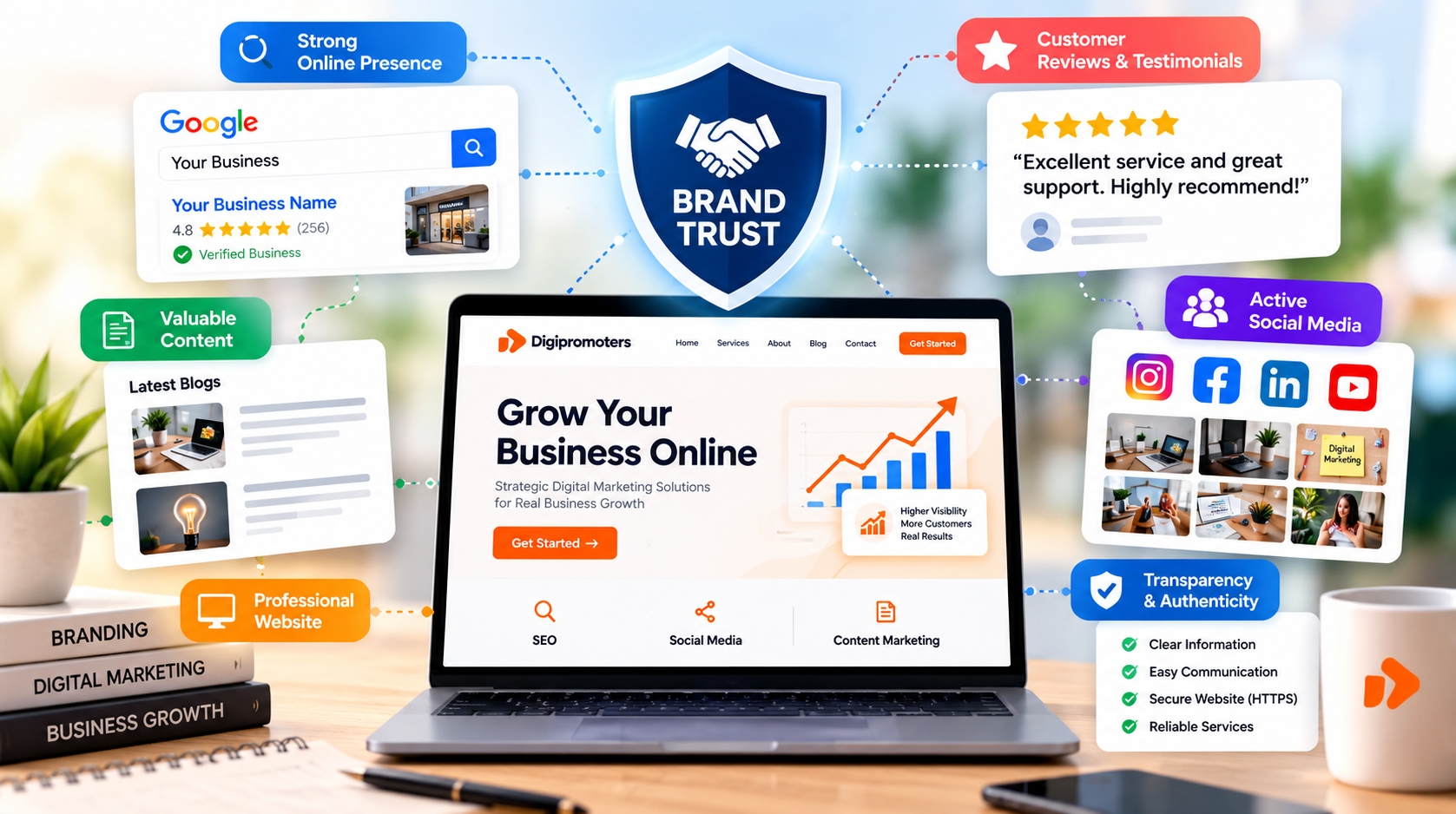
Imagine a potential customer discovers your business on Google, visits your website, checks your social media profile, reads a few reviews—and then leaves without contacting you.
Your product may be excellent. Your pricing may be competitive. Your team may be experienced. But if your online presence does not create confidence, the customer may simply choose a competitor they trust more.
That is why brand trust is one of the most valuable assets a business can build online.
Before buying, customers increasingly look for evidence that a business is genuine, reliable, knowledgeable, transparent, and capable of delivering what it promises. Your website, Google Business Profile, social media accounts, reviews, content, search visibility, and customer interactions all contribute to that impression.
For businesses in Noida, Greater Noida, Delhi NCR, Ghaziabad, and across India, building a trustworthy online presence is no longer just about getting attention. It is about giving potential customers enough confidence to take the next step.
At Digipromoters, we believe effective digital marketing should do more than generate visibility. It should help businesses establish credibility, communicate their value clearly, and create positive experiences at every digital touchpoint.
What Is Brand Trust?
Brand trust is the confidence customers have that a business is honest, reliable, capable, and likely to deliver what it promises. Online, that trust develops through consistent information, authentic communication, positive customer experiences, credible content, reviews, secure websites, and a professional digital presence.
For example, imagine two companies offering similar services.
Company A has an outdated website, incomplete business information, no recent social media activity, very few reviews, and unanswered customer comments.
Company B has a professional website, clear service information, genuine customer reviews, useful content, an active Google Business Profile, consistent social media activity, and responsive customer service.
Even if both companies offer similar services, most customers are likely to feel more comfortable with Company B.
That is the power of online brand trust.
Why Is Brand Trust Important for Businesses?
Trust influences what happens after someone discovers your business. A customer who trusts your brand is generally more comfortable making an enquiry, purchasing a product, sharing personal information, recommending your business, or returning in the future.
Strong brand trust can contribute to:
- Customer loyalty: Customers are more likely to stay with businesses they trust.
- Higher conversions: Credibility can reduce hesitation before an enquiry or purchase.
- Repeat purchases: A positive experience creates reasons to return.
- Better reputation: Consistent positive experiences strengthen your business reputation.
- Positive word of mouth: Satisfied customers can become valuable advocates.
- Stronger relationships: Trust creates a foundation for long-term customer relationships.
- Competitive advantage: A credible brand can stand out when several businesses offer similar products or services.
- Long-term growth: A trusted reputation can support sustainable business growth.
Building customer trust online is therefore not a single marketing campaign. It is an ongoing process involving your branding, marketing, website, content, customer service, and overall customer experience.
How to Build Brand Trust Online
1. Create a Professional and Trustworthy Website
Your website is often one of the first places potential customers go when researching your business.
A professional website does not necessarily need to be complicated. It needs to be clear, useful, accessible, and trustworthy.
Make sure your website includes:
- Professional and easy-to-understand design
- Simple navigation
- Mobile responsiveness
- Fast-loading pages
- Clear contact information
- A genuine About Us page
- Detailed product or service information
- Privacy policy
- Terms and conditions where appropriate
- HTTPS and appropriate security measures
- Clear calls to action
Avoid making visitors work to understand what your business does.
If someone lands on your homepage and cannot quickly determine who you are, what you offer, where you operate, or how to contact you, you may lose their confidence.
Your website should answer the customer’s basic questions before they have to ask them.
2. Be Transparent About Your Business
Transparency is one of the simplest ways to improve brand credibility online.
Be clear about your services, pricing where appropriate, policies, delivery timelines, business location, contact information, and what customers can realistically expect.
If there are limitations, explain them instead of hiding them.
For example, rather than making an unrealistic promise such as “Guaranteed results for every business,” explain what your service includes, what factors affect results, and how you measure progress.
Honest communication may not always sound as impressive as an exaggerated claim, but it creates something much more valuable: credibility.
3. Publish Valuable and Helpful Content
Content marketing is not only about attracting traffic. Good content can demonstrate that your business understands its customers and its industry.
You can build authority through:
- Blog articles
- How-to guides
- Videos
- FAQs
- Case studies
- Tutorials
- Industry insights
- Educational social media posts
- Helpful checklists
- Product or service explainers
For example, a digital marketing company could publish articles explaining SEO, Google Business Profile optimization, social media marketing, website conversion principles, and online reputation management.
When potential customers repeatedly find useful information from your brand, they have more opportunities to recognize your expertise.
The key is to prioritize usefulness over publishing content simply because you want to target another keyword.
4. Build a Strong Social Media Presence
Social media gives customers a window into your brand personality.
A trustworthy social media presence should be consistent, active, and authentic.
Businesses can use platforms such as Instagram, Facebook, LinkedIn, or other relevant channels to:
- Share educational content
- Answer questions
- Respond to comments
- Highlight customer experiences
- Introduce team members
- Share behind-the-scenes content
- Explain products or services
- Communicate company updates
- Show the human side of the business
Customers do not expect every post to be perfect. They do expect businesses to communicate honestly and professionally.
Social media can also demonstrate how a business responds when customers ask questions or raise concerns.
That interaction itself becomes a trust signal.
5. Use Customer Reviews and Testimonials
Reviews are among the most visible forms of social proof.
Before contacting a business, potential customers may look at Google reviews, testimonials, ratings, case studies, or customer experiences.
Positive reviews can help reduce uncertainty, particularly when a customer is comparing several businesses.
Encourage genuine customers to share honest feedback when appropriate. You can also showcase legitimate testimonials and case studies on your website.
However, never create fake reviews.
Fake testimonials may create short-term appearances of credibility, but they can seriously damage your reputation when discovered.
Instead, focus on delivering a good customer experience and making it easy for satisfied customers to share genuine feedback.
6. Maintain a Strong Google Business Profile
For local businesses, your Google Business Profile can play an important role in online visibility and credibility.
An accurate and well-maintained profile can help customers find important information such as:
- Business name
- Address or service area
- Phone number
- Website
- Opening hours
- Photos
- Services
- Customer reviews
- Business updates
For businesses operating in Noida, Greater Noida, Delhi NCR, Ghaziabad, and other Indian markets, local SEO can help connect your business with people searching for relevant products or services nearby.
For example, searches related to a digital marketing agency in Noida, digital marketing company in Greater Noida, or digital marketing company in Delhi NCR can have strong local intent.
Keeping your business information accurate and responding professionally to reviews can support both customer confidence and your broader local SEO strategy.
7. Keep Your Brand Consistent
Trust grows when customers receive a consistent experience.
Your website should not communicate one personality while your social media profiles communicate another. Your Google Business Profile, advertisements, visual identity, and content should all feel like they belong to the same business.
Maintain consistency across:
- Website
- Social media
- Google Business Profile
- Logo and visual identity
- Brand messaging
- Tone of voice
- Content
- Marketing materials
Consistency helps customers recognize your business and understand what they can expect from it.
8. Respond to Customers Quickly and Professionally
Customer service is part of branding.
A beautiful website cannot compensate for consistently poor communication.
When customers send messages, ask questions, leave reviews, or raise concerns, respond as quickly as reasonably possible.
Your responses should be:
- Polite
- Relevant
- Clear
- Professional
- Helpful
- Human
Even when a customer leaves negative feedback, avoid becoming defensive.
A thoughtful response can demonstrate that your business takes customer experience seriously.
9. Show Real People Behind the Brand
People often connect more easily with businesses when they can see the people behind them.
Consider sharing:
- Founder stories
- Team introductions
- Workplace moments
- Behind-the-scenes processes
- Company milestones
- Customer success stories
- Real experiences from your business journey
This can make your brand feel more authentic and approachable.
For service-based businesses especially, showing expertise and personality can help potential customers understand who they may be working with.
10. Protect Customer Data and Privacy
Trust also depends on how responsibly a business handles customer information.
Businesses collecting personal information should take appropriate steps to protect it.
Pay attention to:
- Website security
- HTTPS
- Privacy policies
- Secure payment systems
- Responsible data handling
- Customer privacy
- Appropriate access controls
Customers should feel confident that their information is being handled responsibly.
Security should not be treated as a technical issue alone. It is also part of your brand reputation.
11. Build Authority Through SEO
SEO can contribute to brand trust in an indirect but meaningful way.
When your business consistently appears for relevant searches with useful, well-structured content, potential customers have more opportunities to encounter your expertise.
A strong SEO strategy can include:
- Helpful content
- On-page SEO
- Local SEO
- Technical SEO
- Internal linking
- Relevant keyword targeting
- Search-friendly website structure
- Strong user experience
The goal should not simply be to rank for keywords.
The goal is to be useful when customers are searching for answers.
That distinction can make SEO a valuable part of a long-term digital branding strategy.
12. Use Social Proof Strategically
Reviews are not the only form of social proof.
Depending on your business, you may also showcase:
- Awards
- Certifications
- Client results
- Case studies
- Media mentions
- Industry recognition
- Genuine customer-generated content
- Partnerships
For example, instead of simply saying that your company delivers quality work, you could demonstrate the work through a case study explaining the challenge, approach, implementation, and outcome.
Evidence is often more persuasive than promotional language.
Common Mistakes That Can Damage Brand Trust Online
Building trust takes time, but damaging it can happen quickly.
Common mistakes include:
- Creating fake reviews
- Having a poorly designed website
- Using inconsistent branding
- Ignoring negative reviews
- Making unrealistic promises
- Providing poor customer service
- Leaving outdated business information online
- Hiding important pricing or policies
- Copying competitors
- Publishing excessive promotional content
- Taking too long to respond to enquiries
Another common problem is treating every digital channel independently.
For example, if your website says one thing, your social media says another, and your Google Business Profile contains outdated information, customers may become uncertain about which information is accurate.
Consistency matters.
How Digital Marketing Helps Build Brand Trust
Digital marketing is not only about advertising or generating leads. When strategically managed, it can help create a complete ecosystem of credibility around a business.
Different digital marketing activities support different parts of the trust-building process.
SEO helps your business become discoverable for relevant searches.
Content marketing demonstrates knowledge and provides useful information.
Social media marketing creates opportunities for communication and authentic brand interaction.
Google Business Profile optimization and local SEO help customers discover accurate local business information.
Online reputation management helps businesses monitor and respond to customer feedback.
Website optimization improves the experience customers have after clicking through to your site.
Paid advertising can increase visibility, but the destination experience still matters. An advertisement may attract a click, but a confusing website or weak brand presence can lose the customer’s confidence.
This is why digital marketing works best when these activities support one another.
At Digipromoters, we help businesses strengthen their online presence through strategies that can combine SEO, social media marketing, content, website optimization, local visibility, and other digital marketing activities according to their goals.
Whether you are a startup building your reputation from scratch or an established business trying to improve its online presence, the objective should be the same: create a digital experience that makes customers feel informed and confident.
How Long Does It Take to Build Brand Trust Online?
There is no fixed timeline for building brand trust.
Trust develops gradually through repeated positive experiences.
A business may improve its website today, optimize its Google Business Profile tomorrow, and start publishing useful content next month. These actions can strengthen the overall digital presence, but customers need time to encounter the brand, interact with it, and form their own opinions.
The strongest approach is consistency.
Keep your information accurate. Publish useful content. Respond to customers. Deliver on your promises. Encourage genuine feedback. Improve your customer experience.
Over time, these individual actions can create a stronger reputation.
How to Measure Brand Trust Online
Brand trust is not always represented by one metric. Instead, businesses can monitor several indicators together.
Useful measurements include:
- Customer reviews
- Average review rating
- Website engagement
- Repeat customers
- Conversion rate
- Social media engagement
- Brand mentions
- Organic traffic
- Direct traffic
- Customer feedback
- Search visibility
You should also look beyond numbers.
Read customer comments. Examine recurring questions. Review negative feedback. Look at why people contact your business and what prevents them from converting.
Combining quantitative data with qualitative feedback gives you a more useful picture of your brand reputation.
Final Thoughts
Building brand trust online is not about making your business look perfect.
It is about making your business credible, consistent, transparent, helpful, and dependable.
A trustworthy online presence is built through many small interactions: an accurate Google Business Profile, a useful blog, a professional website, a genuine review, a helpful social media response, a secure checkout, a transparent policy, or a customer service representative who takes the time to solve a problem.
The most effective businesses do not simply ask customers to trust them. They continuously give customers reasons to trust them.
If you want to build a stronger online presence, improve your brand credibility, and reach more customers through digital marketing, Digipromoters can help.
Frequently Asked Questions
1. How do you build brand trust online?
You can build brand trust online by maintaining a professional website, providing accurate information, publishing useful content, collecting genuine customer reviews, maintaining an active social media presence, responding professionally to customers, protecting customer data, and keeping your branding consistent.
2. Why is brand trust important?
Brand trust reduces customer uncertainty and can support stronger relationships, repeat purchases, positive word of mouth, better conversions, and long-term business growth.
3. How do online reviews build trust?
Online reviews provide social proof by showing potential customers the experiences of other people. Genuine reviews can help customers evaluate a business before making a purchase or enquiry.
4. How does social media affect brand trust?
Social media gives customers an opportunity to see how a business communicates, answers questions, shares information, and interacts with its audience. Consistent and authentic communication can strengthen credibility.
5. How can small businesses build trust online?
Small businesses can start with the fundamentals: a professional website, accurate Google Business Profile, genuine reviews, consistent branding, helpful content, responsive customer service, and active communication with customers.
6. How does digital marketing improve brand credibility?
Digital marketing can improve brand credibility by increasing search visibility, demonstrating expertise through content, strengthening social proof, improving customer experiences, managing online reputation, and maintaining consistent communication across digital channels.
7. How can businesses improve their online reputation?
Businesses can improve their online reputation by delivering better customer experiences, encouraging genuine reviews, responding professionally to feedback, correcting inaccurate information, publishing useful content, and consistently monitoring their digital presence.
8. How can businesses establish a trustworthy online presence?
Start with accurate business information, a secure and professional website, consistent branding, useful content, genuine customer reviews, responsive communication, strong local visibility, and transparent business practices.