



If you’re trying to grow your business online, you’ve probably faced the same question:
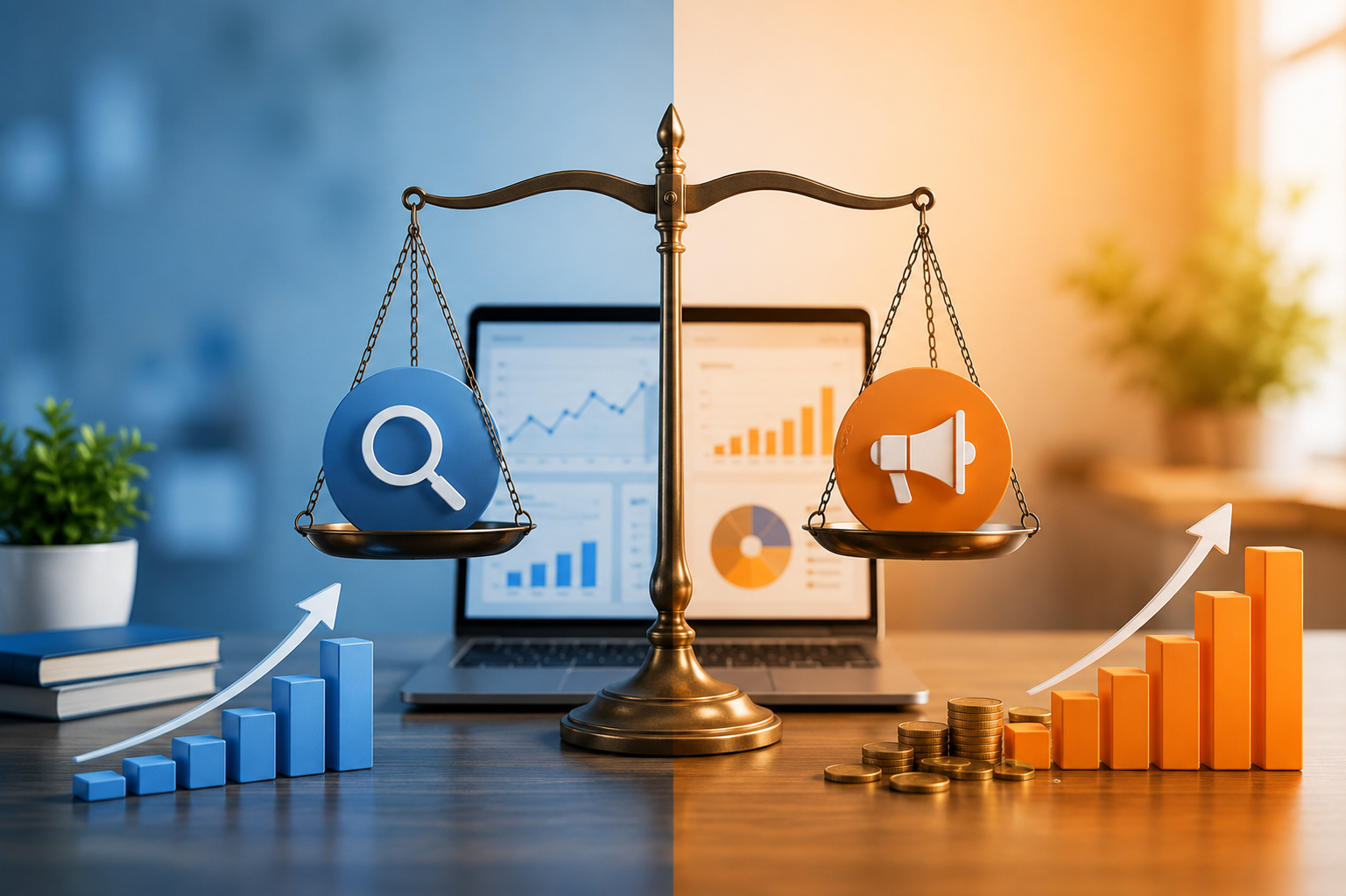
Should I invest in SEO or Google Ads first?
The answer isn’t as simple as saying “SEO is long-term and Google Ads is short-term.”
Your better starting point depends on your business model, competition, location, sales cycle, budget, website, and how quickly you need customers.
SEO and Google Ads also work differently. Organic search results are unpaid listings that Google matches to searches based on relevance and other signals, while Google Ads gives businesses paid placements based on factors such as keywords, targeting and bidding.
So instead of choosing one because it’s currently popular, let’s look at which approach makes more sense for different business situations.
SEO vs Google Ads: The Basic Difference
SEO
Search Engine Optimization (SEO) focuses on improving your website and online presence so that your business can appear more prominently in relevant organic search results.
For example, a business might target searches such as:
- digital marketing agency in Greater Noida
- interior designer in Noida
- solar installation company near me
- best dentist in Greater Noida
SEO can involve:
- Keyword and search-intent research
- Technical SEO
- Website optimisation
- Helpful content
- On-page optimisation
- Internal linking
- Local SEO
- Google Business Profile optimisation
- Authority and reputation building
The objective isn’t simply to rank for keywords.
It’s to become visible when potential customers are actively looking for what you offer.
Google Ads
Google Ads allows businesses to pay for placements when their ads are eligible for relevant searches.
For example, if someone searches:
“performance marketing agency in Greater Noida”
a relevant Search campaign can potentially show an ad for that query. Google explains that Search ads can appear above or below organic results when the user’s search matches the campaign’s targeting and keywords.
Google Ads can therefore be useful when you need to:
- Generate enquiries
- Promote a new service
- Reach high-intent searches
- Drive ecommerce sales
- Test an offer
- Enter a competitive market
- Generate demand in a specific location
For ecommerce businesses, Google Shopping and Performance Max can also use product information to promote products across Google’s advertising inventory.
The Real Question: Which One Should You Start With?
Instead of asking:
“Is SEO better than Google Ads?”
ask:
“What does my business need right now?”
Here’s a practical way to think about it.
| Business Situation | Better Starting Point |
|---|---|
| New business with little online visibility | SEO + Google Ads |
| Local service business | Local SEO + Google Ads |
| Ecommerce business | SEO + Shopping/Performance campaigns |
| High-ticket services | SEO + Lead Generation |
| Highly competitive market | SEO + Paid Search |
| Immediate lead requirement | Google Ads |
| Long-term organic growth | SEO |
| New offer that needs testing | Google Ads |
| Strong existing organic traffic | Expand SEO + Paid Search |
| Limited budget | Focused SEO + selective paid campaigns |
Now let’s look at each situation in more detail.
1. You’re a New Business With Almost No Online Visibility
If your business is new, you have a problem that neither SEO nor Google Ads can solve alone:
Nobody knows you exist.
You need to build visibility while also finding out which products, services and messages actually generate demand.
A practical approach:
SEO: Build your website structure, service pages, local visibility and useful content.
Google Ads: Target high-intent searches that can generate immediate enquiries.
This combination gives you two different opportunities:
Paid search → immediate market access
SEO → long-term organic visibility
Google itself notes that businesses can use both search results and ads to connect with customers when they’re looking for a product or service.
Best approach:
Don’t wait months for SEO before testing demand.
Start focused paid campaigns while building the organic foundation.
2. You’re a Local Service Business
Suppose you’re:
- An interior designer
- Dentist
- Solar installer
- Real estate company
- Hospital
- Digital marketing agency
- Home renovation company
Your customers are usually searching with location and service intent.
Examples:
“dentist in Greater Noida”
“solar company in Noida”
“interior designer near me”
For these businesses, Local SEO + Google Ads can be a powerful combination.
Local SEO helps you build:
- Google Business Profile visibility
- Local organic rankings
- Location-specific service pages
- Reviews and reputation
- Local search presence
Google Ads helps you:
- Target specific locations
- Bid on commercial keywords
- Generate enquiries while SEO develops
- Promote specific services
The important point is that your local strategy shouldn’t be just about getting your website to rank.
Your Google Business Profile, website, reviews, landing pages and paid campaigns should work together.
3. You’re Running an Ecommerce Business
For ecommerce, the question becomes more interesting.
You don’t just have one service page.
You may have:
100 → 1,000 → 10,000+ product pages.
SEO can help those products and categories gain organic visibility over time.
But paid campaigns can put products in front of potential buyers much faster.
Google Shopping ads can show product information such as the product image, title, price and store name, helping users understand the offer before clicking.
Performance Max can also access multiple Google channels, including Search, Shopping, YouTube, Display, Gmail and Maps, depending on campaign setup and eligibility.
For ecommerce:
SEO → category + product visibility
Google Ads → product discovery + sales
Rather than choosing one permanently, ecommerce brands often benefit from building both.
4. You Sell High-Ticket Services
Now imagine your business sells:
- Commercial real estate
- Enterprise software
- Interior design
- Solar installations
- Business consulting
- Corporate services
- Premium construction
Your customer might not purchase after one click.
They may:
Search → Visit website → Compare companies → Read reviews → Check case studies → Talk to sales → Request proposal → Purchase
That’s where SEO becomes particularly valuable.
Your website can capture people at different stages of the decision-making process.
For example:
Informational search
“How much does commercial solar installation cost?”
Commercial research
“Best commercial solar companies in Noida”
High-intent search
“Commercial solar installation company Noida”
A good SEO strategy can create content and landing pages for these different stages.
At the same time, Google Ads can target high-intent searches that are more likely to produce immediate enquiries.
Best approach:
SEO + Lead Generation + focused Google Ads
5. You’re Entering a Highly Competitive Market
Some industries have extremely competitive search results.
For example:
“Digital marketing agency”
“Real estate company”
“Best hospital in Noida”
“Interior designer”
Trying to immediately rank organically for broad, competitive keywords may not be realistic.
This doesn’t mean SEO isn’t worthwhile.
It means you need a smarter strategy.
Start with:
Paid Search
to capture relevant commercial searches.
At the same time:
SEO
can target:
- Long-tail keywords
- Location-specific searches
- Service-specific searches
- Problem-based searches
- Industry-specific searches
- Informational content
Over time, you can expand into more competitive search terms.
6. You Need Leads Immediately
This is probably the clearest case for Google Ads.
Imagine you’ve launched a new service and need enquiries this month.
Waiting for organic visibility to develop may not fit your timeline.
Google Ads can put eligible ads in front of people searching for relevant products or services, depending on campaign targeting, budget, bidding and ad relevance.
For example:
“Emergency AC repair Noida”
“Google Ads agency Greater Noida”
“Book dentist appointment Noida”
These are searches where the person may already have a problem or requirement.
But there’s an important warning:
Google Ads doesn’t automatically mean profitable leads.
You still need:
- Relevant keywords
- Strong ad messaging
- Good landing pages
- Proper conversion tracking
- Appropriate bidding
- Negative keywords where relevant
- Lead qualification
- Continuous optimisation
Google also recommends aligning ad messaging with the landing page and focusing campaigns around relevant conversion goals.
7. You Want Long-Term Organic Growth
If your goal is to build an acquisition channel that isn’t completely dependent on advertising spend, SEO deserves serious attention.
When your website earns organic visibility for relevant searches, those rankings can continue bringing qualified visitors without paying for every individual click.
But SEO shouldn’t be treated as:
“Publish 20 blogs and wait.”
Modern SEO involves much more:
- Technical website health
- Search intent
- Helpful content
- Strong service pages
- Internal linking
- Local SEO
- Structured information
- Good user experience
- Authority and credibility
Google’s current SEO guidance focuses on helping site owners understand the fundamentals that make content accessible, understandable and useful for searchers.
SEO vs Google Ads: What About Cost?
This is where many businesses make the wrong comparison.
They ask:
“Which one is cheaper?”
A better question is:
“Which one produces profitable customers for my business?”
With Google Ads, you pay for advertising performance according to the campaign and ad format.
With SEO, you’re investing in the work required to improve your website’s organic visibility.
Neither is automatically cheap.
Neither is automatically expensive.
The real calculation should be:
Marketing Cost → Qualified Leads → Customers → Revenue
For example:
If Campaign A generates 100 leads but only 2 become customers, it may be less valuable than Campaign B generating 20 leads with 8 customers.
That’s why lead quality and customer acquisition cost matter more than traffic volume.
What If You Can Afford Only One?
This is where the decision becomes practical.
Choose Google Ads first if:
- You need leads quickly
- You have a clear commercial offer
- People already search for your service
- You have a conversion-ready landing page
- You can track leads and sales
- You have enough budget for meaningful testing
Prioritise SEO if:
- You want sustainable organic visibility
- Your customers research before buying
- You have a longer sales cycle
- Your industry has valuable search demand
- You can invest consistently
- You want to reduce dependence on paid acquisition over time
Choose both if:
You want to build short-term acquisition and long-term visibility at the same time.
For many established businesses, this is the strongest strategy.
A Smarter Strategy: Let SEO and Google Ads Work Together
SEO and Google Ads don’t have to compete for your budget.
They can actually provide useful information to each other.
For example, Google Ads can help you identify:
Which keywords generate enquiries?
Which offers get clicks?
Which landing pages convert?
Which locations perform best?
Those insights can inform your SEO strategy.
At the same time, your SEO data can reveal:
Which searches are already bringing qualified users?
Which services have organic demand?
Which pages deserve more visibility?
This creates a feedback loop:
SEO insights → Paid campaigns → Conversion data → Better SEO strategy
Google also notes that analysing organic search results can help identify potential keywords for Google Ads campaigns.
What About Performance Max?
For some businesses, particularly ecommerce and businesses with strong conversion goals, the decision isn’t simply:
SEO vs Search Ads.
Google’s Performance Max campaigns can access multiple Google advertising channels from one campaign, using your campaign objectives, creative assets, audience signals and other inputs to optimise toward conversions or conversion value.
For ecommerce businesses using Merchant Center, Performance Max can also use product feeds to promote products across eligible Google inventory.
But it still doesn’t replace SEO.
Think of it as another paid acquisition tool, not an alternative to organic search visibility.
The DigiPromoters Approach
At DigiPromoters, we don’t believe every business should receive the same SEO or advertising strategy.
A local service company in Greater Noida doesn’t have the same requirements as an ecommerce brand.
And an established B2B company doesn’t need the same approach as a new startup.
The starting point should depend on:
Your business model
Your customer journey
Your search demand
Your competition
Your location
Your conversion goals
Your available budget
From there, SEO, Google Ads and lead-generation activities can be structured around the role each channel needs to play.
Final Verdict: SEO or Google Ads?
There isn’t one universal winner.
If you need customers now:
Start with Google Ads.
If you want long-term organic visibility:
Prioritise SEO.
If you’re a local business:
Consider Local SEO + Google Ads.
If you’re ecommerce:
Combine SEO with Shopping/Performance campaigns.
If you sell high-ticket services:
Build SEO + lead generation while using paid search for high-intent demand.
If you’re entering a competitive market:
Use paid search for immediate visibility while building a focused SEO strategy.
And for many businesses, the strongest answer isn’t:
SEO OR Google Ads.
It’s:
SEO + Google Ads + a website built to convert.
Because driving traffic is only the beginning.
The real goal is to turn relevant searches into qualified leads, customers and measurable business growth.
Frequently Asked Questions
Is SEO better than Google Ads?
Neither is automatically better. SEO can build organic visibility over time, while Google Ads can provide paid visibility for relevant searches. The right choice depends on your business goals, competition, budget and timeline.
Should a new business invest in SEO or Google Ads?
A new business often benefits from combining both. Google Ads can help test demand and generate enquiries while SEO builds the long-term organic foundation.
Is Google Ads good for local businesses?
Yes. Local businesses can use Google Ads to target relevant searches and geographic areas. Local SEO can complement paid campaigns by building organic and Google Business Profile visibility.
Should ecommerce businesses use SEO?
Yes. Ecommerce SEO can help product and category pages gain organic visibility, while Shopping and Performance Max campaigns can provide paid product exposure.
Can SEO and Google Ads be used together?
Absolutely. Using both can help businesses capture paid and organic opportunities while using performance data to improve their overall search strategy.