



Digital marketing gives small businesses an opportunity to reach potential customers, build brand awareness, generate leads, and compete in their markets. However, simply creating a website, posting on social media, or running advertisements does not guarantee business growth.
Many small businesses invest time and money in digital marketing without seeing the results they expect. They may struggle to attract website visitors, generate qualified enquiries, convert leads into paying customers, or understand which marketing activities are working.
Often, the problem is not digital marketing itself but the mistakes businesses make while planning and executing their strategies.
From targeting the wrong audience to ignoring search engine optimization (SEO), inconsistent content, and poor performance tracking, small marketing mistakes can limit growth and waste valuable resources.
In this guide, Digipromoters explores the 10 most common digital marketing mistakes small businesses make, explains why they matter, and provides practical solutions to help you improve your online marketing strategy.
Whether you run a startup, a local service business, a retail store, or an established small company, these insights can help you make more informed marketing decisions.
Table of Contents
- Not Defining a Clear Target Audience
- Ignoring Search Engine Optimization (SEO)
- Having a Poorly Optimized Website
- Posting on Social Media Without a Strategy
- Focusing on Followers Instead of Conversions
- Running Paid Ads Without Proper Planning
- Ignoring Content Marketing
- Failing to Track Marketing Performance
- Neglecting Customer Engagement and Follow-Ups
- Expecting Instant Results From Digital Marketing
- How to Avoid These Mistakes: A Practical Action Plan
- How Digipromoters Can Help
- Frequently Asked Questions
1. Not Defining a Clear Target Audience
One of the biggest digital marketing mistakes small businesses make is trying to reach everyone.
When a business does not clearly understand its ideal customers, its advertising, website content, and social media messages often become too broad. As a result, marketing efforts may attract people who have little interest in purchasing its products or services.
For example, a company offering professional website development may waste resources promoting its services to a general audience instead of focusing on startups, local businesses, or companies that need website improvements.
Why this mistake hurts your business
Without a defined target audience, you may experience:
- Low engagement with marketing content.
- Irrelevant enquiries and unqualified leads.
- Poor advertising performance.
- Unclear brand messaging.
- Difficulty identifying the most effective marketing channels.
How to fix it
Start by identifying your ideal customer. Consider their needs, location, budget, interests, purchasing behaviour, and the problems they want to solve.
Create a simple customer profile and use it to guide your marketing decisions.
For example, if you provide digital marketing services to small businesses in Greater Noida, you could develop campaigns focused on local retailers, professional service providers, or businesses seeking better local search visibility.
You should also review customer feedback, website analytics, sales conversations, and competitor positioning to understand which audiences are most relevant.
Digipromoters tip: Focus on one clearly defined customer segment first. Once you understand what attracts that audience and generates enquiries, you can expand your strategy where appropriate.
2. Ignoring Search Engine Optimization (SEO)
Many small businesses depend heavily on social media or paid advertising while overlooking SEO.
Search engine optimization helps search engines understand your website and can improve its visibility when people search for relevant products, services, or information.
If your website is not optimized, potential customers may struggle to discover your business through organic search.
For example, someone searching for “digital marketing agency for small businesses” may find several relevant providers. If your website does not clearly communicate your services or provide relevant content, it may miss opportunities to appear for those searches.
Why SEO matters for small businesses
SEO can help you:
- Reach people actively searching for relevant solutions.
- Improve organic website visibility.
- Answer customer questions through helpful content.
- Support local business discovery.
- Build a more sustainable source of relevant website traffic.
How to fix it
Start with these SEO fundamentals:
Conduct keyword research: Identify the terms your potential customers use when searching for your services.
Optimize website pages: Write descriptive page titles, headings, meta descriptions, and relevant content.
Publish helpful blog posts: Answer common questions and explain the solutions your business provides.
Improve internal linking: Connect relevant blog posts, service pages, and supporting resources.
Review technical SEO: Check indexing, broken links, mobile usability, and website performance.
Improve local SEO: If your business serves a particular area, maintain accurate business information and optimize your eligible Google Business Profile.
Use Google Search Console to monitor impressions, clicks, indexing, and search queries.
Remember that SEO requires ongoing effort, and rankings depend on many factors. Avoid expecting immediate results or relying on guaranteed-ranking promises.
3. Having a Poorly Optimized Website
Your website is often one of the first places potential customers visit to learn about your business. Even if your social media campaigns attract attention, a confusing or poorly functioning website can prevent visitors from becoming customers.
Some businesses invest in website design but overlook the experience visitors have when trying to understand their services, find contact details, or complete a purchase.
Common website mistakes
- Slow-loading pages.
- Poor mobile responsiveness.
- Unclear service descriptions.
- Confusing navigation.
- Broken buttons or enquiry forms.
- Missing contact information.
- Weak calls to action.
- Outdated or irrelevant content.
- Insufficient trust signals.
Imagine a potential customer visits your website to request a quotation but cannot find your contact form or understand what your service includes. They may leave and explore another business.
How to fix it
Make your website easy to navigate and understand.
Ensure your homepage clearly explains what you offer, who you serve, and how customers can contact you. Create dedicated pages for important services, use readable text, and make your main calls to action visible.
Test the website on smartphones and desktop computers. Compress large images, review page performance, and regularly check forms, telephone links, and other interactive elements.
Include genuine testimonials, relevant credentials, clear service terms, and accurate contact details where appropriate.
You should also use analytics to understand which pages attract visitors and whether those visitors complete important actions.
A good website should do more than look attractive. It should help the right people find information, understand your value, and take the next step.
4. Posting on Social Media Without a Strategy
Creating social media posts regularly is not the same as having a social media marketing strategy.
Some businesses publish content whenever they have time, follow unrelated trends, or post promotional messages without considering what their audience wants to see.
This approach can make it difficult to build a recognizable brand or connect social media activity to business goals.
Why random posting is ineffective
Without a clear strategy, you may experience inconsistent messaging, limited audience engagement, repetitive content, and difficulty measuring results.
You may also spend time creating posts for platforms that do not reach your intended customers.
How to fix it
Start by selecting the platforms most relevant to your audience.
For example:
- Instagram can support visual storytelling, product demonstrations, and short videos.
- Facebook can help local businesses communicate with communities and promote relevant offers.
- LinkedIn can support professional services and B2B marketing.
- YouTube can help businesses explain products, publish tutorials, and demonstrate expertise.
Next, create a content plan with a few clear content categories.
A small business could use this simple mix:
- Educational posts that answer customer questions.
- Product or service demonstrations.
- Behind-the-scenes content.
- Genuine customer stories and testimonials.
- Relevant offers and calls to action.
Plan content in advance and maintain a schedule that your business can realistically sustain.
Use engagement, profile visits, website clicks, enquiries, and conversions to evaluate performance.
The goal is not simply to publish more content. It is to publish relevant content that supports your business objectives.
5. Focusing on Followers Instead of Conversions
Having a large social media following may increase visibility, but follower count alone does not demonstrate business success.
A business can have thousands of followers and still struggle to generate enquiries or sales. Meanwhile, a smaller but more relevant audience may produce meaningful commercial opportunities.
The problem occurs when businesses measure success using vanity metrics without connecting them to actual outcomes.
What should you measure instead?
Depending on your goals, focus on metrics such as:
- Qualified enquiries.
- Website visits from relevant audiences.
- Product purchases.
- Consultation bookings.
- Lead-to-customer conversion rate.
- Cost per lead.
- Customer acquisition cost.
- Repeat purchases and customer retention.
How to fix it
Give every important marketing activity a clear objective.
If you want to generate leads, create content and landing pages that help interested visitors enquire. If you want to increase online sales, make product information, checkout, and purchasing options easy to access.
Use clear calls to action, such as “Request a Quote,” “Book a Consultation,” or “Shop Now,” where appropriate.
Track what happens after someone clicks a link or sends a message. This helps you understand whether your marketing attracts the right audience and supports business growth.
Social media engagement still matters because it can help you understand audience interest and build relationships. However, it should be evaluated alongside the outcomes that matter to your business.
6. Running Paid Ads Without Proper Planning
Paid advertising can help small businesses reach targeted audiences, but it can also waste money when campaigns are launched without clear objectives, appropriate targeting, or reliable conversion tracking.
Some businesses start running Google Ads or Meta Ads simply because competitors are advertising. Others spend money promoting posts without knowing what outcome they want.
Advertising should be treated as a measurable investment, not an activity that automatically produces sales.
Common paid advertising mistakes
- Targeting an audience that is too broad.
- Using unclear or misleading ad messaging.
- Sending visitors to an irrelevant landing page.
- Failing to configure conversion tracking.
- Spending too much before testing an offer.
- Ignoring the quality of leads.
- Increasing budgets without reviewing profitability.
How to fix it
Begin by deciding what you want the campaign to achieve: website purchases, qualified leads, calls, bookings, or another measurable action.
Then identify your target audience, select relevant keywords or audience criteria, and create an advertisement that accurately reflects your offer.
Send users to a dedicated landing page that matches the advertisement. Ensure that visitors can understand the benefits, review the relevant details, and complete the desired action.
Before scaling the campaign, verify that conversion tracking works correctly. Review advertising spend alongside lead quality, sales, and customer acquisition costs.
For example, a local service business might test a focused Google Search campaign for relevant service queries within its actual service area.
Start with a budget your business can afford to test, and make changes based on evidence rather than assumptions.
7. Ignoring Content Marketing
Content marketing is another area that small businesses sometimes overlook.
Some companies publish only promotional messages, expecting customers to make a purchase without first understanding the product, service, or business behind it.
However, potential customers often research a problem, compare options, and seek answers before deciding whom to trust.
Useful content helps your business participate in that decision-making process.
Content marketing ideas for small businesses
You can create:
- Blog posts answering frequently asked questions.
- Step-by-step tutorials.
- Product demonstrations.
- Industry insights and educational guides.
- Genuine customer case studies.
- Buying guides and comparisons.
- Short videos explaining common problems.
- Downloadable checklists or templates.
For example, a digital marketing agency could publish articles about local SEO, website optimization, keyword research, and social media planning.
These articles can attract people researching marketing solutions and provide relevant opportunities to explore the agency’s services.
How to fix it
Start by listing the ten questions customers ask most often. Turn those questions into blog posts, videos, social media content, or website resources.
Create content that is specific, accurate, and useful. Include original examples and explain concepts clearly rather than copying competitors or producing repetitive articles.
Use internal links to connect related content with appropriate service pages.
You do not need to publish every day. Choose a manageable schedule and focus on the quality and relevance of what you create.
8. Failing to Track Marketing Performance
One of the most costly digital marketing mistakes is making decisions without measuring results.
Without reliable data, you may continue spending on ineffective campaigns, overlook promising channels, or misinterpret an increase in website traffic as evidence of business growth.
Tracking helps you understand what is working, what needs improvement, and where your marketing resources should go.
Important marketing metrics
| Metric | What it measures |
| Website traffic | Visitors arriving at your website |
| Organic clicks | Visits generated from unpaid search results |
| Conversion rate | Percentage of visitors who complete a desired action |
| Cost per lead | Marketing spend required to generate a lead |
| Customer acquisition cost | Total relevant acquisition costs per new customer |
| Return on ad spend (ROAS) | Attributed revenue relative to advertising spend |
| Customer retention | How effectively you maintain customer relationships |
For example, suppose a campaign costs ₹12,000 and generates 60 leads. Your cost per lead is ₹200.
If six of those leads become paying customers, the advertising cost per acquired customer is ₹2,000. This calculation excludes other acquisition expenses, such as staff time, agency fees, software, and sales costs.
The example illustrates why measuring leads and sales is more useful than looking at clicks alone.
How to fix it
Use Google Analytics to understand website activity and conversions, Google Search Console to monitor organic search performance, and advertising dashboards to review paid campaign results.
Create a simple monthly report showing marketing spend, leads, sales, conversion rates, and acquisition costs where available.
Review these numbers regularly and make changes based on the evidence. Ensure your tracking is configured correctly and that you distinguish attributed results from sales that would have occurred through other channels.
9. Neglecting Customer Engagement and Follow-Ups
Digital marketing does not end when someone visits your website, comments on a post, or submits an enquiry.
Potential customers may need more information, clarification about pricing, or time to compare alternatives before making a decision.
If your business responds slowly or fails to follow up with interested prospects, you may lose opportunities that your marketing efforts have already generated.
Common customer engagement mistakes
- Ignoring comments and direct messages.
- Taking too long to respond to enquiries.
- Providing incomplete answers.
- Failing to record and organize leads.
- Forgetting to follow up with interested prospects.
- Offering poor after-sales support.
How to fix it
Establish a simple process for managing enquiries.
Record relevant details, assign responsibility for responding, and set a realistic response standard for your business. Provide clear answers to common questions and follow up with people who have expressed interest, respecting their communication preferences.
A basic customer relationship management (CRM) system or organized spreadsheet can help you track lead status, previous conversations, and next steps.
Email marketing can also help you nurture people who have voluntarily subscribed to receive updates. Share relevant information and provide an easy way to unsubscribe.
Finally, continue supporting customers after a purchase. Good service can encourage repeat business, honest reviews, and recommendations.
10. Expecting Instant Results From Digital Marketing
Digital marketing can produce different results depending on the channel, competition, audience, budget, and quality of execution.
A common mistake is expecting SEO to deliver immediate rankings, social media to generate instant sales, or every paid campaign to become profitable from its first day.
When results take longer than expected, some businesses abandon their strategies before collecting enough information to understand what needs to change.
Why patience matters
SEO requires time for search engines to discover, crawl, index, and evaluate content. Content marketing often takes consistent publishing and distribution to build visibility. Paid advertising can generate exposure more quickly, but it still requires testing, accurate measurement, and optimization.
There is no universal timeline or guaranteed outcome.
How to fix it
Set realistic goals based on your business stage and resources.
Divide your marketing objectives into short-term and long-term activities.
Short-term priorities may include:
- Improving landing pages.
- Responding to existing enquiries.
- Testing a relevant paid advertising campaign.
- Improving calls to action.
- Reaching suitable prospects through professional networks.
Long-term priorities may include:
- Building organic search visibility.
- Developing useful website content.
- Strengthening brand recognition.
- Earning relevant backlinks.
- Improving customer retention.
Review performance at appropriate intervals rather than changing everything every few days. If a strategy is not working, investigate the underlying problem and make informed adjustments.
Consistency does not mean repeating an ineffective tactic forever. It means allowing enough time to evaluate your efforts while remaining willing to improve them.
How to Avoid These Digital Marketing Mistakes: A Practical Action Plan
You do not need to fix every marketing issue at once. Start with the problems most likely to affect your business goals.
Week 1: Review your marketing foundations
- Define your target audience.
- Clarify your main offer and business message.
- Review your website’s mobile experience.
- Check contact forms, phone numbers, and calls to action.
- Identify the marketing channels you currently use.
Goal: Understand your current position and identify immediate problems.
Week 2: Improve visibility and content
- Review important website pages for SEO.
- Research relevant customer search terms.
- Improve your social media profiles.
- Plan helpful blog and social media content.
- Check your eligible Google Business Profile.
Goal: Make your business easier to discover and understand.
Week 3: Strengthen lead generation
- Review your landing pages.
- Configure or test conversion tracking.
- Evaluate paid campaigns if you are running them.
- Organize enquiries in a spreadsheet or CRM.
- Establish a clear follow-up process.
Goal: Improve the path from initial interest to enquiry or purchase.
Week 4: Measure and refine
- Review traffic, enquiries, and sales.
- Calculate relevant marketing costs.
- Identify your strongest-performing channels.
- Address the most important remaining issues.
- Prepare your next month’s marketing priorities.
Goal: Establish a repeatable process for improving marketing performance.
This plan is a starting point, not a guarantee of results within 30 days. Continue refining your approach based on your actual performance data.
How Digipromoters Can Help Small Businesses Grow Online
Avoiding digital marketing mistakes becomes easier when your business has a clear strategy, consistent execution, and reliable performance tracking.
Digipromoters helps businesses strengthen their online presence and develop marketing activities aligned with their audience and business objectives.
Depending on your needs, relevant services may include:
Search Engine Optimization (SEO): Improve website structure, relevant content, and organic search visibility.
Social Media Marketing: Build a consistent social media presence, create relevant content, and engage with potential customers.
Content Marketing: Develop useful blogs, website content, and educational resources that answer customer questions.
Google Ads Management: Reach people searching for relevant products or services through targeted advertising campaigns.
Meta Ads Management: Develop and test suitable advertising campaigns across Facebook and Instagram placements.
Website Optimization: Improve messaging, navigation, usability, and conversion opportunities.
Lead Generation: Create strategies that help attract relevant prospects and encourage qualified enquiries.
The right combination of services depends on your business model, current marketing performance, audience, competition, and budget.
Instead of applying the same marketing approach to every business, start by identifying your most important challenge. A business with low search visibility may need SEO improvements, while a business receiving traffic but few enquiries may need stronger landing pages and conversion tracking.
Ready to improve your digital marketing strategy? Contact Digipromoters to discuss your business goals and explore practical ways to improve your online visibility, reach relevant customers, and generate more qualified enquiries.
Frequently Asked Questions
1. What are the most common digital marketing mistakes small businesses make?
Common mistakes include targeting the wrong audience, ignoring SEO, having a poorly optimized website, posting without a social media strategy, focusing only on followers, running untracked advertisements, neglecting content marketing, and failing to measure conversions. Improving these areas can help businesses make more informed marketing decisions.
2. Why is digital marketing not working for my small business?
Digital marketing may underperform because your offer is unclear, your audience targeting is too broad, your website does not convert visitors, your content does not match customer needs, or your campaigns are not measured correctly. Review your marketing funnel to identify where potential customers stop engaging.
3. How can small businesses improve their digital marketing?
Start with a defined audience and a clear value proposition. Improve your website, implement relevant SEO, publish useful content, choose suitable social media platforms, and measure enquiries and sales. Prioritize the activities most relevant to your business rather than trying every marketing channel at once.
4. Is SEO important for small businesses?
SEO can help small businesses become more visible when potential customers search for relevant products, services, and information. It supports organic discovery and can complement paid advertising and social media. Results depend on competition, website quality, content usefulness, and other factors.
5. How much should a small business spend on digital marketing?
The appropriate budget depends on your revenue, margins, growth goals, competition, and ability to convert leads into profitable customers. Start with a sustainable budget, track the costs and results of your activities, and increase spending only when the evidence supports doing so.
6. How long does it take to see results from digital marketing?
Timelines vary by channel and business. Paid advertising can generate exposure relatively quickly, while SEO and content marketing often require sustained work to develop visibility. Use realistic milestones, track performance, and refine your strategy based on results instead of expecting guaranteed outcomes.
7. Should small businesses hire a digital marketing agency?
A digital marketing agency may help businesses develop a strategy, manage campaigns, improve SEO, create content, and measure performance. The decision depends on your internal capabilities, budget, and objectives. Choose a provider that explains its approach clearly, sets realistic expectations, and reports meaningful business metrics.
8. Which digital marketing channel is best for a small business?
There is no single best channel for every business. SEO may support long-term organic discovery, social media may help build engagement, paid advertising may help test demand, and email marketing may support customer relationships. Choose channels based on your audience, offer, budget, and measurable goals.
Conclusion
Digital marketing can help small businesses reach new audiences, build customer relationships, and create opportunities for sustainable growth. However, results depend on more than simply having a website, posting on social media, or spending money on advertisements.
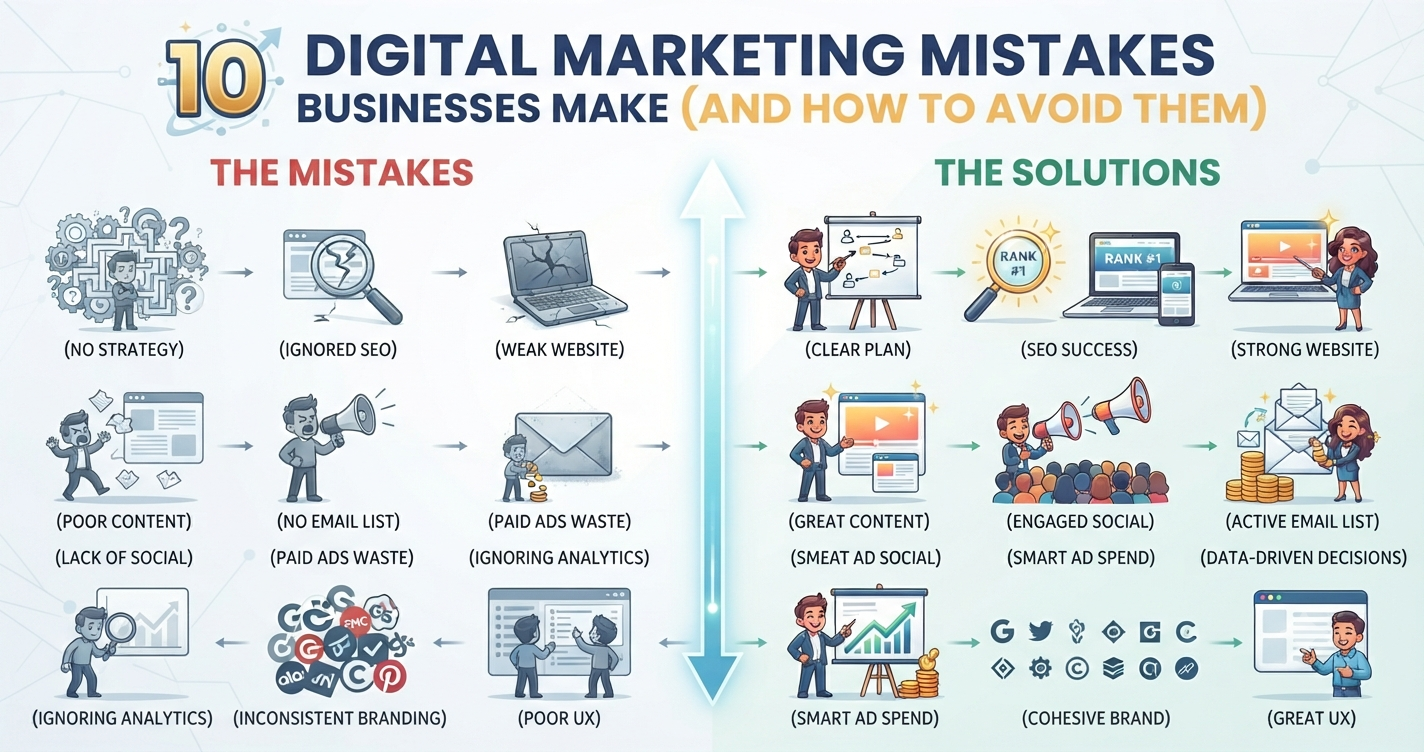
The ten mistakes covered in this guide highlight the importance of understanding your audience, improving your website, investing in relevant SEO and content, measuring performance, and following up with interested prospects.
Start with the issues that have the greatest impact on your business. Set clear objectives, track meaningful results, and keep improving your approach as you learn more about your customers.
With a focused strategy and consistent execution, your business can make better use of its marketing resources and build a stronger online presence.
Want expert support with your digital marketing? Contact Digipromoters to explore SEO, social media marketing, content marketing, paid advertising, and lead generation strategies tailored to your business goals.