




Running paid advertising is not simply about creating an attractive ad and hoping people click or buy. Even experienced marketers cannot always predict which image, video, headline, offer, or call to action will perform best with a particular audience.
That is where A/B testing ad creatives becomes useful.
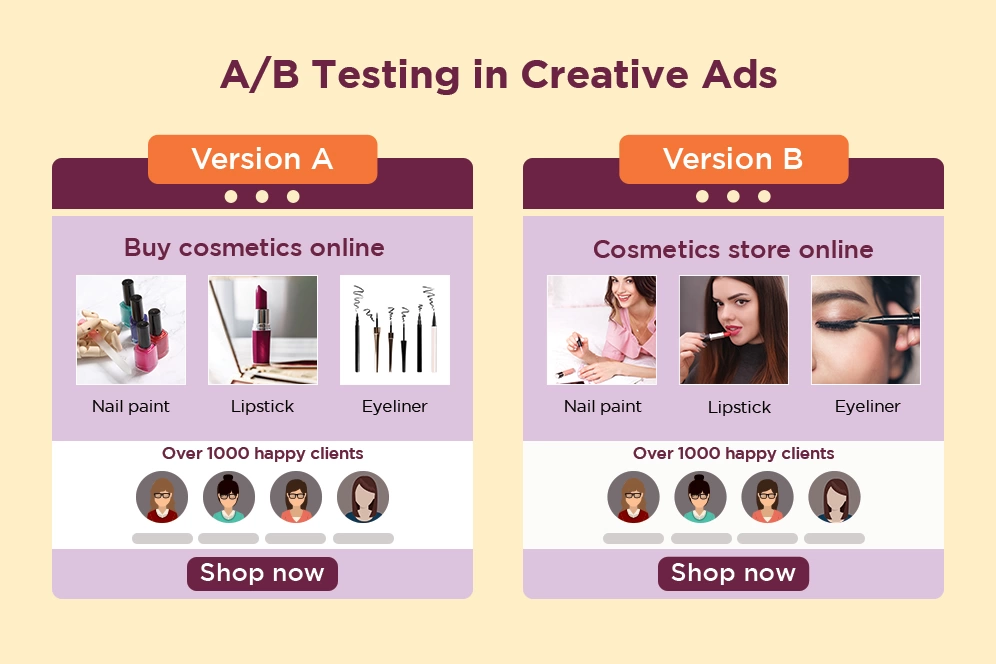
A/B testing, also called split testing, allows advertisers to compare different versions of an ad and use performance data to determine which version produces better results. Instead of relying entirely on assumptions, businesses can make creative decisions based on actual audience behavior.
For beginners, A/B testing can sound complicated. But the basic idea is simple:
Change one important element, show the different versions to comparable audiences, measure the results, and learn from the data.
Whether you are running Meta Ads, Google Ads, LinkedIn Ads, or other paid campaigns, having a structured creative testing process can help improve ad performance over time.
In this guide, we will explain what A/B testing is, how to A/B test ad creatives, what to test, how long to run a test, which metrics to track, common mistakes to avoid, and a simple framework beginners can use to get started.
What Is A/B Testing in Advertising?
A/B testing is a method of comparing two versions of an advertisement to determine which one performs better against a specific objective.
For example, imagine you are running a Meta Ads campaign for an online clothing store.
You create two versions of the same advertisement:
- Ad A: Lifestyle image showing a person wearing the product
- Ad B: Product-focused image showing the product clearly
You keep the audience, offer, budget structure, and other important variables as consistent as possible.
After collecting enough data, you compare the results.
If Ad B generates more purchases at a lower cost, you have evidence that the product-focused creative performed better under those test conditions.
The purpose is not simply to find a “prettier” ad.
The purpose is to discover which creative element helps achieve the campaign objective more effectively.
Why A/B Testing Ad Creatives Matters
Creative performance can have a significant effect on paid advertising results.
Two advertisements can target the same audience and promote the same product but generate very different outcomes because of differences in messaging, visuals, or presentation.
A/B testing helps businesses:
Make Data-Driven Creative Decisions
Instead of saying, “I think this image will work better,” you can test it and evaluate the results.
Understand Your Audience
Testing can reveal what type of messaging, visual style, or value proposition resonates with your audience.
Improve Advertising Performance
Successful creative insights can help improve metrics such as click-through rate, conversion rate, cost per acquisition, or return on ad spend.
Reduce Guesswork
Advertising always involves uncertainty, but structured testing can reduce unnecessary assumptions.
Build a Repeatable Process
Once you understand what works, you can apply those insights to future campaigns instead of starting from zero every time.
What Should You A/B Test in Ad Creatives?
There are many elements you can test, but beginners should avoid changing everything at once.
Some of the most useful creative variables include:
1. Images
Test different visual approaches, such as:
- Product photography
- Lifestyle images
- Human-focused images
- Before-and-after visuals where appropriate
- Product-in-use images
- Graphic designs
- Close-up product shots
For example:
Version A: Product alone
Version B: Product being used by a customer
The goal is to understand which visual communicates the product’s value more effectively.
2. Videos
Video ads provide many testing opportunities.
You can compare:
- Short vs. longer videos
- Different opening hooks
- Product demonstrations vs. testimonials
- Different editing styles
- Different visual sequences
- Voiceover vs. text-based presentation
The first few seconds are particularly important because they can influence whether someone continues watching.
3. Headlines
Try different approaches to communicate the same offer.
For example:
Headline A: “Upgrade Your Everyday Skincare”
Headline B: “A Simpler Routine for Healthier-Looking Skin”
Both communicate a benefit, but they appeal to the audience differently.
4. Primary Ad Copy
You can test:
- Short vs. detailed copy
- Problem-focused messaging
- Benefit-focused messaging
- Emotional messaging
- Educational messaging
- Different value propositions
The key is to make the difference meaningful enough to learn from.
5. Calls to Action
Depending on the advertising platform and campaign objective, you may test different calls to action.
Examples include:
- Shop Now
- Learn More
- Get Started
- Book Now
- Sign Up
The best CTA depends on the user’s stage in the customer journey and the campaign goal.
6. Offers
Offers can have a significant impact on advertising performance.
You could test:
- Percentage discounts
- Flat discounts
- Free shipping
- Bundles
- Limited-time offers
- Free consultations
- Free trials
However, offer testing should be carefully controlled because changing the offer can affect both conversion rate and revenue.
The Most Important Rule: Test One Major Variable at a Time
One of the biggest mistakes beginners make is changing multiple elements simultaneously.
Imagine:
Ad A
- Image 1
- Headline 1
- Copy 1
- CTA 1
Ad B
- Image 2
- Headline 2
- Copy 2
- CTA 2
If Ad B performs better, what did you learn?
You do not know whether the improvement came from:
- The image
- The headline
- The copy
- The CTA
- Or the combination of all four
This makes the result difficult to apply to future campaigns.
Instead, start with a controlled test.
Example
Keep everything the same and change only the image:
Ad A: Image 1 + same headline + same copy
Ad B: Image 2 + same headline + same copy
Now, if there is a meaningful difference in performance, you have a clearer indication that the visual may have influenced the result.
This approach is particularly useful when you are building a systematic ad creative testing framework.
A Simple A/B Testing Framework for Beginners
You do not need a complicated testing system to get started.
Use this five-step framework:
Step 1: Define Your Goal
Before creating different ads, decide what you are trying to improve.
Your objective could be:
- More purchases
- More qualified leads
- Lower cost per acquisition
- Higher conversion rate
- Higher click-through rate
- More landing page visits
- Better return on ad spend
Your testing goal should match the campaign objective.
For a sales campaign, purchases and cost per purchase may be more important than simply generating clicks.
Step 2: Choose One Variable
Select one major creative element to test.
For example:
Test: Image
Do not change the image, headline, audience, offer, and landing page simultaneously if your goal is to learn what caused the difference.
Step 3: Create Two Strong Variations
Create Version A and Version B.
Both should be good enough to run.
Do not intentionally make one advertisement weak just to make the other look better.
For example:
Version A: Product-focused image
Version B: Lifestyle image
Keep the remaining important elements consistent.
Step 4: Run the Test
Give the ads enough opportunity to collect useful data.
Avoid making a decision after only a few clicks or impressions.
The amount of data required depends on your campaign objective, conversion volume, audience size, budget, and expected difference between variations.
Step 5: Analyze and Learn
Once you have sufficient data, compare the results against your chosen success metric.
Ask:
- Which version performed better?
- Was the difference meaningful?
- Did the winning version improve the actual campaign goal?
- What can we learn for the next creative test?
The objective is not just to declare a winner.
It is to build knowledge that improves future advertising decisions.
A/B Testing Example for Meta Ads
Imagine DigiPromoters is testing an advertisement for a fictional online fitness brand.
The campaign objective is to generate website purchases.
Version A
- Lifestyle image
- Headline: “Build a Stronger Routine”
- Same offer
- Same landing page
Version B
- Product-focused image
- Same headline
- Same offer
- Same landing page
After running the test, suppose the results are:
| Metric | Version A | Version B |
| Impressions | 30,000 | 30,000 |
| Clicks | 900 | 1,050 |
| Purchases | 36 | 48 |
| Cost per purchase | ₹833 | ₹625 |
| Conversion rate | 4% | 4.57% |
Version B generated more clicks and purchases while producing a lower cost per purchase.
The next step would not necessarily be to assume that every product-focused image will always outperform lifestyle images.
Instead, the result provides a useful creative hypothesis:
Product-focused visuals may be worth testing further for this audience and offer.
The business can then test another product-focused variation to determine whether the insight is repeatable.
Which Metrics Should You Track?
The right metric depends on your campaign objective.
Click-Through Rate (CTR)
CTR measures the percentage of impressions that result in clicks.
It can help evaluate how effectively the advertisement attracts attention and interest.
Conversion Rate
Conversion rate measures how many users complete the desired action after visiting the relevant destination.
This can help determine whether increased clicks are actually translating into results.
Cost Per Acquisition (CPA)
CPA measures how much it costs to generate a desired conversion or acquisition.
For sales campaigns, this may be one of the most important metrics.
Return on Ad Spend (ROAS)
ROAS measures attributed revenue relative to advertising spend.
It is particularly useful for revenue-focused campaigns.
Cost Per Lead (CPL)
For lead-generation campaigns, CPL can help marketers understand how efficiently advertisements generate leads.
However, businesses should also consider lead quality, not just the number or cost of leads.
Engagement Metrics
Depending on the campaign, metrics such as video views, engagement, or watch time can provide additional information about creative performance.
But engagement should not automatically be treated as business success.
CTR vs Conversion Rate: Which One Matters More?
This is a common question among beginners.
The answer depends on your campaign objective.
Imagine an advertisement has a very high CTR but produces almost no sales.
Another advertisement gets fewer clicks but generates significantly more purchases.
For an e-commerce sales campaign, the second advertisement may be more valuable.
This is why you should avoid optimizing your creative testing process around one metric alone.
A useful hierarchy is:
Business Goal → Conversion Metric → Supporting Metrics
For example:
Goal: Generate purchases
Primary metric: Cost per purchase or revenue/ROAS
Supporting metrics: CTR, CPC, conversion rate
This prevents advertisers from choosing an ad simply because it received more clicks.
How Long Should an A/B Test Run?
There is no universal number of days that every A/B test should run.
The test needs enough data to produce a useful comparison.
Factors that affect testing duration include:
- Advertising budget
- Conversion volume
- Audience size
- Campaign objective
- Sales cycle
- Expected performance difference
- Advertising platform
- Traffic volume
A campaign generating hundreds of conversions may produce useful insights faster than a campaign generating only a handful.
Avoid Ending Tests Too Early
If one ad receives slightly more clicks after a short period, that does not necessarily mean it is the long-term winner.
Early performance can fluctuate.
Give your test enough time and data before making major decisions.
Avoid Running Tests Indefinitely
A/B testing should also have a practical purpose.
Once you have enough evidence to make a decision, use the result to inform your next test rather than continuing indefinitely without learning anything new.
How to A/B Test Ad Creatives on a Small Budget
You do not need a massive advertising budget to learn from creative testing.
If your budget is limited, prioritize your tests carefully.
Test High-Impact Variables First
Start with elements that can strongly influence user behavior:
- Creative concept
- Hook
- Visual
- Offer
- Messaging
Avoid Testing Too Many Variations
Instead of creating ten ads at once, start with two or a small number of clearly differentiated variations.
This helps concentrate your available traffic and budget.
Test Within Your Existing Campaign Strategy
Do not constantly change audiences, objectives, budgets, creatives, and landing pages at the same time.
A controlled approach makes your results easier to interpret.
Common A/B Testing Mistakes
Testing Too Many Things at Once
If several variables change simultaneously, you may not know what caused the performance difference.
Choosing a Winner Too Quickly
A small early difference does not necessarily represent a reliable long-term trend.
Using Too Little Data
A few clicks or conversions may not be enough to support a strong conclusion.
Testing Weak Creatives
Both versions should be thoughtfully created.
A/B testing is not an excuse to launch one deliberately poor advertisement.
Focusing Only on CTR
High CTR is useful, but clicks do not automatically equal conversions or revenue.
Ignoring Conversion Tracking
If your conversion tracking is inaccurate, your test results may be misleading.
Changing the Audience During the Test
If the audience changes significantly between variations, the comparison becomes less controlled.
Ignoring Business Context
The winning ad may generate a better metric while producing less valuable customers or lower-quality leads.
Always connect creative performance to the actual business objective.
A/B Testing vs Multivariate Testing
A/B testing usually compares two versions or variations.
Multivariate testing evaluates multiple variables or combinations simultaneously.
For example, a multivariate test might compare different combinations of:
- Headlines
- Images
- CTAs
This can provide deeper insights, but it generally requires more traffic and data to produce useful conclusions.
For beginners, A/B testing is usually the easier place to start.
Build a reliable testing process first before moving into more complicated experimentation.
How to Build a Creative Testing Strategy
Successful advertising teams do not treat A/B testing as a one-time activity.
They create a continuous testing process.
Start With a Hypothesis
Instead of randomly creating ads, write down what you expect to happen.
For example:
“We believe showing the product in use will increase purchases because it makes the product easier to understand.”
Then test the idea.
Create the Variation
Develop a new creative that specifically addresses the hypothesis.
Measure the Result
Use the metric that matches the campaign objective.
Record the Learning
Document what happened.
For example:
Test: Lifestyle image vs product demonstration
Result: Product demonstration produced a lower cost per purchase.
Learning: Demonstrating product use may help this audience understand the product’s value.
Apply the Learning
Use the insight to create your next test.
This turns individual experiments into a growing library of creative knowledge.
A Beginner-Friendly Ad Creative Testing Matrix
A simple testing matrix can make the process easier to organize.
| Test | Version A | Version B | Primary Metric |
| Visual | Product image | Lifestyle image | CPA |
| Hook | Problem-focused | Benefit-focused | CTR |
| Video | Product demo | Testimonial | Conversion rate |
| Headline | Feature-focused | Benefit-focused | CPA |
| CTA | Learn More | Shop Now | Conversion rate |
| Offer | 10% discount | Free shipping | ROAS |
You do not need to run all these tests simultaneously.
Choose the test that is most likely to provide a useful answer based on your current campaign data.
How A/B Testing Can Improve Paid Advertising Performance
A structured creative testing process can help businesses make better decisions across their advertising campaigns.
For example, testing may reveal that:
- Shorter videos attract more qualified clicks.
- Demonstration-based creatives generate more purchases.
- A particular customer benefit produces stronger conversions.
- Certain messages generate cheaper leads but lower lead quality.
- One offer increases conversion rate but reduces profitability.
- A specific creative format performs better for a particular audience.
These insights can influence future campaigns beyond the original test.
That is one of the biggest advantages of A/B testing.
The real value is not just finding a winning ad. It is learning why something worked.
A/B Testing and ROAS
A/B testing and ROAS can work together particularly well for revenue-focused advertising campaigns.
Suppose:
Creative A
- Spend: ₹10,000
- Revenue: ₹25,000
- ROAS: 2.5x
Creative B
- Spend: ₹10,000
- Revenue: ₹35,000
- ROAS: 3.5x
Creative B generated a higher ROAS under the test conditions.
However, marketers should still consider factors such as:
- Profit margins
- Conversion volume
- Customer quality
- Attribution
- Campaign scale
- Customer lifetime value
ROAS can help evaluate revenue efficiency, while A/B testing helps identify which creative variations may be contributing to stronger performance.
A Simple A/B Testing Checklist
Before launching an ad creative test, ask:
Before the Test
- What is the campaign objective?
- What metric will determine success?
- Which single variable am I testing?
- Are both versions strong enough to run?
- Is conversion tracking working correctly?
During the Test
- Are both versions reaching comparable audiences?
- Is enough data being collected?
- Have I avoided making unnecessary changes?
- Am I resisting the urge to declare a winner too early?
After the Test
- Which version performed better?
- Was the difference meaningful?
- Did it improve the actual campaign goal?
- What did the test teach us?
- What should we test next?
This simple process can make ad creative testing much more structured.
How DigiPromoters Can Help With Ad Creative Testing
Effective A/B testing requires more than creating two advertisements.
Businesses need a clear objective, appropriate targeting, accurate conversion tracking, relevant performance metrics, and a process for turning campaign data into actionable insights.
At DigiPromoters, the focus is on creating a more structured approach to digital advertising — from campaign strategy and creative development to performance tracking and optimization.
A practical testing strategy can help businesses understand which messages, formats, and creative concepts resonate with their target audience.
Rather than assuming that one creative will work everywhere, continuous testing can help businesses build campaigns based on actual performance data.
For businesses running Meta Ads, Google Ads, or other paid advertising campaigns, creative experimentation can become an ongoing part of improving advertising efficiency.
Frequently Asked Questions About A/B Testing Ad Creatives
What is A/B testing in advertising?
A/B testing in advertising is the process of comparing two versions of an advertisement to determine which performs better against a specific campaign objective.
What should I A/B test in an ad?
You can test images, videos, headlines, ad copy, hooks, calls to action, offers, and other creative elements. Beginners should generally focus on one major variable at a time.
How long should an ad A/B test run?
There is no fixed duration. A test should run long enough to collect sufficient data for a useful comparison. Budget, conversion volume, audience size, campaign objective, and expected performance differences all affect the required duration.
Is A/B testing useful for Meta Ads?
Yes. A/B testing can help Meta advertisers compare different creative concepts, messaging, audiences, or other campaign elements. The specific testing method should match the campaign objective and available data.
Can I A/B test Google Ads creatives?
Yes. Google Ads provides different ways to test advertising assets and campaign variations depending on the campaign type. Advertisers should use the platform’s reporting alongside broader conversion and business data.
What is the best metric for A/B testing ads?
There is no single best metric. The primary metric should reflect the campaign objective. For sales campaigns, cost per purchase, conversion value, or ROAS may be more useful than CTR alone. For lead campaigns, cost per qualified lead and lead quality may be more important.
How many ad variations should I test?
Beginners can start with two strong variations focused on one major variable. Testing too many variations at once can spread traffic and budget too thin and make results harder to interpret.
Is a higher CTR always better?
No. A higher CTR means more people are clicking, but those clicks may not result in valuable conversions. The best creative is the one that contributes most effectively to the campaign’s actual business objective.
Conclusion
A/B testing ad creatives gives businesses a practical way to replace assumptions with evidence.
Instead of asking, “Which ad do we think will work?”, marketers can ask:
“Which version performs better, and what can we learn from the result?”
The process is straightforward:
Define your goal → Choose one variable → Create two strong variations → Run the test → Analyze the right metrics → Apply the learning.
For beginners, the most important lesson is to keep testing structured. Avoid changing everything at once, do not choose winners based on tiny amounts of data, and do not focus on vanity metrics while ignoring actual business outcomes.
A high-performing creative is valuable, but the real advantage comes from understanding why it worked and using that knowledge to improve the next campaign.
When A/B testing becomes a continuous part of your advertising strategy, every campaign can become an opportunity to learn more about your audience, creative messaging, and what drives meaningful results.
For businesses looking to improve their paid advertising performance, a consistent creative testing framework can be one of the most practical ways to make campaigns more data-driven, efficient, and effective.