





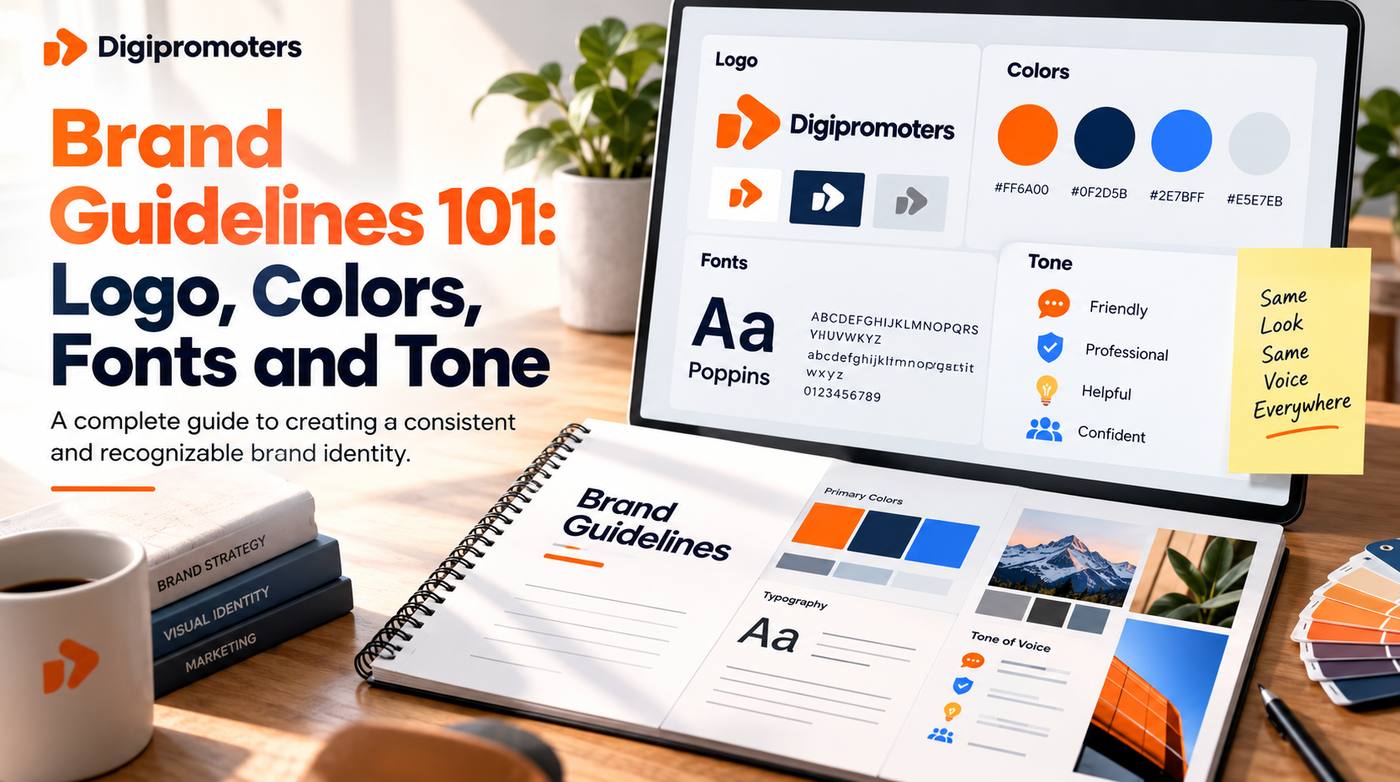
A strong brand is more than a memorable logo.
Think about some of the brands you recognize instantly. You may remember their colors, the way their website looks, the style of their advertisements, the language they use, or even the personality behind their social media posts. That consistency is rarely accidental. It comes from having clear brand guidelines.
Brand guidelines provide a framework for how a business should present itself across different platforms and marketing channels. They help ensure that your website, social media posts, advertisements, presentations, packaging, and other communication all feel like they belong to the same brand.
For startups, small businesses, established companies, and growing brands, creating brand guidelines can make marketing more organized and professional.
Without clear guidelines, different team members may use different logos, colors, fonts, writing styles, or visual elements. Over time, these small differences can make a brand look inconsistent and less recognizable.
In this guide, we will explain the basics of brand guidelines, including logos, colors, fonts, imagery, brand voice, and tone, and why each element matters for building a consistent brand identity.
What Are Brand Guidelines?
Brand guidelines are a set of rules and recommendations that explain how a brand should be represented visually and verbally.
They define the key elements of a brand identity and provide direction for using them consistently.
Depending on the business, brand guidelines may include:
- Logo usage
- Brand colors
- Typography and fonts
- Photography and imagery
- Icons and graphics
- Brand voice
- Tone of communication
- Messaging
- Social media guidelines
- Website design principles
- Advertising guidelines
- Examples of correct and incorrect usage
You can think of brand guidelines as an instruction manual for your brand.
They help everyone involved in marketing understand not only what the brand looks like, but also how the brand should communicate.
Why Are Brand Guidelines Important?
Consistency is one of the most important principles of branding.
When customers repeatedly encounter the same visual identity and communication style, it becomes easier for them to recognize your business.
For example, if your website uses one shade of blue, your Instagram posts use another, your logo appears differently on every graphic, and your writing style changes from professional to casual depending on who creates the content, your brand can feel disconnected.
Clear brand guidelines help prevent this.
Brand guidelines can help you:
- Create a consistent brand identity
- Improve brand recognition
- Make marketing materials look professional
- Save time when creating content
- Maintain consistency across platforms
- Help new employees understand the brand
- Make collaboration with designers and marketers easier
- Strengthen customer perception
- Build a more recognizable business
Brand guidelines are particularly useful when multiple people are creating content for the same company.
The Essential Elements of Brand Guidelines
A complete brand guideline document can be simple or highly detailed depending on the size and needs of your business.
However, several core elements should be considered by almost every brand.
1. Logo Guidelines
Your logo is one of the most recognizable parts of your visual identity.
It may appear on your website, social media profiles, business cards, advertisements, packaging, presentations, signage, and other marketing materials.
Because of this, your logo needs clear usage rules.
What Should Logo Guidelines Include?
Your brand guidelines should explain:
- Primary logo
- Secondary logo variations
- Logo symbol or icon
- Horizontal and vertical versions
- Black and white versions
- Minimum logo size
- Clear space around the logo
- Appropriate backgrounds
- Incorrect logo usage
For example, you may specify that the logo should always have enough empty space around it so that other design elements do not make it difficult to recognize.
You should also explain what designers should not do with the logo.
Avoid:
- Stretching the logo
- Changing its proportions
- Rotating it unnecessarily
- Adding random effects
- Changing brand colors
- Placing it on an unsuitable background
- Adding unnecessary shadows
- Recreating the logo with different fonts
A logo should look the same regardless of where customers encounter it.
Why Logo Consistency Matters
Imagine seeing a company’s logo on its website and then seeing a completely different version on Instagram.
Even if the difference seems small, repeated inconsistencies can weaken visual recognition.
A clear logo system ensures that everyone uses the correct version.
2. Brand Colors
Colors play an important role in visual branding.
They influence how a brand looks and can contribute to the emotions and associations customers develop with it.
Your brand guidelines should define your primary and secondary colors clearly.
Primary Brand Colors
Primary colors are the main colors associated with your brand.
For example, a company may choose:
- One primary color
- One supporting color
- A neutral background color
These colors can appear across websites, social media graphics, advertisements, presentations, and other brand materials.
Secondary Colors
Secondary colors provide additional flexibility.
They can be used for:
- Backgrounds
- Highlights
- Buttons
- Illustrations
- Charts
- Social media designs
- Supporting graphics
However, having too many colors can make a brand look inconsistent.
A carefully selected color palette usually creates a more cohesive appearance.
Define Color Codes
Your brand guidelines should include exact color specifications.
These may include:
- HEX
- RGB
- CMYK
- Pantone, where relevant
For example:
Primary Blue
HEX: #123456
RGB: 18, 52, 86
Providing exact values ensures that different designers and platforms can reproduce your colors more consistently.
3. Typography and Fonts
Typography is another major part of your visual identity.
The fonts you use can influence whether your brand feels modern, traditional, premium, friendly, technical, creative, or professional.
Your brand guidelines should define which fonts should be used and where.
Establish a Font Hierarchy
A simple typography system might include:
Primary Font: Used for headings and major statements.
Secondary Font: Used for body copy and supporting information.
Accent Font: Used selectively for special design elements, if required.
You can also define:
- Heading sizes
- Body text sizes
- Font weights
- Line spacing
- Letter spacing
- Capitalization rules
For example, your guidelines could specify that headlines use a bold font weight while body text uses a regular weight.
The goal is not to restrict creativity. It is to create consistency.
Avoid Using Too Many Fonts
Using several unrelated fonts across your marketing materials can make your brand look unorganized.
For most businesses, a small, carefully selected typography system is easier to manage and more recognizable.
4. Brand Voice
Visual identity is only one part of branding.
Your brand also needs a recognizable way of speaking.
Brand voice is the overall personality and communication style of your business.
It answers the question:
“How does our brand sound?”
For example, a brand might have a voice that is:
- Professional
- Friendly
- Confident
- Helpful
- Straightforward
- Energetic
- Educational
- Sophisticated
- Playful
The right voice depends on the brand, industry, audience, and positioning.
A financial services company may need a very different communication style from a fashion brand or a children’s education business.
Create Clear Voice Guidelines
Instead of simply saying “sound professional,” provide examples.
For example:
Our voice is:
Clear, confident, helpful, and human.
Our voice is not:
Complicated, overly formal, aggressive, or full of unnecessary jargon.
This makes the guidelines easier for writers and marketers to follow.
5. Brand Tone
Brand voice and brand tone are related, but they are not exactly the same.
Your brand voice remains relatively consistent, while your tone can change depending on the situation.
For example, a brand may always be friendly and professional, but the tone used for different situations could vary.
Social Media Post
Friendly and conversational.
Customer Complaint
Calm, respectful, and understanding.
Product Announcement
Excited and informative.
Serious Business Update
Professional and direct.
The brand should still sound like the same company, but the emotional tone can adapt to the context.
6. Imagery and Photography
Images can communicate your brand personality before someone reads a single word.
Your brand guidelines can define the type of imagery your business should use.
For example, should your images be:
- Bright and energetic?
- Minimal and sophisticated?
- Natural and authentic?
- Corporate and professional?
- Bold and colorful?
- Warm and approachable?
You can also specify guidelines for:
- Photography style
- Image composition
- Backgrounds
- Lighting
- Filters
- Illustrations
- Stock photography
- People and lifestyle images
If your brand promotes authenticity, for example, using overly staged stock images everywhere may conflict with your desired identity.
7. Icons, Graphics and Design Elements
Many brands use additional visual elements to make their communication recognizable.
These can include:
- Icons
- Shapes
- Patterns
- Illustrations
- Borders
- Textures
- Graphic styles
- Background elements
Brand guidelines should explain how these elements should be used.
This prevents designers from introducing completely different visual styles every time they create a new campaign.
8. Brand Messaging
Your brand guidelines should also explain the key messages your business wants to communicate.
This can include:
- Brand mission
- Brand vision
- Value proposition
- Key benefits
- Brand positioning
- Tagline
- Core messaging
- Target audience
- Main differentiators
For example, if your brand’s key positioning is based on simplicity, your marketing communication should reinforce that idea consistently.
Brand messaging gives your content a strategic direction instead of making every marketing campaign start from scratch.
How to Create Effective Brand Guidelines
Creating brand guidelines does not have to mean producing a 100-page document.
The most important thing is to create guidelines that your team can actually use.
Step 1: Define Your Brand Identity
Start by understanding:
- Who you are
- What you offer
- Who your customers are
- What makes you different
- What values you represent
- How you want customers to perceive you
Your visual and verbal identity should come from this foundation.
Step 2: Select Your Visual Identity
Define your:
- Logo
- Colors
- Fonts
- Imagery
- Graphic elements
- Icon style
Make sure these elements work well together.
Step 3: Define Your Brand Voice
Write down a few words that describe your communication style.
For example:
We are: Helpful, confident, clear, and approachable.
We are not: Complicated, aggressive, overly casual, or vague.
Then create examples of how the brand should communicate.
Step 4: Create Do’s and Don’ts
Examples make brand guidelines much easier to understand.
Instead of simply saying “Use the logo correctly,” show examples of:
Do:
Use the approved logo with sufficient clear space.
Don’t:
Stretch, rotate, recolor, or distort the logo.
The same approach can be used for fonts, colors, photography, and messaging.
Step 5: Create Templates
Templates can make brand consistency easier.
Consider creating templates for:
- Instagram posts
- Stories
- Presentations
- Business documents
- Advertisements
- Email signatures
- Blog graphics
- Social media covers
Templates reduce the chances of people creating designs that fall outside the brand system.
Step 6: Keep Guidelines Accessible
Your team should be able to find the guidelines easily.
You can keep them in:
- A shared document
- Cloud storage
- Brand management software
- A company knowledge base
- A dedicated brand portal
Also make sure approved logos, fonts, color codes, and templates are easy to access.
Brand Guidelines for Digital Marketing
Brand consistency becomes particularly important when a business is active across multiple digital channels.
Your brand may appear on:
- Website
- YouTube
- Digital advertisements
- Blog posts
- Landing pages
Each platform has different requirements, but your core identity should remain recognizable.
For example, your Instagram posts can have a different format from your website, but they should still use the same visual language, colors, typography, messaging, and personality.
This is where brand guidelines become especially valuable for digital marketing teams.
How Brand Guidelines Help Marketing Teams
When designers, content writers, social media managers, SEO professionals, and advertising specialists work on the same brand, guidelines provide a shared reference point.
Instead of repeatedly asking:
“Which logo should I use?”
“What color should this button be?”
“Should this caption sound formal?”
“Which font should I use?”
Team members can refer to the guidelines.
This can save time and reduce unnecessary revisions.
Common Brand Guideline Mistakes
Even businesses that have brand guidelines can make mistakes.
1. Creating Guidelines and Never Using Them
A brand guideline document is only useful if the team actually follows it.
2. Making Guidelines Too Complicated
If employees need to read dozens of pages just to create a simple social media post, the guidelines may be unnecessarily difficult to use.
3. Focusing Only on the Logo
Brand identity includes much more than the logo.
Colors, typography, imagery, messaging, voice, and customer experience also matter.
4. Not Updating the Guidelines
Brands evolve.
If your business changes its positioning, audience, services, or visual identity, the guidelines may need to be updated.
5. Ignoring Digital Channels
Modern brand guidelines should consider websites, social media, digital advertisements, email, video, and other online platforms.
6. Giving Vague Instructions
“Make it professional” is not always useful.
Specific examples are much easier for teams to follow.
How Brand Guidelines Strengthen Brand Recognition
Brand recognition develops when customers repeatedly encounter familiar elements.
A consistent color palette, logo, typography system, visual style, and communication style can make your brand easier to identify.
Think about how you recognize major brands even before reading their names.
Their visual and verbal identity has become associated with the company.
Smaller businesses can also benefit from the same principle.
You do not need a massive marketing budget to create consistency. You need a clear identity and the discipline to apply it across your marketing.
When Should a Business Create Brand Guidelines?
Ideally, brand guidelines should be established when creating or developing a brand.
However, it is never too late.
You may particularly need brand guidelines if:
- Your business is growing
- Multiple people create marketing content
- Your branding looks inconsistent
- You are launching a new website
- You are expanding to new platforms
- You are working with an external marketing agency
- You are redesigning your brand
- You are launching new products or services
- Your business is entering new markets
If your brand currently looks different across every platform, creating guidelines can be a good starting point for bringing everything together.
Final Thoughts
Brand guidelines are the foundation for consistent brand communication.
They define more than just where to place your logo. A strong brand guideline system explains how your business looks, sounds, communicates, and presents itself.
Your logo creates recognition.
Your colors create visual consistency.
Your fonts create a recognizable design language.
Your imagery reinforces your personality.
Your brand voice defines how you communicate.
Your tone helps you adapt that communication to different situations.
Together, these elements create a brand identity that customers can recognize and understand.
As your business grows, brand guidelines become even more valuable. They give your team, designers, content creators, marketers, and external partners a clear framework to follow.
At Digipromoters, we understand that successful digital marketing works best when strategy and branding work together. A consistent brand identity can make your website, social media, content, advertising, and other digital marketing efforts feel more connected.
Whether you are building a new business or refining an established brand, clear brand guidelines can help you create a stronger and more professional presence across every customer touchpoint.