


Introduction
Attracting new customers is important for every business, but getting customers to return is equally essential for long-term growth. A customer who purchases from your business once may generate revenue, but a customer who returns regularly can become a valuable source of recurring sales, positive reviews, and word-of-mouth referrals.
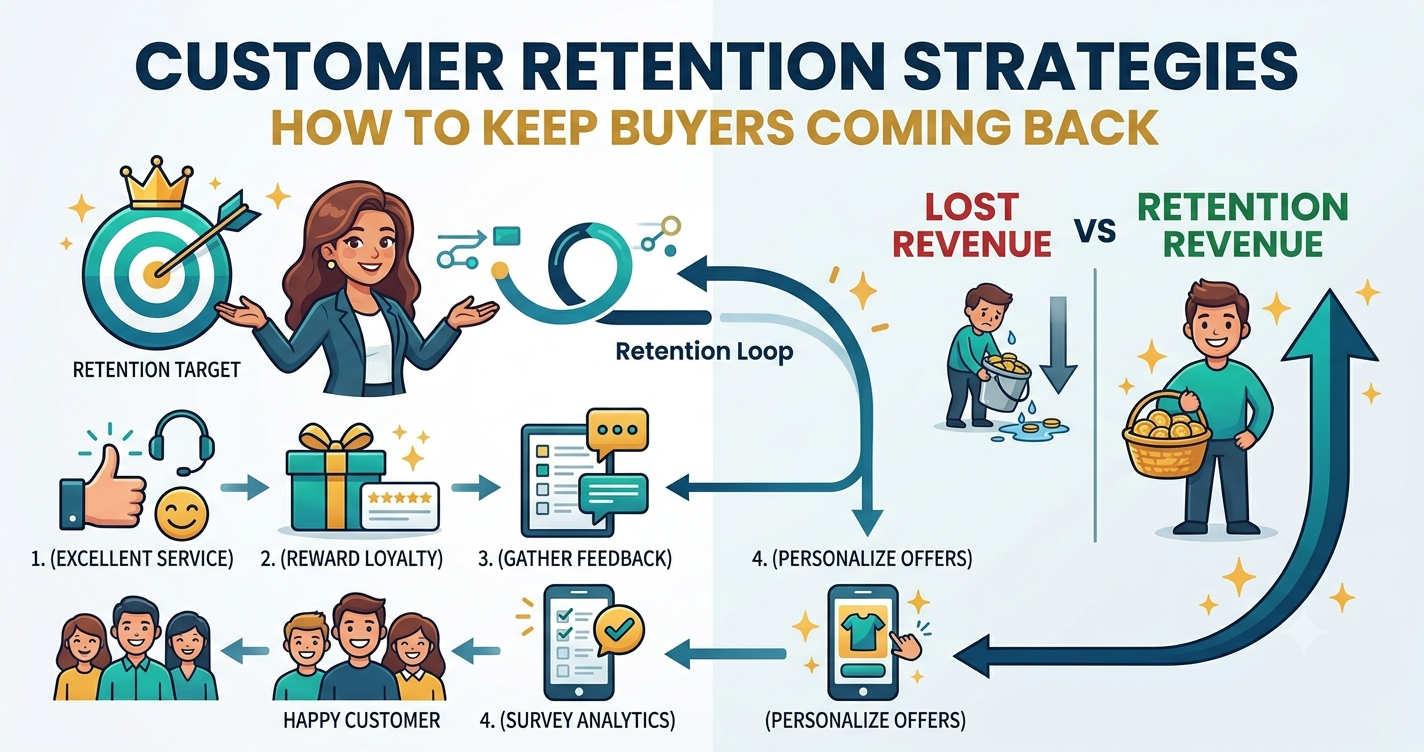
This is where customer retention strategies make a difference. Instead of focusing exclusively on attracting new buyers, businesses can use customer experience improvements, personalized marketing, email campaigns, loyalty programs, and ongoing engagement to build lasting relationships with existing customers.
For small businesses, e-commerce stores, local shops, and service providers, customer retention can help create a more stable customer base and make marketing efforts more effective.
In this guide, we will explore what customer retention strategies are, why they matter, and how businesses can use digital marketing to encourage repeat purchases. You will also learn how to measure retention, avoid common mistakes, and build stronger customer relationships with practical techniques.
1. What Are Customer Retention Strategies?
Customer retention strategies are the methods and activities businesses use to encourage existing customers to continue purchasing their products or services over time.
These strategies focus on delivering positive experiences, maintaining communication, understanding customer preferences, and providing ongoing value after the first transaction.
For example, an online clothing store might send personalized recommendations based on previous purchases. A bakery might offer returning customers a reward after several orders. A digital marketing agency might provide regular performance reports and proactive campaign recommendations to maintain client relationships.
Common customer retention techniques include:
- Personalized email marketing campaigns
- Customer loyalty programs and exclusive rewards
- Responsive customer support
- Post-purchase follow-ups
- Customer feedback collection
- Relevant remarketing campaigns
- Helpful educational content
- Consistent product and service quality
The objective is not simply to persuade people to buy again. It is to give customers good reasons to choose your business over alternatives.
2. Why Is Customer Retention Important for Businesses?
Customer retention helps businesses build sustainable relationships instead of depending entirely on a continuous flow of new buyers.
Here are some important benefits.
Increased repeat sales
Customers who have already purchased from your business understand your products, services, and buying process. When their previous experience is positive, they may be more willing to purchase again.
Better use of marketing resources
Businesses can use purchase history, customer preferences, and existing communication channels to create more relevant campaigns for previous buyers.
Retention marketing still requires investment, but it can complement customer acquisition and reduce dependence on constantly finding new prospects.
Higher customer lifetime value
Customer lifetime value (CLV) estimates the total value a customer generates throughout their relationship with a business. Encouraging repeat purchases and long-term subscriptions can increase this value.
More referrals and recommendations
Satisfied customers may recommend a business to friends, family, colleagues, or social media followers. These recommendations can introduce the brand to potential new customers.
Stronger brand relationships
Consistent service, useful communication, and reliable product quality help build trust. Over time, customers may become more comfortable choosing a familiar brand.
For example, a local salon that remembers customer preferences, sends appointment reminders, and maintains consistent service quality can encourage clients to book their next appointment instead of searching for another provider.
3. Customer Retention vs. Customer Acquisition
Customer acquisition focuses on attracting new customers, while customer retention focuses on keeping existing customers engaged and encouraging them to return.
| Factor | Customer acquisition | Customer retention |
| Main goal | Gain new customers | Keep existing customers |
| Typical activities | SEO, advertising, lead generation | Loyalty campaigns, email marketing, customer support |
| Primary audience | Prospective buyers | Existing customers |
| Key measurements | Cost per acquisition, conversion rate | Retention rate, repeat purchase rate |
| Long-term benefit | Expands the customer base | Builds recurring business and relationships |
Both activities are important. Acquisition introduces people to your business, while retention helps turn successful first purchases into ongoing customer relationships.
For example, an e-commerce store may use Google Ads to attract first-time buyers and email marketing to remind previous customers about product replenishment, new arrivals, or relevant offers.
The right balance depends on the business model, purchase frequency, customer behavior, and growth objectives.
4. 10 Effective Customer Retention Strategies
Businesses do not need to implement every strategy at once. Start with the approaches most relevant to your customers and improve them using performance data.
1. Deliver an Excellent Customer Experience
Customer experience influences whether people want to purchase from your business again. A smooth buying process, accurate product information, reliable delivery, and helpful service can make the experience more satisfying.
How to implement it:
- Make your website easy to navigate on mobile devices.
- Provide clear pricing, product details, and delivery information.
- Simplify checkout, booking, or enquiry forms.
- Set realistic expectations and meet them consistently.
- Make returns, cancellations, or service requests easy to understand.
Example: An online skincare store can provide clear usage instructions, delivery updates, and a simple process for resolving damaged-order complaints. These improvements can reduce frustration and help customers feel more confident about future purchases.
Review the complete customer journey to identify problems that may prevent repeat purchases.
2. Personalize Marketing Messages and Offers
Personalized marketing makes communication more relevant to individual customers. Instead of sending the same promotion to everyone, businesses can use purchase history, expressed preferences, and customer interests to tailor messages.
How to implement it:
- Recommend products related to previous purchases.
- Send birthday offers when customers have provided their details and consented to relevant communication.
- Segment customers according to interests or buying behavior.
- Share service reminders when they are genuinely useful.
- Use customers’ names naturally rather than overusing personalization.
Example: A customer who regularly purchases coffee beans from an online store could receive a reminder when they may be running low, along with suitable product recommendations.
Use accurate customer data, respect privacy preferences, and avoid personalization that feels intrusive.
3. Build a Strong Customer Loyalty Program
A customer loyalty program rewards customers for continued engagement or repeat purchases. Rewards may include discounts, points, exclusive products, priority access, or special benefits.
How to implement it:
- Choose rewards that your target customers value.
- Keep the rules simple and transparent.
- Set achievable milestones.
- Explain how customers can earn and redeem rewards.
- Track whether the program encourages additional purchases.
Example: A bakery could offer a free pastry after a defined number of qualifying purchases. Customers have a clear reason to return, while the bakery can measure participation and repeat visits.
A successful loyalty program should provide genuine value rather than relying on complicated rules or discounts that damage profitability.
4. Use Email Marketing to Nurture Existing Customers
Email marketing helps businesses maintain contact with customers after a purchase. It can share useful information, announce relevant products, and encourage repeat purchases without depending entirely on paid advertising.
Useful email campaigns include:
- Welcome emails for new customers
- Post-purchase thank-you messages
- Product care instructions or usage tips
- Replenishment reminders
- New product announcements
- Personalized recommendations
- Win-back campaigns for inactive customers
Example: A home décor store can send styling advice after a customer purchases a lamp, followed by recommendations for complementary products when relevant.
Segment your mailing list, send emails at appropriate intervals, and make unsubscribing straightforward. Measure clicks, conversions, unsubscribes, and revenue rather than judging success by open rates alone.
5. Engage Customers on Social Media
Social media provides opportunities to maintain relationships between purchases. It allows brands to answer questions, share useful information, showcase customers’ experiences, and create a sense of community.
How to implement it:
- Respond promptly to relevant comments and direct messages.
- Share product demonstrations and practical tips.
- Publish customer stories with appropriate permission.
- Ask meaningful questions and conduct polls.
- Address common concerns through short videos or posts.
- Share updates that are useful to existing customers, not just promotional content.
Example: A bakery can publish cake-care tips, share customer-approved celebration photos, and announce seasonal flavours. Previous customers may engage with the content and consider placing another order.
Focus on meaningful interactions instead of measuring success only through likes and follower counts.
6. Provide Excellent Customer Support
Customers are more likely to trust a business that takes responsibility for problems and communicates clearly.
Good customer support can help resolve delivery delays, booking issues, product questions, billing concerns, and service complaints before they damage the relationship.
How to implement it:
- Provide clear contact and support information.
- Establish reasonable response-time expectations.
- Train staff to handle complaints professionally.
- Keep customers informed while resolving problems.
- Record recurring issues and improve the underlying process.
Example: If a customer receives an incorrect order, an e-commerce business can acknowledge the mistake, explain the replacement process, and provide updates until the issue is resolved.
Customer support should focus on solving the problem, not simply closing the complaint.
7. Collect Customer Feedback and Act on It
Feedback helps businesses understand what customers appreciate and where the experience falls short. It also creates opportunities to identify improvements that may support retention.
How to implement it:
- Send short surveys after purchases or service appointments.
- Ask specific questions about product quality and service.
- Invite customers to share suggestions.
- Monitor reviews on relevant platforms.
- Look for recurring complaints or requests.
- Communicate meaningful improvements when appropriate.
Example: A local fitness studio discovers that customers struggle to book evening classes. After reviewing feedback, it improves the booking process and communicates the change to members.
Do not collect feedback simply to appear customer-focused. Use it to make practical improvements and close the loop with customers.
8. Offer Exclusive Deals and Rewards to Returning Buyers
Returning customers may appreciate relevant benefits that recognize their continued business. These can include early access, member-only offers, complimentary add-ons, or useful bundles.
How to implement it:
- Offer benefits that match customers’ interests.
- Reward meaningful milestones where appropriate.
- Test bundles instead of relying exclusively on price reductions.
- Make eligibility and expiry dates clear.
- Compare campaign results with profit margins and normal purchasing behavior.
Example: A clothing retailer can give existing customers early access to a new collection before promoting it widely.
Exclusive offers should strengthen the customer relationship without training buyers to wait for constant discounts.
9. Use Remarketing and Retargeting Campaigns
Remarketing and retargeting help businesses reconnect with eligible audiences who have previously interacted with their website, advertisements, or other digital properties.
Depending on the platform and available consent, campaigns can reach previous purchasers, returning visitors, or people who showed interest in specific products.
How to implement it:
- Create audience segments based on meaningful interactions.
- Show relevant products or complementary items.
- Exclude customers who should not receive a particular promotion.
- Use frequency limits to avoid excessive advertising.
- Respect applicable privacy requirements and platform policies.
- Measure incremental conversions rather than relying only on attributed sales.
Example: An online electronics store could show compatible accessories to previous customers who purchased a camera, provided the audience and campaign meet applicable platform requirements.
Retargeting should be useful and appropriately timed. Repeatedly showing irrelevant advertisements can frustrate customers rather than encourage loyalty.
10. Create Valuable Content That Keeps Customers Engaged
Helpful content gives customers a reason to remain connected with a brand beyond the transaction itself.
Depending on the business, content may include tutorials, FAQs, product guides, maintenance instructions, educational newsletters, videos, or industry updates.
How to implement it:
- Identify questions customers frequently ask.
- Publish practical guides that help customers get more value from purchases.
- Create videos demonstrating product features.
- Update FAQs as new questions emerge.
- Share relevant content through email and social media.
Example: A company selling gardening supplies can publish seasonal planting guides and plant-care videos. Existing customers benefit from the information and may return when they need additional supplies.
Useful content supports customer engagement and trust while creating opportunities for relevant repeat purchases.
5. How Digital Marketing Helps Improve Customer Retention
Digital marketing supports retention by helping businesses communicate consistently, understand customer behavior, and deliver relevant experiences across channels.
Key methods include:
Search engine optimization (SEO): Educational articles, product guides, and FAQs help customers find useful information after their purchase.
Email marketing automation: Triggered emails can deliver onboarding instructions, service reminders, product recommendations, and win-back messages at relevant times.
Social media marketing: Regular posts, community interactions, and customer stories help keep the brand familiar between purchases.
Customer relationship management (CRM): CRM systems organize customer interactions, preferences, purchase histories, and follow-up activities.
Analytics and conversion optimization: Website and campaign data can reveal where customers encounter friction or stop engaging.
Paid remarketing: Eligible audiences can receive relevant reminders or product suggestions based on their previous interactions.
For example, a service-based business can use SEO to attract customers, a CRM system to record enquiries, email reminders to maintain communication, and customer feedback to improve service delivery.
The most effective digital marketing strategies for customer retention work together. Each channel should support a consistent customer experience instead of operating as a separate, disconnected activity.
6. Common Customer Retention Mistakes Businesses Should Avoid
Even well-intentioned marketing efforts can fail when they overlook customer needs.
Common mistakes include:
- Focusing only on new customers: Existing buyers also need attention after their first purchase.
- Sending too many promotional messages: Excessive communication can lead to unsubscribes and reduced engagement.
- Offering irrelevant discounts: Discounts may increase short-term sales without creating genuine loyalty.
- Ignoring complaints: Unresolved problems can undermine trust and discourage future purchases.
- Using the same message for everyone: Different customers have different needs, interests, and buying cycles.
- Failing to measure results: Without meaningful metrics, businesses cannot tell which strategies are working.
- Making promises the business cannot fulfil: Unreliable delivery, inconsistent service, or misleading offers can damage long-term relationships.
- Ignoring customer privacy: Personal information should be handled responsibly, with appropriate consent and access controls.
The solution is to understand customer behavior, communicate thoughtfully, and improve the experience using reliable evidence.
7. Key Customer Retention Metrics to Track
Customer retention strategies should be evaluated using measurable outcomes. The most useful metrics depend on your business model and the period being measured.
| Metric | What it measures | Formula |
| Customer retention rate | Percentage of starting customers retained | ((E − N) ÷ S) × 100 |
| Repeat purchase rate | Percentage of customers who purchased more than once | (Repeat customers ÷ Total customers) × 100 |
| Customer lifetime value | Estimated value generated over a customer relationship | Average purchase value × Purchase frequency × Customer lifespan |
| Churn rate | Percentage of starting customers lost | (Customers lost ÷ S) × 100 |
| Repeat purchase frequency | How often customers buy again | Total repeat purchases ÷ Number of repeat customers |
In the retention-rate formula:
- S = Customers at the start of the period
- E = Customers at the end of the period
- N = New customers acquired during the period
Example: Calculating Customer Retention Rate
Suppose a business starts the month with 500 customers, ends with 540 customers, and acquires 100 new customers during that month.
Customer retention rate = ((540 − 100) ÷ 500) × 100 = 88%
This means the business retained 440 of its original 500 customers during the period.
For accurate reporting, define what counts as an active or retained customer, use consistent time periods, and distinguish customer counts from subscription accounts or individual transactions.
There is no single customer retention rate that is ideal for every business. Subscription services, retail stores, and businesses selling products with long replacement cycles naturally have different purchasing patterns. Compare your results with your own historical performance and relevant industry benchmarks.
8. How Small Businesses Can Build Long-Term Customer Loyalty
Customer retention for small businesses does not require an expensive marketing system. A few consistent, customer-focused activities can create a strong foundation.
Start with the customer experience
Make it easy for customers to understand your offer, purchase from you, ask questions, and receive support.
Keep a simple customer database
With appropriate consent and access controls, maintain useful information such as purchase dates, service history, communication preferences, and follow-up requirements.
Stay connected after each transaction
Send thank-you messages, share useful advice, request feedback, and provide relevant reminders.
Encourage reviews and referrals
Invite customers to leave honest feedback and share their experience. Never pressure customers into providing positive reviews or offer prohibited incentives.
Reward returning customers
Introduce a simple loyalty benefit or exclusive offer that fits your business model and profit margins.
Review results regularly
Track repeat purchases, customer complaints, feedback, and revenue from returning customers. Use the findings to improve your approach.
Practical example: A local bakery can record regular customers’ favourite products, share seasonal menu updates, provide an easy ordering process, and introduce a simple repeat-purchase reward. A local salon could use appointment reminders, post-visit care advice, and convenient rebooking links.
Small improvements applied consistently can help businesses create a more reliable and customer-friendly experience.
9. How Digipromoters Can Help Businesses Improve Customer Retention
Attracting customers is only one part of sustainable business growth. Businesses also need effective ways to stay connected with existing buyers, provide relevant information, and encourage customers to return.
Digipromoters is a digital marketing agency focused on helping businesses strengthen their online presence, build brand awareness, reach potential customers, and improve conversions through digital marketing strategies.
Our approach to customer retention can support businesses through:
- SEO and content marketing: Create useful website content that answers customer questions and supports ongoing engagement.
- Social media marketing: Maintain an active brand presence and develop meaningful interactions with customers.
- Email marketing: Plan relevant communication campaigns that nurture existing customers and support repeat purchases.
- Website optimization: Improve navigation, mobile usability, calls to action, and the customer journey.
- Remarketing strategies: Reconnect with eligible audiences through relevant, carefully managed advertising campaigns.
- Performance analysis: Review campaign data and customer behavior to identify opportunities for improvement.
The right combination depends on your audience, business model, resources, and customer buying cycle. A well-planned strategy should connect customer acquisition, engagement, and retention rather than treating each activity separately.
If your business attracts website visitors but struggles to generate repeat purchases, or if existing customers rarely engage after their first transaction, reviewing your digital marketing approach can be a useful starting point.
Frequently Asked Questions About Customer Retention Strategies
1. What are the most effective customer retention strategies?
The most effective customer retention strategies include delivering excellent customer experiences, personalizing communication, using email marketing, rewarding repeat purchases, providing responsive customer support, and collecting customer feedback. The best combination depends on customer needs and the business model.
2. How can digital marketing improve customer retention?
Digital marketing can improve customer retention through personalized emails, useful content, social media engagement, CRM tools, remarketing campaigns, and website optimization. These methods help businesses maintain communication and provide relevant experiences after the initial purchase.
3. Why is customer retention important for small businesses?
Customer retention helps small businesses build repeat sales, develop customer relationships, encourage referrals, and reduce reliance on constantly acquiring new customers. It can also help businesses understand their audience and allocate marketing resources more effectively.
4. What is a good customer retention rate?
A good customer retention rate depends on the industry, business model, purchase frequency, and measurement period. Subscription businesses and retail stores have different retention patterns. Businesses should track their own results over time and compare them with relevant industry benchmarks.
5. How can email marketing encourage repeat purchases?
Email marketing can encourage repeat purchases through personalized product recommendations, replenishment reminders, post-purchase guidance, exclusive offers, and re-engagement campaigns. Messages should be relevant, appropriately timed, and easy to unsubscribe from.
6. What is the difference between customer retention and customer loyalty?
Customer retention measures whether customers continue purchasing or maintaining a relationship with a business. Customer loyalty describes a stronger preference, trust, or commitment toward a brand. A customer may return because of convenience or a discount without having strong brand loyalty.
7. How can businesses measure customer retention?
Businesses can measure customer retention using retention rate, repeat purchase rate, customer lifetime value, churn rate, and repeat purchase frequency. Subscription businesses may also monitor renewal rates. The chosen metrics should reflect the business model and use consistent definitions and time periods.
Conclusion: Make Customer Retention a Long-Term Priority
Customer retention strategies help businesses build stronger relationships, encourage repeat purchases, and create more sustainable growth. From improving the customer experience and personalizing marketing messages to implementing loyalty programs and measuring customer behavior, every activity should provide a meaningful reason for customers to return.
Start by identifying where customers lose interest, which problems affect their experience, and what would make their next purchase easier. Then choose a few relevant strategies, measure the results, and refine your approach over time.
Customer retention is not a one-time campaign. It is an ongoing commitment to delivering value, communicating thoughtfully, and earning customer trust.
Ready to strengthen your customer relationships and improve your digital marketing performance?
Connect with Digipromoters to explore SEO, content marketing, social media, email marketing, and customer engagement strategies tailored to your business goals. Build a more effective digital presence and give your customers more reasons to come back.