




Digital marketing is becoming more privacy-conscious, and businesses can no longer assume that traditional tracking methods will remain available forever.
For years, advertisers and publishers relied heavily on third-party cookies to understand online behavior, build audiences, measure campaigns, and support retargeting. But browsers, platforms, and privacy regulations have increasingly restricted cross-site tracking. The situation is more nuanced than simply saying “all cookies are disappearing”: first-party cookies remain widely used, while third-party tracking is facing growing restrictions and user controls. Google, for example, currently allows Chrome users to make choices about third-party cookies rather than proceeding with the previously announced blanket phase-out.
This shift makes first-party data increasingly important.
Instead of depending primarily on data collected elsewhere, businesses can build direct relationships with customers through their websites, apps, CRM systems, email lists, purchases, forms, and other owned channels.
For businesses preparing for privacy-first marketing, the question is no longer simply “What happens when third-party cookies disappear?” It is:
“How can we build a marketing system that creates useful customer insights with data we collect responsibly ourselves?”
That is where a strong first-party data strategy comes in.
What Is First-Party Data?
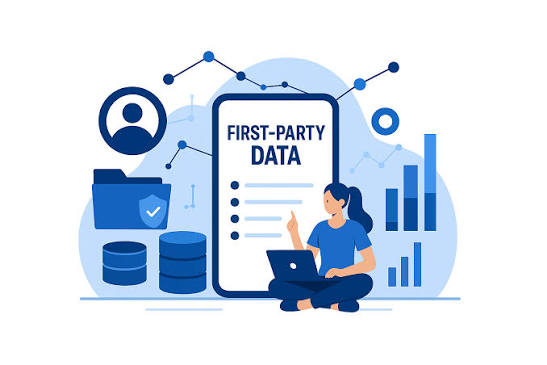
First-party data is information that a business collects directly from its customers or website and app users through its own channels.
Examples include:
- Name and email address submitted through a form
- Customer purchase history
- Account registration information
- Newsletter subscriptions
- Website interactions
- Product preferences
- Customer service conversations
- Survey responses
- Booking or inquiry information
- Loyalty-program activity
- App interactions
The key point is direct collection.
For example, suppose an e-commerce company sells shoes. A customer creates an account, purchases running shoes, and subscribes to the company’s newsletter. The company can use that information—subject to applicable privacy requirements—to understand the customer’s relationship with the brand and create more relevant communications.
Google Analytics itself primarily uses first-party cookies for measurement on websites that implement it. Google also provides mechanisms for businesses to send consented, first-party user-provided data for measurement and advertising-related capabilities.
What Is First-Party Data in Simple Terms?
Think of it this way:
If the customer gives information directly to your business, or your business observes activity on its own digital property, that information can form part of your first-party data.
It is different from buying or receiving a profile about that customer from an unrelated external data provider.
Why Does First-Party Data Matter in Digital Marketing?
First-party data can become an important foundation for modern digital marketing because it connects marketing activity with information a business has collected through its own customer relationships.
It can support:
- Personalization
- Customer segmentation
- Email marketing
- CRM management
- Lead nurturing
- Conversion tracking
- Audience building
- Retargeting
- Customer retention
- Marketing analytics
- Campaign measurement
There is also an important strategic advantage: you have greater visibility into where the information came from and why the customer interacted with your business.
However, first-party data is not automatically “better” simply because it is first-party. Its usefulness depends on data quality, consent, relevance, governance, and how responsibly the business uses it.
What Are Cookies?
A cookie is a small piece of information stored by a website in a user’s browser.
Cookies can support functions such as:
- Remembering preferences
- Maintaining login sessions
- Measuring website activity
- Understanding returning visits
- Supporting advertising and measurement
Not all cookies work in the same way.
The most important distinction for this topic is between first-party cookies and third-party cookies.
First-Party Cookies vs Third-Party Cookies
What Is a First-Party Cookie?
A first-party cookie is generally set by the website the user is visiting.
For example, when someone visits example.com, the website may use a first-party cookie to remember a session or help measure activity on its own domain.
Google Analytics uses first-party cookies for website measurement in its standard setup.
What Is a Third-Party Cookie?
A third-party cookie is associated with a domain different from the website the user is currently visiting.
Historically, third-party cookies have been used for cross-site advertising, audience targeting, and tracking-related purposes.
Their use has become increasingly restricted across the web as browsers and privacy technologies place greater limits on cross-site tracking.
First-Party Cookies vs Third-Party Cookies: Quick Comparison
| Feature | First-Party Cookies | Third-Party Cookies |
| Usually set by | Website being visited | Another domain/service |
| Main relationship | Website ↔ visitor | External service ↔ visitor |
| Common uses | Login, preferences, analytics | Cross-site advertising and tracking |
| Cross-site tracking | Generally not their primary purpose | Historically a major use |
| Current direction | Still widely used | Increasingly restricted |
| Business implication | Useful for owned-channel measurement | Businesses need alternative approaches |
Important: A move away from third-party cookies does not mean businesses should stop using all cookies. Necessary cookies and first-party technologies can still play important roles, subject to applicable laws and consent requirements.
Why Are Third-Party Cookies Disappearing?
There are several reasons behind the shift.
1. Growing Privacy Expectations
People increasingly expect greater control over how their online activity is collected and used.
Browsers have responded by introducing stronger privacy controls and restrictions around cross-site tracking.
2. Browser-Level Restrictions
Different browsers have already introduced mechanisms that restrict third-party cookies.
Chrome’s approach has evolved over time. Google announced in 2024 that it would maintain its current approach of giving users a choice regarding third-party cookies instead of introducing the previously planned standalone deprecation prompt. Incognito mode continues to block third-party cookies by default.
This means marketers should not build their entire strategy around the assumption that third-party cookies will function consistently for every user.
3. Privacy Regulations
Privacy laws and regulations are also changing how organizations collect and process personal data.
For example, India’s Digital Personal Data Protection Act, 2023 establishes requirements around lawful processing, notice, consent, and individuals’ rights. The Act states that consent must be free, specific, informed, unconditional and unambiguous, with clear affirmative action where consent is the basis for processing.
Businesses operating across different markets may also need to consider other privacy frameworks and local requirements.
4. Platform Changes
Advertising platforms are developing measurement and audience solutions that can work with more privacy-conscious approaches.
Google, for example, provides tools involving consented first-party data, Customer Match and enhanced conversions to help advertisers measure and activate audiences when traditional identifiers are unavailable.
What Does the Shift Mean for Advertisers and Businesses?
Businesses should expect some changes in how they:
- Measure conversions
- Build remarketing audiences
- Attribute customer journeys
- Understand cross-site behavior
- Personalize campaigns
- Connect advertising activity with CRM data
This does not mean digital advertising is disappearing.
Instead, marketers need to combine multiple signals and build stronger owned data systems.
A modern marketing stack can include:
Website + CRM + Analytics + Consent Management + Email + Advertising Platforms + First-Party Customer Data
The goal is to create a connected system rather than depend on one tracking technology.
First-Party vs Second-Party vs Third-Party Data
Understanding these three categories makes the privacy shift easier to understand.
| Data Type | Who Collects It? | Example | Common Use |
| First-party data | Your business directly | Customer purchase history | CRM, personalization, retention |
| Second-party data | Another organization directly, then shared through an agreed relationship | A partner sharing relevant audience information | Partnerships and audience activation |
| Third-party data | External data providers aggregating data from multiple sources | Purchased audience segments | Targeting and market analysis |
The important difference is the source and relationship behind the data.
First-party data comes directly from your relationship with the customer.
Examples of First-Party Data
A business may already have more first-party data than it realizes.
Examples include:
E-Commerce Business
- Product purchases
- Cart activity
- Account registrations
- Customer preferences
- Repeat purchases
- Email subscriptions
SaaS Company
- Free-trial registrations
- Product usage
- Demo requests
- Subscription information
- Feature interactions
Local Business
- Inquiry forms
- Appointment bookings
- Phone leads
- Customer feedback
- Service history
Digital Marketing Agency
A digital marketing agency can collect first-party data through:
- Website lead forms
- Consultation requests
- Newsletter subscriptions
- Contact information
- Service inquiries
- Customer conversations
The key is to collect only information that is relevant and appropriately handled.
How Can Businesses Collect First-Party Data?
Businesses do not need complicated technology to start.
Here is a practical process.
1. Optimize Your Website Forms
Create useful forms for:
- Contact inquiries
- Demo requests
- Consultation bookings
- Downloadable resources
- Newsletter subscriptions
Do not ask for unnecessary information.
If you only need a name, email and business requirement, asking for ten additional fields can create unnecessary friction.
2. Create Valuable Content
Offer something useful in exchange for voluntary information.
Examples:
- Industry guides
- Checklists
- Templates
- Webinars
- Case studies
- Free consultations
- Calculators
The value exchange should be clear to the user.
3. Build an Email List
Email subscribers can become an important first-party audience when collected and managed responsibly.
Instead of relying entirely on rented or purchased audiences, businesses can develop an ongoing relationship with people who choose to hear from them.
4. Use CRM Systems
A CRM, or Customer Relationship Management system, stores and organizes customer and prospect information.
For example, a CRM can show:
Lead → Consultation → Proposal → Customer → Repeat Purchase
This gives marketing and sales teams a more connected view of the customer journey.
5. Encourage Accounts or Loyalty Programs
For suitable businesses, account registration and loyalty programs can create opportunities to understand customer preferences and interactions over time.
The experience should provide genuine value rather than forcing unnecessary data collection.
First-Party Data Strategies for Small and Large Businesses
A first-party data strategy does not need to begin with an expensive customer data platform.
For Small Businesses
Start with:
- A properly structured website
- Useful lead forms
- Google Analytics
- A simple CRM
- Email marketing
- Clear consent and privacy information
- Basic conversion tracking
- Regular data-quality reviews
For Larger Businesses
Larger organizations may build more advanced systems involving:
- CRM integration
- Customer data platforms
- Data warehouses
- Server-side measurement
- Advanced segmentation
- Marketing automation
- Offline conversion data
- Consent management platforms
- Cross-channel analytics
The technology should follow the business requirement—not the other way around.
How First-Party Data Improves Personalization
Personalization means delivering more relevant experiences based on information a customer has voluntarily shared or activity the business is permitted to use.
For example:
A customer purchases running shoes.
Instead of sending the same promotion to everyone, an e-commerce brand could create relevant follow-up communication about:
- Running socks
- Shoe care
- Running accessories
- New products in the same category
This is more useful than blindly showing unrelated advertisements.
First-party data can help businesses segment customers based on meaningful interactions such as purchase history, product interest or stage in the customer journey.
How First-Party Data Supports Paid Advertising
First-party data can complement paid advertising in several ways.
For example, businesses may use consented customer information to create advertising audiences where platform policies and applicable laws allow it.
Google provides Customer Match capabilities that can use consented, hashed customer data to supplement advertising audiences. Google also describes enhanced conversions as a way to improve conversion measurement using hashed first-party data.
Meta also provides customer-list audience functionality where businesses can use data such as email addresses and phone numbers, subject to applicable permissions, terms and requirements.
This makes the combination of CRM + advertising + measurement increasingly important.
First-Party Data and CRM
Your CRM can become the central connection point between marketing and sales.
Imagine a business has 500 leads.
Without a structured CRM, those leads may be spread across:
- Spreadsheets
- Website forms
- Phone records
A CRM can organize this information into stages such as:
New Lead → Contacted → Qualified → Proposal → Won → Existing Customer
Marketing teams can then better understand which audiences are converting and which campaigns are generating qualified opportunities.
First-Party Data and Email Marketing
Email marketing is one of the clearest examples of an owned-channel strategy.
A subscriber has voluntarily provided an email address, allowing a business to communicate directly with them according to the applicable consent and marketing rules.
Businesses can segment email audiences based on relevant information such as:
- New subscribers
- Existing customers
- Product interest
- Previous purchases
- Service category
- Engagement level
The goal should be relevance rather than volume.
First-Party Data and Website Analytics
Analytics helps businesses understand what happens on their own digital properties.
Google Analytics uses first-party cookies in its standard web implementation, and businesses can configure consent-related settings for their measurement setup.
Useful website events can include:
- Form submissions
- Product views
- Purchases
- Phone clicks
- Downloads
- Booking requests
- Key navigation actions
A strong analytics setup helps answer:
Which channels are generating meaningful actions?
However, analytics data should not be treated as a perfect representation of every customer interaction. Consent choices, browser restrictions, measurement gaps and modeled data can affect reporting. Google documents modeled key events for situations where direct measurement is unavailable or limited.
Privacy, Consent and Responsible Data Collection
First-party does not mean “collect everything.”
Responsible data collection should follow a few principles:
- Collect only information you genuinely need.
- Clearly explain why information is being collected.
- Obtain consent where required.
- Give users appropriate choices.
- Protect customer information.
- Keep data accurate.
- Remove or retain information according to applicable requirements.
- Respect withdrawal and opt-out requests.
- Review third-party tools connected to your website.
Privacy requirements vary by jurisdiction and use case.
For example, India’s Digital Personal Data Protection Act requires notice about personal data and processing purposes and establishes requirements around consent where consent is the basis for processing.
Similarly, the UK’s ICO guidance states that organizations should provide clear information about cookies and obtain appropriate consent for non-essential cookies.
Businesses should obtain appropriate legal advice for their specific regulatory obligations.
Common First-Party Data Mistakes
1. Collecting Too Much Data
More data does not automatically mean better marketing.
Collect information that has a clear purpose.
2. Keeping Data in Separate Systems
If website leads, sales records and customer purchases cannot be connected, the business may struggle to understand the customer journey.
3. Ignoring Data Quality
Duplicate, outdated or incorrect records can weaken segmentation and reporting.
4. Treating Consent as a Checkbox Only
Privacy is not simply a banner that appears on a website.
Businesses should understand what data they collect, why they collect it and how it is used.
5. Depending Entirely on Retargeting
Retargeting can be useful, but a sustainable strategy should also include:
- SEO
- Content
- CRM
- Direct customer relationships
- Conversion optimization
- Paid search
- Social media
- Customer retention
6. Buying Data Without Understanding Its Source
Third-party or purchased data can create privacy, quality and compliance concerns. Businesses should understand the source, permissions and permitted use before using external data.
What Is Cookieless Marketing?
Cookieless marketing is an approach to digital marketing that reduces dependence on third-party cookies and uses alternative methods for measurement, targeting and customer understanding.
It can involve:
- First-party data
- CRM systems
- Consent-based tracking
- Contextual advertising
- Server-side measurement
- Platform-provided conversion tools
- Email marketing
- Customer research
- Analytics
- Modeled measurement
Cookieless does not necessarily mean “no data.”
It means businesses need to think beyond traditional third-party cookie tracking.
How Businesses Can Prepare for a Cookieless Future
A practical roadmap is:
Step 1: Audit Your Current Data
Identify:
- What data you collect
- Where it comes from
- Where it is stored
- Who can access it
- Which platforms receive it
- How it is used
Step 2: Improve Your Website
Make sure important conversion actions are measurable.
Step 3: Strengthen Your CRM
Connect leads and customers to a structured customer journey.
Step 4: Build Owned Audiences
Develop email lists, customer databases and loyalty programs where appropriate.
Step 5: Review Consent
Make privacy choices clear and aligned with applicable requirements.
Step 6: Improve Conversion Tracking
Use appropriate analytics and advertising-platform measurement tools.
Step 7: Connect Marketing and Sales
Do not measure only clicks. Track what happens after the lead enters your business.
Step 8: Test and Improve
Review data quality, conversion rates, campaign performance and customer behavior regularly.
How DigiPromoters Can Help
Building a privacy-first marketing system involves more than installing an analytics tag.
At DigiPromoters, businesses can combine digital marketing strategy with practical execution across areas such as:
- SEO
- Performance marketing
- Paid advertising
- Social media marketing
- Website optimization
- Analytics and tracking
- Lead generation
- Conversion optimization
- Content marketing
A strong strategy can connect these activities instead of treating them as isolated marketing channels.
For example:
SEO → Website Visit → Lead Form → CRM → Follow-Up → Conversion → Customer Data → Future Marketing
This creates a more connected customer journey while reducing unnecessary dependence on external tracking signals.
If your business is unsure what customer data it already has, how it should be collected, or how to connect that data with marketing campaigns, DigiPromoters can help you develop a practical first-party data and privacy-focused digital marketing strategy.
The Future of First-Party Data and Cookieless Marketing
The future is unlikely to be defined by one replacement for third-party cookies.
Instead, digital marketing is moving toward a broader combination of:
- First-party customer relationships
- Privacy-conscious measurement
- Consent management
- CRM data
- Platform-based measurement
- Better analytics
- Contextual targeting
- Owned audiences
- Stronger content
- Better customer experiences
The exact technologies will continue to change.
For example, Google’s approach to third-party cookies has changed from its earlier phase-out plan, demonstrating why businesses should avoid building their entire strategy around one predicted technology timeline.
The more durable strategy is to build assets your business controls: your website, customer relationships, CRM, content, email audience, analytics foundation and customer experience.
Conclusion
Third-party cookies are not simply disappearing overnight, and not every cookie is going away. But the digital marketing environment is clearly becoming more privacy-conscious, with browsers, platforms and regulations changing how businesses can collect and use customer information.
That makes first-party data strategy increasingly important.
Businesses can prepare by:
- Collecting useful information directly from customers
- Building strong CRM systems
- Improving website conversion tracking
- Developing email audiences
- Using consent appropriately
- Connecting marketing and sales data
- Improving data quality
- Diversifying beyond third-party tracking
- Investing in owned digital channels
The objective is not to collect the maximum amount of customer information.
The objective is to build useful, permission-aware and trustworthy customer relationships that can support marketing over the long term.
For businesses navigating this transition, DigiPromoters can help turn first-party data, analytics, SEO, paid advertising, content and conversion optimization into a more connected digital marketing strategy.
Frequently Asked Questions
1. What is first-party data?
First-party data is information a business collects directly from its customers or users through its own websites, apps, forms, purchases, CRM systems, surveys and other owned channels.
2. Why is first-party data important?
First-party data can help businesses understand their customers, personalize marketing, improve segmentation, strengthen CRM systems and support measurement while reducing dependence on external audience data.
3. What is the difference between first-party and third-party data?
First-party data is collected directly by your business. Third-party data is generally obtained from external organizations that collect or aggregate information from multiple sources.
4. Why are third-party cookies disappearing?
Third-party cookies have faced increasing restrictions because of privacy concerns, browser changes and evolving approaches to cross-site tracking. Chrome’s current approach gives users a choice regarding third-party cookies, while other browsers have already implemented stronger restrictions.
5. Is first-party data better than third-party data?
They serve different purposes. First-party data provides information from a direct relationship with your audience, while third-party data can provide broader external audience information. Businesses should consider relevance, quality, permissions, privacy requirements and business objectives.
6. How can businesses collect first-party data?
Businesses can collect first-party data through website forms, purchases, account registrations, email subscriptions, surveys, loyalty programs, customer service interactions and CRM systems.
7. How does first-party data help digital advertising?
Where platform rules and applicable laws permit, businesses can use consented first-party customer information to support audience creation and conversion measurement. Google, for example, provides Customer Match and enhanced-conversion capabilities involving first-party data.
8. Can first-party data improve personalization?
Yes. Relevant first-party information such as purchase history, product interest and customer lifecycle stage can help businesses create more relevant experiences and communications.
9. How does first-party data work with CRM systems?
CRM systems organize customer and prospect information so businesses can connect interactions such as inquiries, sales calls, purchases and follow-ups. This can help marketing and sales teams understand the customer journey.
10. What is cookieless marketing?
Cookieless marketing is an approach that reduces dependence on third-party cookies by using methods such as first-party data, CRM systems, consent-based measurement, contextual advertising, analytics and platform-based conversion tools.
11. How can small businesses build a first-party data strategy?
Start small. Set up useful website forms, maintain a simple CRM, build an opt-in email list, configure analytics correctly, track important conversions and create a clear privacy and consent process.
12. Is first-party data compliant with privacy regulations?
First-party data is not automatically compliant simply because the business collected it directly. Businesses must still follow applicable privacy laws, platform policies, consent requirements, security practices and data-use rules.