



Artificial intelligence is no longer just a technology discussed by researchers and large technology companies. In 2026, it has become part of the everyday workflow for many digital marketers.
From researching keywords and analyzing customer behavior to creating content, optimizing advertisements, automating repetitive tasks, and improving customer interactions, AI tools for digital marketing are changing how businesses plan and execute their marketing strategies.
But the biggest change is not that AI is replacing marketers. It is changing how marketers work.
AI can process large amounts of information quickly, identify patterns, generate ideas, and automate repetitive activities. Human marketers, meanwhile, remain responsible for strategy, creativity, judgment, brand understanding, fact-checking, and making decisions that require real business context.
For businesses, the opportunity is to combine both.
This article explores AI in digital marketing, the major ways AI tools are changing marketing in 2026, their benefits and limitations, and how businesses can use AI without losing the human element that makes marketing effective.
What Is AI in Digital Marketing?
AI in digital marketing refers to the use of artificial intelligence technologies to support activities such as research, content creation, advertising, customer service, data analysis, personalization, and automation.
In simple terms, AI helps marketing systems learn from data, recognize patterns, generate useful outputs, and make certain tasks faster or more automated.
For example, instead of manually reviewing thousands of customer interactions, an AI system can help identify common questions, customer interests, or behavioral patterns. A marketer can then use those insights to improve campaigns.
Common applications of artificial intelligence in digital marketing include:
- Keyword and search-intent research
- Content ideation and drafting
- SEO analysis
- Social media planning
- Ad optimization
- Customer segmentation
- Marketing automation
- Predictive analysis
- Chatbots and conversational AI
- Personalized customer experiences
The important point is that AI is generally most useful when it supports a clear marketing strategy, rather than being used simply because it is available.
How AI Tools Are Changing Digital Marketing in 2026
The role of AI has expanded across almost every major digital marketing channel. Marketing teams are increasingly using AI to reduce repetitive work, analyze information faster, personalize experiences, and test more variations.
HubSpot’s 2026 State of Marketing research, for example, identifies AI-powered personalization and automation among the leading trends marketers are focusing on, while also highlighting the continued importance of established channels such as websites, social media, email, and blogs.
Here are some of the biggest changes.
AI for SEO
SEO is becoming increasingly data-driven, and AI can help marketers work through that data more efficiently.
AI-powered SEO tools can assist with:
- Keyword research
- Search intent analysis
- Topic discovery
- Competitor research
- Content briefs
- Content optimization
- Identifying content gaps
- Organizing related topics
- Analyzing existing pages
For example, a marketer creating a page about digital marketing services might use AI to group related search queries into topics such as SEO, social media marketing, PPC, content marketing, and performance marketing.
This can make the research process faster and help create a more organized content strategy.
AI can also help marketers understand the difference between informational, commercial, and transactional search intent.
However, AI for SEO does not remove the need for SEO expertise.
A tool can suggest keywords, but it cannot automatically understand every business’s customers, competitive advantages, brand positioning, or local market.
Google also emphasizes that websites should focus on helpful, reliable, people-first content rather than creating content primarily to manipulate search rankings. Google specifically warns that generating large amounts of low-value content with AI can fall under its scaled content abuse policy.
So the better approach is:
AI-assisted research + human strategy + original expertise + useful content.
AI-Powered Content Creation
Content creation is one of the most visible applications of AI in marketing.
AI marketing tools can help marketers with:
- Blog topic ideas
- Content outlines
- First drafts
- Headlines
- Social media captions
- Email ideas
- Content repurposing
- Editing and rewriting
- Content personalization
Imagine a company publishes a detailed blog about SEO.
Instead of creating every piece of content from scratch, a marketer could use the article as the foundation for:
- A LinkedIn post
- Instagram captions
- Short video ideas
- An email newsletter
- FAQ content
- A social media carousel
- A sales-team summary
AI can help speed up this repurposing process.
But there is an important difference between AI-assisted content and simply publishing AI-generated text.
Good content still needs:
- Original insights
- Accurate information
- Human review
- Brand voice
- Fact-checking
- Relevant examples
- First-hand experience where appropriate
- A clear purpose for the reader
Google’s guidance states that generative AI can be useful for research and structuring original content, but creating many pages without adding value can violate spam policies.
In other words, AI should help marketers create better content—not simply more content.
AI in Social Media Marketing
Social media marketing involves a large amount of repetitive work, which makes it a natural area for AI assistance.
AI tools for marketers can help with:
- Content ideas
- Caption creation
- Content calendars
- Audience analysis
- Post variations
- Sentiment analysis
- Social listening
- Performance analysis
- Content repurposing
- Personalization
For example, a digital marketing agency may create one campaign around a new service and then adapt its messaging for LinkedIn, Instagram, Facebook, and short-form video.
AI can help generate variations for each platform while the marketer decides which version actually fits the audience and brand.
AI can also help identify patterns in engagement data. If certain topics consistently receive stronger engagement, marketers can investigate why and use those insights in future content.
The goal is not to allow AI to run social media without supervision. The goal is to reduce repetitive work so marketers have more time for creative strategy and audience connection.
AI in Paid Advertising
Paid advertising is another area where AI has become increasingly important.
Advertising platforms already use AI and machine learning for tasks such as:
- Audience targeting
- Automated bidding
- Budget allocation
- Placement optimization
- Creative variations
- Performance prediction
- Campaign optimization
Google Ads Smart Bidding, for example, uses Google AI to optimize bids for conversions or conversion value at auction time.
Meta’s Advantage+ solutions similarly use AI and automation across areas such as audience, placement, budget, and creative optimization.
This changes the marketer’s role.
Instead of manually controlling every small campaign setting, marketers increasingly need to focus on:
- Defining the right business objective
- Providing accurate conversion data
- Developing strong creative concepts
- Testing messaging
- Understanding customer economics
- Monitoring campaign quality
- Interpreting performance
AI can optimize within the system, but it still depends heavily on the quality of the strategy and information provided to it.
AI and Marketing Automation
Marketing automation has existed for years, but AI is making automated workflows more flexible and intelligent.
Traditional automation might follow a fixed rule:
If a visitor downloads an ebook → send email A.
AI-powered marketing automation can add more context by helping analyze customer behavior and determine what content, message, or action may be more relevant.
Businesses can use AI marketing automation for:
- Lead qualification
- Email personalization
- Follow-up workflows
- Customer segmentation
- Content recommendations
- Reporting
- Campaign monitoring
- Routine data analysis
This can be especially valuable for small marketing teams that have limited time.
However, automation should not mean removing human involvement from important customer interactions. High-value leads, complaints, sensitive questions, and strategic decisions may still require a person.
AI-Powered Personalization
Customers increasingly expect businesses to understand their interests and needs.
AI can help businesses analyze customer behavior and create more personalized experiences.
For example, an ecommerce business may use customer behavior to recommend products based on:
- Previous purchases
- Browsing behavior
- Product interests
- Engagement history
- Customer segments
Similarly, a B2B company can personalize website content, emails, or follow-up messages based on where a prospect is in the buying journey.
The value of personalization is not simply showing someone’s name in an email.
Effective personalization means showing more relevant information at the right stage of the customer journey.
At the same time, businesses need to consider privacy, consent, data quality, and how customer information is being used.
AI Chatbots and Customer Experience
AI chatbots and conversational AI are changing how businesses interact with website visitors and customers.
A chatbot can help answer common questions, guide visitors toward relevant services, collect basic lead information, or direct customers to appropriate resources.
For example, a visitor to a digital marketing agency website might ask:
“Do you provide SEO services for small businesses?”
An AI chatbot could provide a basic answer and guide the visitor toward the appropriate service page or contact form.
This can make customer interactions faster, especially outside normal business hours.
However, chatbots should have clear boundaries. If a customer has a complicated issue, the conversation should be transferred to a human rather than forcing the user through an automated system.
Traditional Digital Marketing vs AI-Powered Digital Marketing
| Factor | Traditional Digital Marketing | AI-Powered Digital Marketing |
| Research | Mostly manual research | AI-assisted research and pattern analysis |
| Content creation | Created primarily by marketers | AI-assisted ideation, drafting and repurposing |
| Personalization | Often based on predefined segments | More dynamic, data-driven personalization |
| Data analysis | Manual reporting and interpretation | Faster analysis and pattern identification |
| Automation | Rule-based workflows | More adaptive AI-assisted workflows |
| Customer interaction | Human support and basic automation | Chatbots plus human support |
| Speed | More manual processes | Faster execution and testing |
| Decision-making | Primarily human-led | AI-assisted, human-controlled |
The important distinction is that AI-powered marketing does not necessarily eliminate traditional marketing methods.
Instead, it changes how those methods are executed.
Benefits of AI Tools for Digital Marketing
When implemented correctly, AI can provide several practical benefits.
1. Saves Time
AI can handle repetitive tasks such as creating initial drafts, organizing information, summarizing reports, and generating content variations.
2. Improves Productivity
A marketer can use AI to move faster from research to execution while spending more time on strategic work.
3. Analyzes Large Amounts of Data
AI can process large datasets and help identify patterns that might take humans significantly longer to find manually.
4. Enables Personalization
AI can help businesses adapt messages and experiences to different customer groups.
5. Supports Better Decision-Making
AI-generated insights can provide another input when marketers evaluate campaigns, audiences, content, and customer behavior.
The final decision, however, should still consider business goals and human judgment.
6. Automates Repetitive Tasks
Routine workflows such as reporting, follow-ups, categorization, and certain campaign tasks can be partially automated.
7. Helps Marketers Scale
A small team can potentially manage more content variations, campaigns, and customer interactions with the right workflows.
8. Can Improve Campaign Efficiency
AI-driven advertising systems can automate elements such as bidding, targeting, placements, and creative optimization. Google’s Smart Bidding and Meta’s Advantage+ are examples of this approach.
Still, AI does not guarantee better rankings, traffic, leads, or sales. Results depend on the strategy, data, execution, market, offer, competition, and many other factors.
Limitations and Risks of AI in Digital Marketing
AI is powerful, but it is not perfect.
Businesses that use AI without proper oversight can create new problems instead of solving old ones.
Inaccurate Information
AI systems can produce incorrect or outdated information. Important claims should always be checked before publication.
Lack of Originality
If hundreds of businesses use AI to generate similar content from the same prompts, the result can become generic.
Overdependence on AI
Marketers who rely on AI for every decision may gradually lose strategic and creative thinking.
Privacy Concerns
Businesses need to handle customer data responsibly and consider applicable privacy requirements when using AI-powered systems.
Potential Bias
AI systems can reflect biases present in their training data or inputs.
Generic Content
AI-generated content can sound polished while still lacking meaningful insight, experience, or differentiation.
Human Oversight Is Essential
AI output should be reviewed before it influences important marketing decisions or reaches customers.
SEO Risks
Publishing large volumes of low-quality, unoriginal AI content simply to capture search traffic can create SEO problems. Google explicitly states that scaled content abuse can involve AI-generated pages when they are produced primarily to manipulate search rankings and provide little value.
The safest principle is simple:
Use AI to improve the quality and efficiency of your work—not to manufacture low-value content at scale.
Best AI Tools for Digital Marketers in 2026
There is no single “best AI marketing tool” for every business.
The right choice depends on the marketing task, team size, budget, data, existing technology, and business objectives.
AI Writing and Content Tools
Useful for:
- Brainstorming
- Outlines
- Drafting
- Editing
- Repurposing
- Content variations
These tools are most effective when marketers provide clear context and then add their own expertise.
AI SEO Tools
Useful for:
- Keyword research
- Search intent analysis
- Content briefs
- Competitor analysis
- Topic clustering
- On-page optimization
SEO tools should support—not replace—an overall SEO strategy.
AI Graphic and Design Tools
Useful for:
- Social media creatives
- Ad variations
- Visual concepts
- Image editing
- Presentation assets
Human designers and marketers still need to ensure that visuals are on-brand and appropriate for the audience.
AI Analytics Tools
Useful for:
- Data analysis
- Reporting
- Trend identification
- Customer behavior analysis
- Performance monitoring
AI can make large datasets easier to understand, but marketers still need to determine what the data means for the business.
AI Social Media Tools
Useful for:
- Content planning
- Caption variations
- Scheduling assistance
- Audience insights
- Social listening
- Performance analysis
AI Advertising Tools
Advertising platforms increasingly provide built-in AI for bidding, targeting, creative generation, placements, and optimization. Google Ads and Meta Ads are two major examples.
AI Customer-Support and Chatbot Tools
Useful for:
- FAQs
- Lead qualification
- Basic customer support
- Website assistance
- Conversational experiences
The best setup usually combines automation for routine questions with human support for complex situations.
How Businesses Can Use AI Effectively
Simply subscribing to an AI tool will not create a successful marketing strategy.
Businesses should introduce AI systematically.
1. Identify Repetitive Marketing Tasks
Start by finding activities that consume significant time but do not require constant human creativity.
2. Choose the Right AI Tool
Do not select a tool simply because it is popular. Match the tool to the specific business problem.
3. Give Clear Instructions and Context
AI output improves when the input includes useful information such as:
- Target audience
- Brand voice
- Marketing objective
- Product or service details
- Customer pain points
- Desired format
- Important restrictions
4. Review AI-Generated Output
Never assume that AI output is automatically correct.
Review the content for accuracy, relevance, tone, originality, and brand alignment.
5. Add Human Expertise and Brand Voice
This is where businesses can differentiate themselves.
Add:
- Real examples
- Customer insights
- Original opinions
- Industry knowledge
- First-hand experience
- Brand personality
6. Fact-Check Important Information
Statistics, legal information, product specifications, medical information, financial claims, and other sensitive information require particular care.
7. Measure Results
Track meaningful business metrics rather than simply measuring how much content AI helped produce.
Depending on the campaign, this could include:
- Organic traffic
- Qualified leads
- Conversion rate
- Cost per lead
- Return on ad spend
- Engagement
- Customer retention
8. Improve the Workflow Continuously
AI implementation should be treated as an ongoing process.
Test what works, remove unnecessary steps, improve prompts, review results, and update the workflow as tools and customer behavior change.
AI + Human Expertise: The Real Future of Marketing
The future of digital marketing is not simply AI vs humans.
It is:
AI + Human Expertise = Better Marketing
AI is excellent at:
- Speed
- Data processing
- Pattern recognition
- Automation
- Generating variations
- Handling repetitive work
Humans are still essential for:
- Strategy
- Creativity
- Emotional understanding
- Brand positioning
- Critical thinking
- Decision-making
- Original ideas
- Understanding business context
Consider a simple example.
AI may generate 20 advertising headlines in seconds.
But a marketer still needs to determine:
- Which headline fits the brand?
- Which one addresses the customer’s real problem?
- Which claim can the business actually support?
- Which message differentiates the company?
- Which idea is appropriate for the target audience?
That combination is much more valuable than either AI or human effort alone.
The Future of AI in Digital Marketing
AI will likely continue becoming more integrated into everyday marketing workflows.
Some areas marketers should watch include:
Greater Automation
More routine marketing tasks may become automated, from reporting to campaign optimization and workflow management.
More Personalized Marketing
Businesses will increasingly use customer data and AI systems to deliver more relevant experiences.
AI-Assisted SEO
AI will continue helping marketers research topics, understand search intent, analyze content, and adapt to changing search experiences.
Google’s 2026 guidance on optimizing for generative AI features emphasizes that traditional SEO fundamentals remain important while encouraging valuable, unique content and useful supporting formats such as images and video.
Predictive Analytics
AI may increasingly help marketers identify patterns and estimate potential customer behavior, although predictions will always depend on data quality and assumptions.
Smarter Advertising
Advertising platforms will continue automating elements such as targeting, bidding, creative variations, placements, and budget allocation.
Conversational Marketing
Customers will increasingly interact with businesses through conversational interfaces, making clear and helpful customer communication even more important.
Faster Content Workflows
AI can help teams move from research and ideation to production and repurposing faster.
But speed should not become the only objective.
The businesses that stand out will still be those that create useful, original, trustworthy, and audience-focused marketing.
How DigiPromoters Can Help Businesses Adapt
AI is changing the digital marketing landscape, but businesses still need a clear strategy to use these technologies effectively.
At DigiPromoters, the focus is on combining modern digital marketing practices with practical technology to help businesses build stronger online visibility and customer acquisition strategies.
From SEO and content marketing to social media and performance marketing, AI-powered tools can be incorporated where they genuinely improve research, efficiency, analysis, or execution.
The goal is not to use AI simply because it is trending.
The goal is to understand where AI can create value while keeping strategy, creativity, quality, and the customer at the center.
If your business is looking to improve its digital presence and explore a smarter approach to marketing, explore DigiPromoters’ digital marketing services or get in touch to discuss your goals.
Conclusion
AI is changing digital marketing in 2026—but it is not making marketing less human.
Instead, it is changing where marketers spend their time.
Tasks that once required hours of manual research, analysis, drafting, testing, or reporting can increasingly be supported by AI. This gives marketers more opportunities to focus on strategy, creativity, customer understanding, and business growth.
The most effective approach is not to ask whether AI will replace digital marketers.
A better question is:
How can marketers use AI to become more effective without sacrificing quality, originality, and human judgment?
Businesses that answer that question thoughtfully will be better positioned for the future of digital marketing.
SEO Metadata
SEO Title: AI Tools for Digital Marketing: 2026 Guide
Meta Description: Discover how AI tools for digital marketing are changing SEO, content, social media, ads, automation, and customer experiences in 2026.
URL Slug: ai-tools-for-digital-marketing-2026
Primary Keyword:
AI tools for digital marketing
Secondary Keywords:
- AI in digital marketing
- AI digital marketing tools
- artificial intelligence in digital marketing
- AI marketing tools
- AI tools for marketers
- AI-powered digital marketing
- AI for SEO
- AI content creation
- AI social media marketing
- AI marketing automation
- future of digital marketing
- digital marketing trends 2026
- AI and digital marketing
Suggested Long-Tail Keywords:
- how AI tools are changing digital marketing in 2026
- how AI is used in digital marketing
- best AI tools for digital marketing
- how AI is changing SEO in 2026
- how businesses can use AI for marketing
- AI tools for small business marketing
- how AI helps digital marketers
- benefits of AI in digital marketing
- AI-powered digital marketing strategies
- future of AI in digital marketing
- how AI is changing social media marketing
- how AI is used in paid advertising
Internal Linking Suggestions
Since the exact existing DigiPromoters website URLs should not be invented, use the relevant page URL once those pages are confirmed.
| Suggested Anchor Text | Recommended Page/Topic | Where to Place It |
| SEO services | DigiPromoters SEO services page | AI for SEO section |
| digital marketing services | DigiPromoters digital marketing services page | Introduction or DigiPromoters section |
| social media marketing | DigiPromoters social media marketing page | AI in Social Media Marketing |
| performance marketing | DigiPromoters performance marketing page | AI in Paid Advertising |
| content marketing | DigiPromoters content marketing page | AI-Powered Content Creation |
| Google Ads services | DigiPromoters Google Ads/PPC page | AI in Paid Advertising |
| SEO strategy | DigiPromoters SEO strategy/service resource | AI for SEO |
| contact DigiPromoters | DigiPromoters contact page | Final CTA |
Tip: Use descriptive anchor text rather than repeatedly linking the same keyword phrase. Only link to pages that actually exist on the DigiPromoters website.
External Linking Suggestions
Use external links selectively so they support the article rather than distracting from it.
- Google Search Central – AI-generated content guidance
Support the discussion about responsible AI-assisted content creation and Google’s scaled content abuse policy. Google Search Central: Generative AI Content Guidance - Google Search Central – Spam Policies
Support the section explaining scaled content abuse and low-value automated content. Google Search Central: Spam Policies - Google Search Central – Helpful, Reliable, People-First Content
Support the article’s people-first SEO approach. Google Search Central: Helpful Content Guidance - Google Search Central – Generative AI Search Optimization Guide
Useful for the section discussing AI search and the continued importance of SEO fundamentals. Google Search Central: Optimizing for Generative AI Features - Google Ads – Smart Bidding
Support claims about AI-powered bidding and auction-time optimization. Google Ads: Smart Bidding - Meta for Business – Advantage+
Support claims about AI-assisted audience, budget, placement, and campaign optimization. Meta for Business: Advantage+ - HubSpot – 2026 State of Marketing
Useful as a current industry research reference when discussing 2026 marketing trends. HubSpot: 2026 State of Marketing
Image Suggestions
Image 1 — After the Introduction
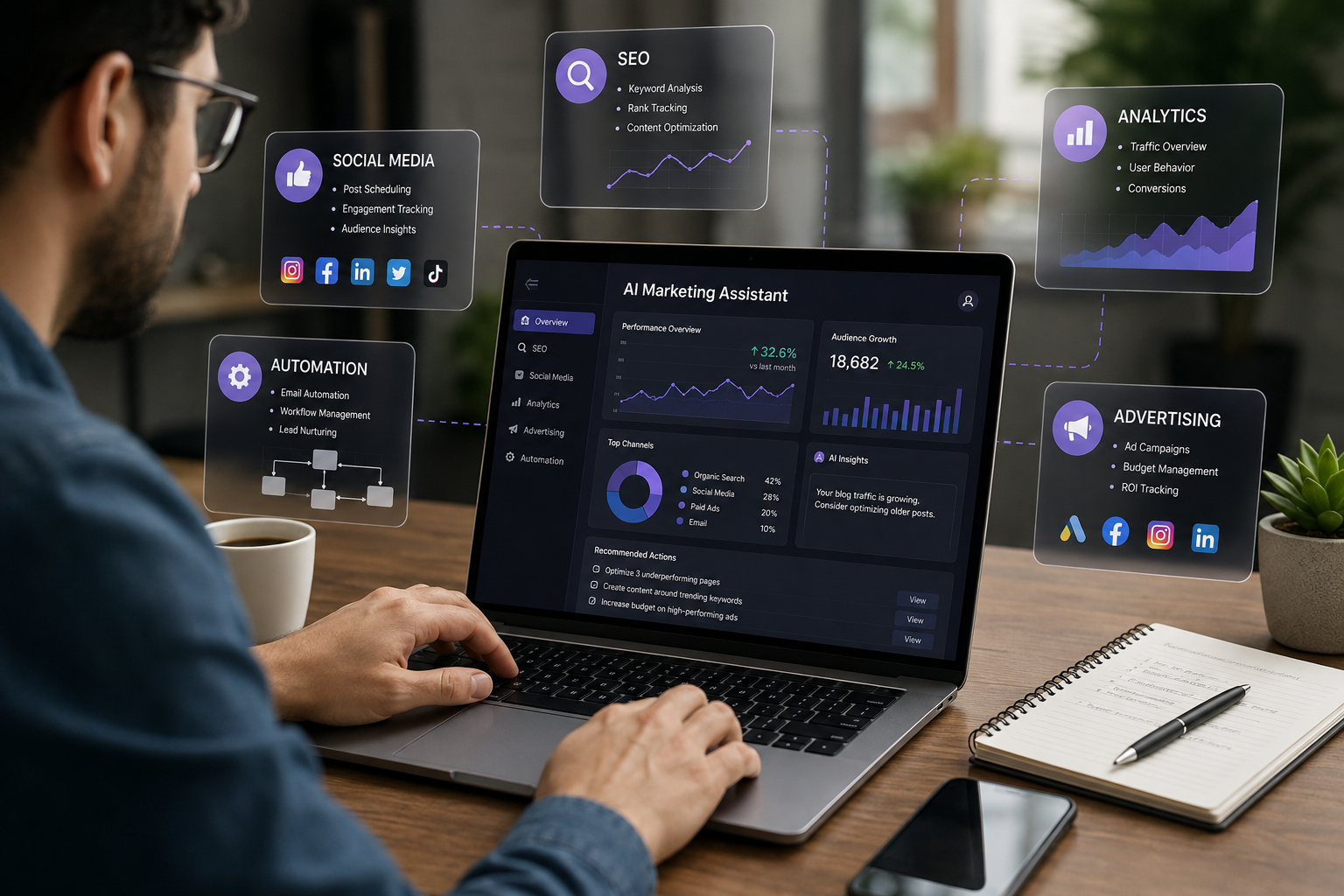
Concept: A realistic modern marketing workspace showing a laptop/dashboard with AI analytics, SEO data, social media icons, advertising metrics, and a human marketer reviewing the results.
Short label: AI + Digital Marketing
Filename: ai-tools-digital-marketing-2026.jpg
ALT text: AI tools for digital marketing in 2026
Image 2 — AI for SEO Section
Concept: A realistic SEO dashboard showing keyword research, search intent, content optimization, ranking analysis, and a marketer reviewing insights.
Short label: AI for SEO
Filename: ai-for-seo-digital-marketing.jpg
ALT text: AI for SEO keyword research and content optimization
Image 3 — AI-Powered Advertising Section
Concept: Realistic digital advertising dashboard showing campaign performance, audience targeting, conversion data, budget allocation, and AI optimization.
Short label: AI-Powered Advertising
Filename: ai-powered-digital-advertising.jpg
ALT text: AI-powered digital advertising campaign optimization
Image 4 — AI + Human Expertise Section
Concept: A realistic professional scene showing a digital marketer working alongside an AI analytics interface, visually communicating collaboration rather than replacement.
Short label: AI + Human Expertise
Filename: ai-human-digital-marketing-expertise.jpg
ALT text: AI and human expertise in digital marketing
Featured Image Concept
Create a modern, realistic, professional featured image that visually communicates:
AI + Digital Marketing + 2026
Show a digital marketer working at a laptop with a sophisticated but believable AI-powered marketing dashboard. Include subtle visual elements representing SEO, analytics, social media, advertising, automation, and content.
Keep the composition clean and premium, suitable for a professional digital marketing agency website.
Text on image:
AI + Digital Marketing 2026
Keep the text minimal and prominent without overcrowding the image.
FAQs
1. How is AI changing digital marketing in 2026?
AI is making digital marketing faster and more data-driven by assisting with SEO research, content creation, advertising, personalization, automation, analytics, and customer interactions. It is increasingly being used to support marketers rather than completely replace them.
2. What are the best AI tools for digital marketing?
There is no single best AI marketing tool for every business. The right tool depends on the task. Businesses can choose from AI tools for SEO, content, design, analytics, social media, advertising, automation, and customer support.
3. Can AI replace digital marketers?
AI can automate and assist with many marketing tasks, but it does not replace the need for human strategy, creativity, critical thinking, brand understanding, and decision-making. The strongest approach is generally AI combined with human expertise.
4. How is AI used in SEO?
AI can assist with keyword research, search-intent analysis, topic discovery, competitor research, content briefs, and content optimization. However, marketers still need to create useful, original content and make strategic SEO decisions.
5. Can AI-generated content rank on Google?
AI-assisted content can appear in Google Search, but simply using AI does not guarantee rankings. Google emphasizes helpful, reliable, people-first content and warns against producing large amounts of low-value content primarily to manipulate search rankings.
6. How can small businesses use AI for marketing?
Small businesses can start with repetitive tasks such as content ideation, social media assistance, basic reporting, customer FAQs, email drafting, and marketing research. They should introduce AI gradually and review its output before using it publicly.
7. What are the benefits of AI in digital marketing?
AI can save time, improve productivity, process large amounts of data, support personalization, automate repetitive tasks, assist decision-making, and help marketing teams scale certain activities more efficiently.
8. What is the future of AI in digital marketing?
AI is likely to become increasingly integrated into SEO, advertising, personalization, analytics, automation, content workflows, and conversational marketing. Human strategy and judgment will remain important because technology alone cannot determine what is right for every brand and audience.
Final CTA for DigiPromoters
Ready to make your digital marketing more efficient?
AI is changing how businesses approach SEO, content, social media, advertising, and customer engagement. DigiPromoters can help you combine modern digital marketing strategies with the right technology to build a stronger and more effective online presence.
Explore DigiPromoters’ digital marketing services and discover how AI-powered marketing can support your business goals.