




SEO Metadata
| Field | Details |
| Category | Digital Marketing / SEO |
| Target Keyword | how long does SEO take to show results |
| Search Intent | Informational |
| Secondary Keywords | SEO results timeline, how long does SEO take, SEO ranking timeline, SEO results in 3 months, Google ranking after SEO, organic traffic growth, SEO for new websites, SEO performance, SEO ranking factors |
| Meta Description | How long does SEO take to show results? Learn the realistic SEO timeline, ranking factors, traffic milestones, and what businesses can do to grow faster. |
| Suggested URL Slug | /how-long-does-seo-take-to-show-results/ |
How Long Does SEO Take to Show Results?
Short answer: SEO usually takes 3–6 months to produce meaningful results, although some improvements can appear within the first few weeks. New websites, highly competitive industries, and difficult keywords may need 6–12 months or longer. The timeline depends on technical SEO, content quality, search intent, competition, backlinks, website authority, and how consistently SEO work is implemented.
If you are investing in SEO, one of the first questions you are likely to ask is: how long does SEO take to show results?
The honest answer is that there is no fixed number of days or months.
SEO is different from paid advertising. You cannot simply turn on a campaign and expect immediate organic rankings. Search engines need time to crawl and index pages, understand their content, evaluate relevance, and compare them with competing websites.
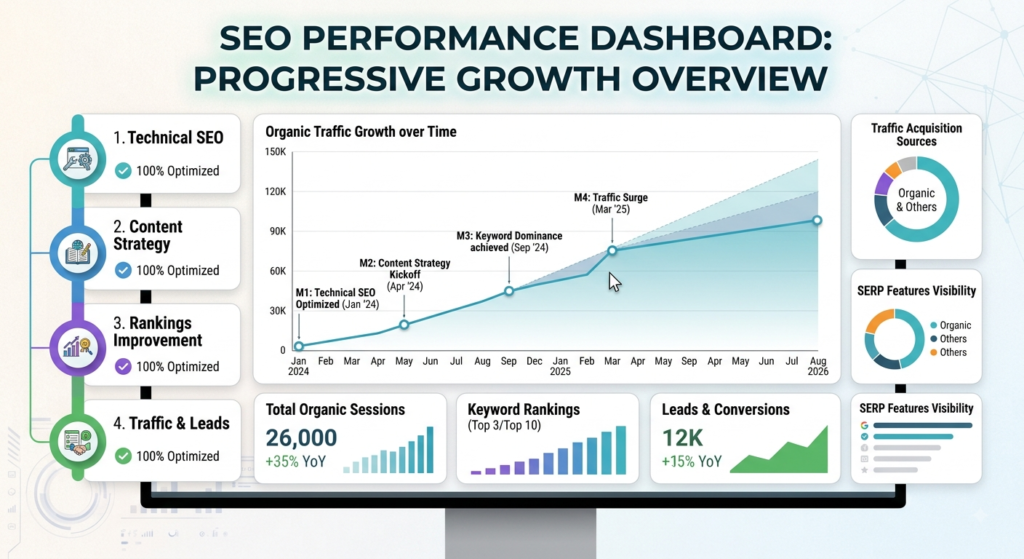
For many businesses, 3–6 months is a realistic timeframe for noticeable SEO progress, while stronger rankings, consistent organic traffic growth, and lead generation can take 6–12 months or longer.
The exact timeline depends on your website’s current condition, competition, content quality, domain authority, technical SEO, backlinks, and the keywords you are targeting.
The short answer: Most SEO results take 3–6 months
There is no universal SEO ranking timeline that applies to every website.
An established website with good technical health, useful content, existing authority, and achievable keywords may see improvements sooner. A brand-new website competing against established competitors will usually take longer.
It is also important to understand what “SEO results” actually means.
SEO progress does not always mean reaching position #1 immediately. Early indicators can include:
- More pages being indexed
- Increased search impressions
- Improvements in keyword rankings
- Higher organic click-through rates
- Growth in organic traffic
- More visitors reaching important service pages
- More enquiries, calls, bookings, or sales
This is why SEO should be evaluated using multiple performance indicators instead of focusing on one keyword position.
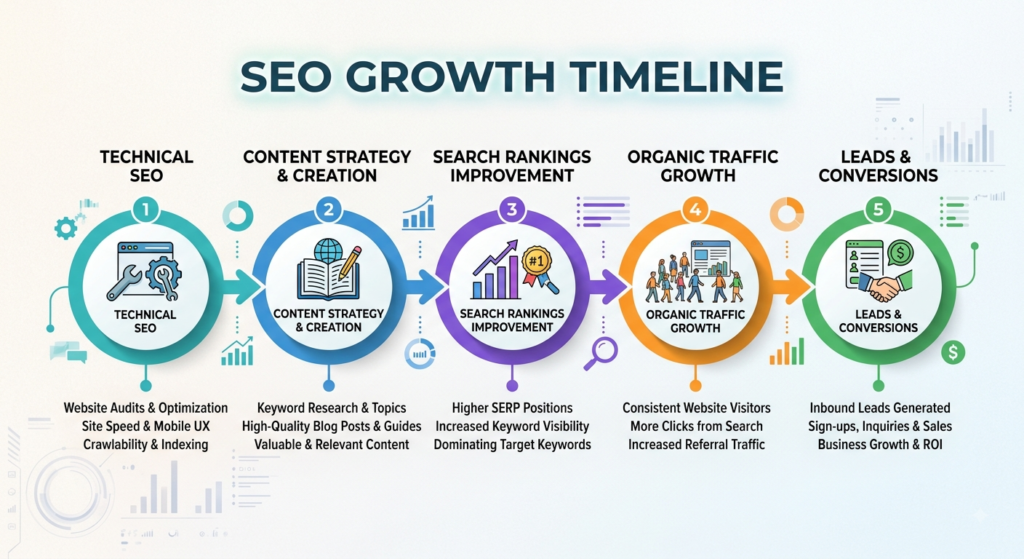
A realistic SEO timeline
| Timeline | What usually happens |
| Month 1 | Technical fixes, indexing, keyword research |
| Months 2–3 | Content publication and early ranking movement |
| Months 4–6 | Organic traffic growth and keyword improvements |
| Months 6–12 | Stronger rankings, authority, and lead generation |
These are realistic planning ranges, not guarantees.
For example, a local business targeting a specific city may see useful results sooner than a national company competing for broad, highly competitive keywords.
Your starting point matters.
What happens during the first 30 days of SEO?
The first month is mainly about building a strong foundation. A professional SEO campaign starts by identifying technical problems, keyword opportunities, competitors, and pages that need improvement.
Technical SEO
Technical SEO helps search engines crawl, understand, and index your website efficiently.
An initial audit may check:
- Crawlability and indexability
- Broken links and redirects
- XML sitemap
- Robots.txt
- Canonical URLs
- Mobile usability
- Page speed
- Core Web Vitals
- Website architecture
- HTTPS and security
Fixing technical problems early prevents avoidable issues from affecting future SEO performance.
Indexing
Before a page can compete in Google Search, search engines need to discover and process it.
Google Search Console can help identify indexing problems and show whether important pages are appearing in Google’s index.
Keyword research
Keyword research goes beyond finding terms with high search volume.
A good strategy considers:
- Search intent
- Competition
- Search volume
- Business relevance
- Commercial value
- Keyword difficulty
- Related searches and topics
The goal is to target searches that can realistically be won and can bring valuable visitors.
Competitor analysis
Competitor analysis reveals which pages are already ranking, what topics they cover, what search intent they satisfy, and where content gaps exist.
On-page SEO
Existing pages can then be improved through:
- Title tags
- H1 and H2 headings
- Meta descriptions
- Content structure
- Internal links
- Image alt text
- Keyword relevance
- Search intent alignment
- Calls to action
What happens in months 2–3?
Once the foundation is in place, the focus generally shifts toward creating and improving useful content.
Content publishing
Businesses can create service pages, landing pages, location pages, and blog content around topics their audience actually searches for.
The goal should not be publishing as many articles as possible.
Quality, relevance, originality, and usefulness matter more than simply hitting a publishing target.
Internal linking
Internal links connect related pages across your website.
For example, this article could naturally link to a relevant SEO Services page.
Internal linking helps users discover useful information and gives search engines more context about the relationship between pages.
Search intent optimization
Search intent is one of the most important parts of SEO.
Someone searching for:
“how long does SEO take?”
is looking for an explanation, timeline, expectations, and factors affecting results.
Someone searching for:
“SEO agency near me”
has a commercial intent and may be looking for an agency.
A page needs to satisfy the reason behind the search, not simply contain the keyword.
Initial ranking movement
During months 2–3, some pages may begin showing ranking movement.
A keyword moving from position 60 to position 35 may not look dramatic, but it can indicate that Google is beginning to understand and evaluate the page.
Small improvements can become significant when they continue consistently.
What happens in months 4–6?
With consistent SEO work, months 4–6 can be when progress becomes more visible.
Authority building
Authority can grow through genuinely useful content, relevant mentions, industry resources, digital PR, partnerships, and other legitimate methods.
Backlinks
Backlinks are links from other websites to your website.
Relevant and trustworthy backlinks can support website authority and visibility. However, backlinks are not a shortcut to instant rankings.
Buying large quantities of irrelevant or low-quality links is not a sustainable strategy.
Topical relevance
Creating connected content around important subjects can strengthen topical relevance.
For a digital marketing agency, this might include related content about:
- SEO
- Technical SEO
- Local SEO
- Content marketing
- Google Ads
- Performance marketing
- AEO
- GEO
These pages can support one another through internal linking and a clear website structure.
Organic traffic growth
At this stage, monitor whether relevant organic traffic is increasing.
Google Analytics can help determine where organic visitors come from and what they do after arriving on the website.
Lead generation
Traffic is not the final goal for most businesses.
The real question is:
Are SEO visitors becoming customers?
Track actions such as:
- Contact form submissions
- Phone calls
- Bookings
- Purchases
- Demo requests
- Enquiries
Why SEO takes time
SEO takes time because search engines need to discover, process, understand, and evaluate websites in a highly competitive environment.
Google crawling
Google must discover your pages before it can evaluate them. Internal links, XML sitemaps, website architecture, and crawlability can influence how efficiently important pages are discovered.
Indexing
Crawling does not automatically mean ranking.
A page may be discovered but still require further processing before it can compete for relevant searches.
Competition
You are competing with other websites targeting the same audience and keywords.
Established competitors may have years of content, backlinks, brand recognition, and domain authority.
Content quality
Publishing content does not guarantee rankings.
Content should provide useful information, demonstrate expertise, answer the searcher’s question, and offer genuine value.
Search intent
A technically optimized page can still perform poorly if it does not match what users actually want.
Backlinks and authority
Relevant backlinks can contribute to authority, but building a trustworthy website takes time.
Technical SEO
Problems such as poor site architecture, indexing issues, broken pages, slow performance, or mobile usability problems can limit SEO progress.
Factors that can speed up SEO results
An SEO campaign may progress more efficiently when a website has:
- A technically healthy foundation
- Clear website architecture
- Realistic keyword targeting
- Strong search intent alignment
- High-quality, original content
- Consistent publishing
- Strong internal linking
- Existing domain authority
- Relevant and trustworthy backlinks
- Strong local SEO signals for local businesses
- Fast correction of technical problems
- Conversion-focused landing pages
- Regular SEO monitoring and optimization
The goal is not to find an SEO shortcut.
The goal is to consistently improve the factors that influence organic visibility.
Factors that can delay SEO results
SEO can take longer when a website has:
- A brand-new domain with little authority
- Highly competitive target keywords
- Thin or duplicated content
- Poor search intent alignment
- Technical SEO problems
- Weak internal linking
- Poor mobile experience
- Slow-loading pages
- Few relevant backlinks
- An inconsistent publishing schedule
- Frequent website redesigns or migrations
- Poor conversion optimization
- Unrealistic ranking expectations
For example, a new local business may struggle to rank immediately for a broad keyword such as “digital marketing.”
A more focused search such as “digital marketing agency in Noida” may provide a more realistic opportunity, depending on local competition and search demand.
Common SEO mistakes that slow rankings
1. Expecting page-one rankings immediately
SEO does not work on a fixed 30-day guarantee.
A business that expects every keyword to reach page one within one month may abandon its campaign before meaningful progress has a chance to develop.
2. Publishing without understanding search intent
Imagine someone searches for “SEO services for small businesses.”
If your page only defines SEO but does not explain how SEO services can help small businesses, it may not satisfy the searcher’s intent.
3. Keyword stuffing
Repeating the same keyword unnaturally does not make a page more relevant.
Modern SEO should focus on topics, context, related entities, and usefulness.
4. Ignoring existing pages
Some businesses constantly publish new blogs while their important service pages remain poorly optimized.
Improving pages that already receive impressions can sometimes produce better results than publishing another completely new article.
5. Buying low-quality backlinks
Large quantities of irrelevant backlinks do not automatically create authority.
Relevant, trustworthy links are much more valuable.
6. Measuring only rankings
Rankings are useful, but they are not the whole picture.
A keyword moving from position 50 to position 20, impressions increasing, and qualified organic leads rising can represent meaningful SEO progress even before reaching the top three results.
How to track SEO progress properly
A professional SEO campaign should use multiple metrics.
Google Search Console
Monitor:
- Search queries
- Impressions
- Clicks
- Average position
- Click-through rate
- Indexing issues
- Search performance by page
Google Analytics
Use it to understand:
- Organic traffic
- User engagement
- Landing pages
- Conversions
- Traffic quality
- User journeys
Keyword rankings
Track priority keywords along with related variations.
Do not focus on one “money keyword.” A strong page can rank for hundreds of related searches.
Organic traffic
Look for growth in relevant organic visitors over time.
Qualified traffic is more valuable than empty traffic numbers.
Click-through rate
If a page receives many impressions but few clicks, improving its title and meta description may increase CTR.
Conversions
Ultimately, connect SEO to business outcomes:
Visibility → Traffic → Engagement → Leads → Revenue
This provides a much clearer picture of SEO performance than rankings alone.
Final thoughts
So, how long does SEO take to show results?
For many businesses, 3–6 months is a realistic timeframe for meaningful SEO progress, while stronger rankings, authority, organic traffic growth, and lead generation may take 6–12 months or longer.
The exact SEO results timeline depends on your starting point, competition, technical SEO, content quality, search intent, backlinks, domain authority, and consistency.
The biggest mistake is treating SEO as a one-time task.
SEO is an ongoing process of research, optimization, content creation, measurement, and improvement.
Instead of asking only, “When will I reach 1?”, ask:
- Are my important pages being indexed?
- Are my rankings improving?
- Are impressions and clicks increasing?
- Is organic traffic becoming more qualified?
- Are visitors converting into leads?
- Is my website becoming more authoritative?
These questions provide a much more accurate picture of SEO performance.
Want faster SEO growth? The team at Digipromoters can help you build a long-term SEO strategy that improves rankings, traffic, and leads.
Frequently Asked Questions
How long does SEO take for a new website?
For a new website, SEO often takes around 3–6 months to produce noticeable movement, while competitive markets may require 6–12 months or longer. A new domain has little existing authority and must first be crawled, indexed, and evaluated. Strong technical SEO, useful content, realistic keyword targeting, and consistent publishing can improve the chances of earlier progress.
Can SEO work in one month?
Yes, SEO can produce early improvements within one month, especially when fixing technical problems, improving existing pages, or targeting low-competition searches. However, one month is usually too soon to judge the full potential of an SEO campaign. Early gains may appear as improved indexing, impressions, clicks, or small ranking movements rather than major traffic growth.
Why is my website not ranking after 3 months?
A website may still be struggling after three months because of strong competition, weak search intent alignment, technical SEO problems, insufficient content depth, poor internal linking, limited authority, or targeting keywords that are too difficult. Review Google Search Console, crawling and indexing, page quality, competitor content, and your keyword strategy before assuming SEO is failing.
Does local SEO work faster?
Local SEO can sometimes produce results faster than broad national SEO because the target area and search intent are more specific. A well-optimized Google Business Profile, consistent business information, strong local pages, reviews, and relevant local signals can help. However, speed still depends on competition, location, website quality, authority, and how established the business is.
How many blog posts do I need for SEO?
There is no fixed number of blog posts that guarantees rankings. One highly useful page can outperform dozens of weak articles. The better approach is to create content around valuable topics and related questions that match search intent. Building a connected group of authoritative pages around important subjects is generally more effective than simply chasing a publishing quota.
Can backlinks speed up SEO?
Relevant, trustworthy backlinks can support SEO by strengthening website authority and helping search engines discover important pages. They are not an instant ranking shortcut, however. Buying large quantities of low-quality links can create risk and rarely replaces strong content and technical SEO. The goal should be earning relevant links from credible sources because the content is genuinely worth referencing.
How long does Google take to index a page?
Google can discover and index a page within days, but there is no guaranteed indexing time. Some pages are processed quickly, while others take longer depending on crawl availability, site quality, internal links, technical signals, and overall website importance. Google Search Console can be used to inspect indexing status and request crawling for eligible pages.
Is SEO faster than Google Ads?
Google Ads can generate visibility and clicks as soon as campaigns are approved and launched, so it is usually faster for immediate traffic. SEO takes longer because rankings are earned over time. The two channels serve different purposes: paid search can support short-term demand, while SEO can build sustainable organic visibility that continues generating traffic without paying for every click.
Does technical SEO affect ranking speed?
Yes. Technical SEO can affect how efficiently search engines crawl, understand, and index a website. Problems such as blocked pages, broken links, poor mobile usability, incorrect canonicals, slow performance, or weak site architecture can delay or limit SEO progress. Fixing technical barriers early gives quality content a better chance to be discovered, indexed, and evaluated properly.
What is the fastest way to improve SEO?
The fastest practical approach is to fix high-impact technical issues, improve pages that already receive impressions, match content closely to search intent, strengthen internal links, and target achievable keywords. For local businesses, improving local SEO can also help. Avoid shortcuts such as keyword stuffing or mass low-quality backlinks. Sustainable SEO improvements come from prioritizing changes that help both users and search engines.
Internal Linking Suggestions
Use these links naturally within the article:
- Why Is My Website Not Ranking on Google?
- SEO Services
- Local SEO Services
- Google Ads vs SEO
- Technical SEO Guide
Recommended placement
Technical SEO section: Link to Technical SEO Guide
Local SEO section: Link to Local SEO Services
SEO strategy/service discussion: Link to SEO Services
Paid search comparison: Link to Google Ads vs SEO
Ranking problems section: Link to Why Is My Website Not Ranking on Google?
Final Pre-Publishing Checklist
- Add the featured image.
- Add the second relevant image.
- Add descriptive ALT text to both images.
- Apply H1, H2, and H3 heading structure.
- Add the actual Digipromoters internal-link URLs.
- Verify the title tag and meta description in the CMS/SEO plugin.
- Confirm the URL slug.
- Ensure the page is indexable.
- Add FAQ structured data if appropriate.
- Check mobile formatting and page speed.
- Verify Core Web Vitals.
- Connect Google Search Console and Google Analytics tracking.
- Confirm conversion tracking for leads.
- Proofread the final article.
- Review the CTA and contact/lead destination.
- Submit the URL for indexing after publishing, where appropriate.