



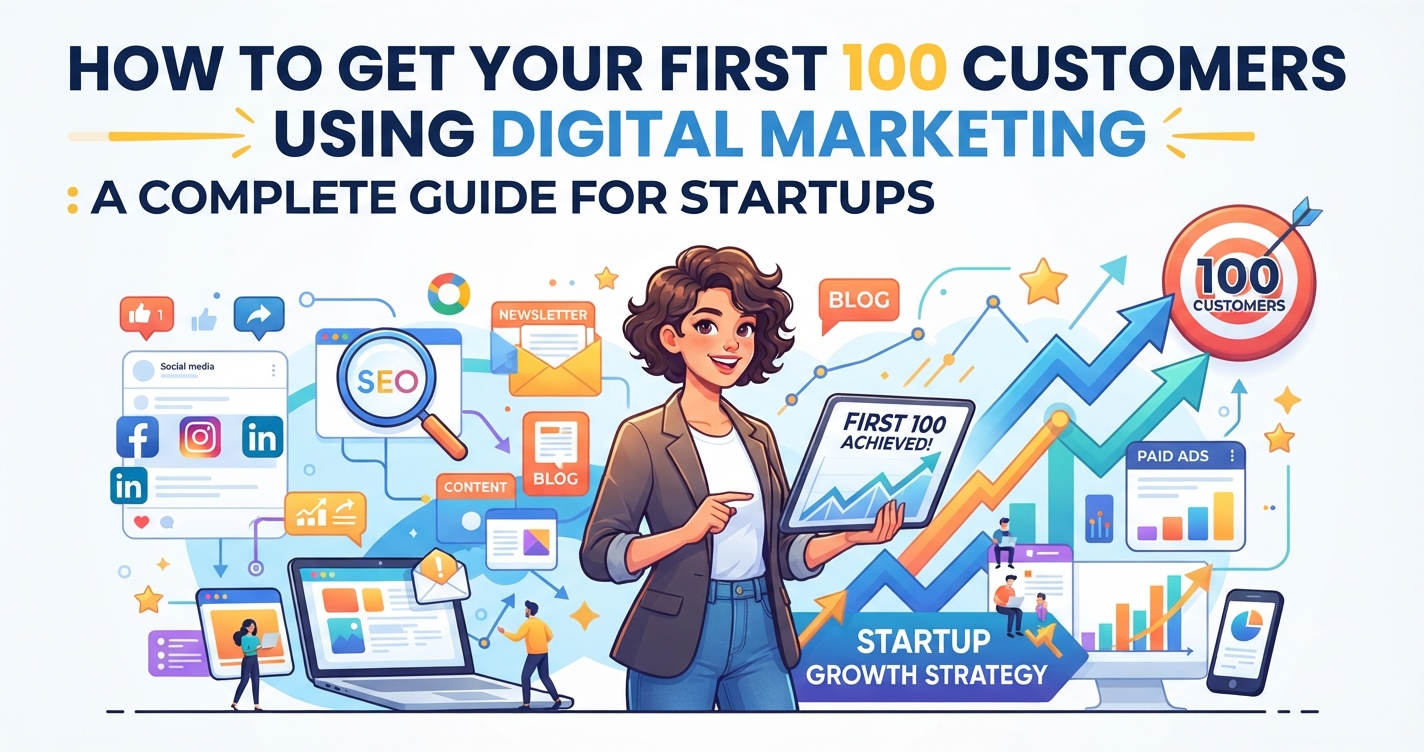
Getting your first 100 customers is one of the biggest milestones for any new business. You may have an excellent product, a valuable service, and a strong business idea, but without the right marketing strategy, reaching potential customers can be challenging.
The good news is that you do not need a massive advertising budget to start attracting customers. With the right combination of search engine optimization (SEO), content marketing, social media, paid advertising, and lead generation, you can build awareness, earn trust, and turn interested people into paying customers.
In this guide, Digipromoters explains how to get your first 100 customers using digital marketing, with practical strategies that startups, entrepreneurs, and small business owners can begin implementing today.
Table of Contents
- Understand Your Target Audience
- Define Your Unique Selling Proposition
- Build a Conversion-Focused Website
- Optimize Your Website for SEO
- Use Content Marketing to Attract Customers
- Leverage Social Media Marketing
- Use Google Business Profile and Local SEO
- Run Targeted Paid Advertising Campaigns
- Build an Email Marketing Strategy
- Encourage Referrals and Customer Reviews
- Participate in Online Communities and Partnerships
- Track Results and Improve Your Campaigns
- Your 30-Day Digital Marketing Action Plan
- Common Digital Marketing Mistakes to Avoid
- How Digipromoters Can Help
- Frequently Asked Questions
1. Understand Your Target Audience
Before spending money on advertising or creating content, understand who your ideal customers are. Marketing becomes more effective when you know the people you want to reach, the problems they experience, and the solutions they are searching for.
Start by answering these questions:
- Who is most likely to purchase your product or service?
- What problems are they trying to solve?
- What is their approximate budget?
- Which social media platforms do they use?
- What questions do they ask before making a purchase?
- What factors influence their buying decisions?
Create a simple customer persona that includes their age range, location, interests, needs, challenges, and purchasing behaviour.
For example, if you own a digital marketing agency, your target customers might include local businesses, e-commerce brands, startups, and service providers that want more website traffic and qualified enquiries.
You can research your audience by interviewing existing customers, reading online reviews, studying competitor websites, exploring relevant community discussions, and using keyword research tools.
Actionable tip: Choose one specific customer segment to target first. A focused campaign for independent retailers, for example, will usually be easier to plan and evaluate than a campaign aimed at every type of business.
2. Define Your Unique Selling Proposition (USP)
Your unique selling proposition explains why customers should choose your business instead of a competitor.
Customers often compare several businesses before making a decision. If your message is too general, they may struggle to understand what makes your offer valuable.
To develop your USP, identify:
- Your audience: Who do you serve?
- Their problem: What challenge do you solve?
- Your solution: How does your product or service help?
- Your difference: What makes your approach distinctive?
- Your evidence: What genuine experience, expertise, or customer feedback supports your claims?
For example, instead of saying, “We provide digital marketing services,” a more specific message could be, “We help small businesses improve their online visibility and generate qualified leads through SEO, content marketing, and targeted advertising.”
This communicates a clearer benefit and helps potential customers understand your value.
Use your USP consistently across your homepage, landing pages, social media profiles, advertisements, and sales conversations.
3. Build a Conversion-Focused Website
Your website often serves as the first point of contact between your business and potential customers. It should explain your offer clearly and make it easy for visitors to take the next step.
A visually attractive website is useful, but it must also support conversions.
Essential website elements
- Clear messaging: Explain what you offer, whom you serve, and how customers benefit.
- Mobile responsiveness: Ensure your website works properly on smartphones and tablets.
- Fast loading: Optimize images, scripts, and other elements that affect page performance.
- Strong calls to action: Use clear options such as “Get a Quote,” “Book a Consultation,” or “Shop Now.”
- Trust signals: Display genuine testimonials, relevant credentials, contact information, and clear business policies.
- Dedicated landing pages: Create pages that match the specific service, product, or campaign being promoted.
- Simple enquiry forms: Request only the information you need to start a conversation.
Imagine you run a home interior design business. A dedicated landing page featuring your services, project photographs, service area, and consultation form gives potential customers a direct path to enquire.
Track important actions, including form submissions, phone calls, purchases, and consultation bookings. This helps you identify whether your website is turning visitors into leads and customers.
4. Optimize Your Website for SEO
Search engine optimization is an important long-term customer acquisition strategy. It helps your website appear in relevant search results when potential customers look for products, services, and solutions you provide.
For startups with limited budgets, SEO can help build sustainable visibility without requiring payment for every website visit.
Conduct keyword research
Identify the search terms your potential customers use.
For example, a digital marketing agency might target relevant phrases such as:
- Digital marketing agency for small businesses
- SEO services for startups
- Affordable digital marketing services
- Lead generation services for businesses
- Digital marketing agency in Greater Noida
Choose keywords that match your services, audience, and location. Consider search intent as well: someone searching for “what is SEO” may want information, while someone searching for “SEO agency for my business” may be closer to hiring a service provider.
Improve on-page SEO
Optimize your important website pages by including:
- Descriptive page titles and meta descriptions.
- Clear headings that organize information.
- Relevant keywords used naturally.
- Helpful, original content that answers customer questions.
- Descriptive image alt text.
- Internal links connecting related pages.
- Clear navigation and readable URLs.
Focus on technical SEO
Make sure search engines can access and understand your website. Review mobile usability, indexing, broken links, redirects, XML sitemaps, and page performance.
Tools such as Google Search Console can help you monitor search impressions, clicks, indexing issues, and the queries that bring visitors to your site.
Remember that SEO takes time, and results depend on competition, website quality, relevance, and many other factors. Avoid anyone promising guaranteed rankings.
5. Use Content Marketing to Attract Customers
Content marketing allows you to demonstrate expertise, answer questions, and build relationships with potential customers before asking them to purchase.
Instead of publishing content only to promote your business, create material that helps your audience make informed decisions.
Content ideas for new businesses
- Blog posts answering common customer questions.
- Step-by-step tutorials and practical guides.
- Short educational videos and demonstrations.
- Case studies based on real customer projects.
- Frequently asked questions about your services.
- Product comparisons and buying guides.
- Checklists, templates, and downloadable resources.
For example, a digital marketing agency can publish articles about local SEO, social media marketing, website optimization, and lead generation. These topics can attract business owners who are researching ways to grow online.
Each piece of content should have a clear purpose. An educational article might encourage readers to explore a related service page, while a downloadable checklist could invite them to join your email list.
Actionable tip: Start with one useful blog post each week and repurpose its key ideas into social media posts, short videos, and email newsletters. This creates a consistent content system without requiring completely new ideas for every channel.
6. Leverage Social Media Marketing
Social media helps new businesses reach relevant audiences, communicate their value, and build familiarity with potential customers.
However, you do not need to be active on every platform. Choose channels based on where your target audience spends time and what type of content works best for your business.
For example:
- Instagram: Visual products, lifestyle brands, local businesses, and short-form videos.
- Facebook: Local communities, business updates, customer engagement, and selected advertising campaigns.
- LinkedIn: B2B services, professional networking, industry insights, and business decision-makers.
- YouTube: Tutorials, product demonstrations, educational videos, and detailed explanations.
How to turn social media engagement into customers
- Optimize your profile with a clear description, contact details, and relevant links.
- Publish educational, entertaining, and product-focused content consistently.
- Answer comments and direct messages promptly.
- Share genuine customer feedback and behind-the-scenes content.
- Use clear calls to action that encourage enquiries or purchases.
- Review which posts generate meaningful conversations, website visits, and leads.
For instance, a bakery can share product videos, customer celebrations, seasonal offers, and ordering instructions. A consulting business might publish expert tips, common mistakes, and practical advice.
The goal is not simply to collect followers. It is to build relationships with people who are likely to become customers.
7. Use Google Business Profile and Local SEO
If your business serves a specific geographical area, local SEO can help nearby customers discover you when searching for relevant products or services.
An eligible business can create a Google Business Profile to manage its presence across Google Search and Maps.
To improve your local visibility:
- Use your real business name and accurate contact information.
- Select the most relevant business categories.
- Add complete, accurate business hours.
- Describe your services clearly.
- Upload genuine photographs of your business, team, products, or work.
- Keep your profile updated.
- Encourage satisfied customers to leave honest reviews.
- Respond professionally to reviews and customer questions.
For example, a service provider targeting Greater Noida could create relevant website pages describing its services and the areas it genuinely serves.
Local SEO works best when your business information is consistent and your website supports the services listed on your profile.
Do not create fake locations, purchase reviews, or stuff business descriptions with repetitive keywords. These practices can damage customer trust and put your online presence at risk.
8. Run Targeted Paid Advertising Campaigns
Paid advertising can help you reach potential customers while your organic marketing efforts develop. However, advertising should begin with a clear objective and a way to measure results.
Two common options are Google Ads and Meta Ads.
Google Ads can help businesses reach people searching for relevant products or services. Meta Ads can help businesses reach selected audiences across Facebook and Instagram placements.
How to start advertising with a limited budget
- Choose one product, service, or offer to promote.
- Define the audience and geographical area.
- Select an appropriate campaign objective.
- Create a clear advertisement with a relevant call to action.
- Send visitors to a dedicated landing page.
- Configure conversion tracking before scaling spending.
- Test different messages, creatives, or audience approaches.
- Review lead quality and actual sales, not just clicks.
For example, a business offering website development could test a Google Search campaign targeting relevant service searches. An online clothing store could test Meta Ads featuring specific products and a direct shopping link.
Start with a budget your business can afford to test. Advertising platforms may generate clicks or enquiries, but these do not automatically translate into profitable customers.
Evaluate the cost of acquiring a customer and the revenue or profit that customer generates before increasing your budget.
9. Build an Email Marketing Strategy
Not every potential customer is ready to purchase immediately. Some need more information, time to compare options, or reassurance before making a decision. Email marketing helps you maintain contact with interested prospects and guide them toward the next step.
Build your email list
Offer something useful in exchange for a voluntary email subscription, such as:
- A free industry checklist.
- A practical e-book or guide.
- A product buying guide.
- A free consultation or introductory session.
- Access to useful tips and educational resources.
Once people subscribe, send relevant emails that address their needs.
A simple welcome sequence might include:
- Welcome email: Deliver the promised resource and introduce your business.
- Educational email: Share advice that helps subscribers solve a common problem.
- Trust-building email: Explain your approach and provide genuine examples of your work.
- Offer email: Invite subscribers to book a consultation, request a quote, or explore a product.
For example, a digital marketing agency could offer a free website SEO checklist and follow up with practical advice about keyword research, technical SEO, and lead generation.
Personalize your messages where useful, make unsubscribing easy, and obtain consent in accordance with applicable privacy and marketing requirements. Avoid purchasing email lists or sending unsolicited bulk messages.
10. Encourage Referrals and Customer Testimonials
Your first customers can help you reach additional customers through recommendations and positive experiences.
Referral marketing works by encouraging satisfied customers to introduce your business to people who may benefit from your products or services.
You can support referrals by:
- Providing excellent customer service.
- Asking satisfied customers to recommend your business.
- Creating a simple referral programme.
- Offering a reasonable incentive where appropriate.
- Requesting honest reviews after a completed purchase or project.
- Sharing customer stories with their permission.
For example, a web design company might invite a satisfied client to refer another business that needs a website. If the company offers a referral reward, it should explain the conditions clearly.
Testimonials can also reduce uncertainty for potential customers. Use genuine feedback that reflects actual customer experiences, and obtain permission before publishing names, photographs, or detailed project information.
Do not purchase fake reviews or offer incentives in exchange for positive reviews on platforms where such incentives are prohibited.
Actionable tip: After successfully completing a project, ask the customer about their experience, request honest feedback, and invite them to recommend your business if they are satisfied.
11. Participate in Online Communities and Build Partnerships
Your potential customers may already be participating in industry groups, local business communities, professional networks, and online discussion forums.
Engaging in these communities can help you establish credibility and develop relationships without relying entirely on paid advertising.
Start by identifying communities relevant to your target audience. Then:
- Answer questions with practical, useful information.
- Share relevant resources when community rules allow.
- Participate in discussions without repeatedly promoting your services.
- Connect with complementary businesses.
- Attend suitable local events, webinars, and networking sessions.
- Explore partnerships that offer value to both audiences.
For example, a digital marketing agency could collaborate with a website development company that does not provide SEO services. Both businesses may be able to refer suitable clients to one another.
Similarly, a fitness studio might partner with a local nutrition professional for an educational event.
The key is to build trust before asking for business. Useful participation and mutually beneficial partnerships can create opportunities for customer acquisition over time.
12. Track Results and Improve Your Campaigns
You cannot reliably improve your marketing strategy if you do not measure its performance.
Tracking helps you understand which channels attract qualified leads, which campaigns produce paying customers, and where your budget is being used effectively.
Monitor these key performance indicators (KPIs):
| Metric | What it tells you |
| Website traffic | How many people visit your website |
| Conversion rate | What percentage of visitors complete a desired action |
| Cost per lead (CPL) | How much you spend to generate a lead |
| Customer acquisition cost (CAC) | How much it costs to acquire a paying customer |
| Return on ad spend (ROAS) | How much attributed revenue advertising generates per unit of ad spend |
| Lead-to-customer rate | What percentage of leads become customers |
| Customer retention | How effectively your business keeps customers over time |
For example, suppose you spend ₹10,000 on a campaign and generate 50 leads. Your cost per lead is ₹200.
If five of those leads become customers, the campaign’s advertising spend per acquired customer is ₹2,000. This calculation excludes other expenses, such as agency fees, staff time, software, and fulfilment, so it is not necessarily your complete customer acquisition cost.
Use Google Analytics, Google Search Console, advertising dashboards, and a spreadsheet or CRM to track performance.
Review your results regularly. If a campaign produces many enquiries but few sales, investigate whether the audience is relevant, the offer is clear, and your follow-up process is effective.
13. Your 30-Day Digital Marketing Action Plan
Getting your first customers does not require launching every marketing channel at once. A focused 30-day plan can help you establish a foundation, test your messaging, and begin building a repeatable acquisition process.
Week 1: Research and preparation
Goal: Understand your audience and prepare your business for customer acquisition.
- Define your ideal customer and primary problem you solve.
- Research competitors and customer search behaviour.
- Write a clear USP and value proposition.
- Identify relevant keywords.
- Review your website, service pages, and contact forms.
- Set up basic analytics and conversion tracking.
Expected outcome: A clear target audience, a defined offer, and a website ready to receive potential customers.
Week 2: Build visibility and publish content
Goal: Help potential customers discover your business.
- Publish one or two useful, search-focused blog posts.
- Optimize important website pages.
- Set up or improve your eligible Google Business Profile.
- Publish several useful social media posts.
- Share educational content in relevant communities.
- Reach out to potential business partners.
Expected outcome: Improved marketing foundations and an initial collection of helpful content.
Week 3: Generate leads and start conversations
Goal: Turn visibility into enquiries.
- Create a dedicated landing page for your main offer.
- Launch a small paid advertising test if your budget allows.
- Create a relevant downloadable resource or introductory offer.
- Start collecting consent-based email subscriptions.
- Contact suitable prospects through appropriate, personalized channels.
- Follow up with people who have expressed interest.
Expected outcome: Initial campaign data, customer conversations, and opportunities to generate qualified leads.
Week 4: Analyze, improve, and build momentum
Goal: Identify what is working and focus on the strongest opportunities.
- Review website traffic, leads, and sales.
- Calculate your cost per lead and acquisition cost where possible.
- Identify the best-performing content and campaigns.
- Improve weak landing pages and calls to action.
- Ask satisfied customers for honest feedback or referrals.
- Plan the next month’s marketing activities around your findings.
Expected outcome: A more informed marketing strategy and a clear list of next steps.
How do you turn this plan into your first 100 customers?
Treat 100 customers as a measurable business goal rather than a guaranteed 30-day outcome.
Start by estimating how many leads you need. If 10% of qualified leads become paying customers, you would need approximately 1,000 qualified leads to acquire 100 customers at that conversion rate.
This is an illustrative calculation, not a universal benchmark. Your actual conversion rate will depend on your product, price, market, sales process, and lead quality.
Use your real results to update your estimates. If customer retention, repeat purchases, or referrals are important to your business, include them in your longer-term growth plan.
14. Common Digital Marketing Mistakes to Avoid
Even a promising business can struggle to attract customers when its marketing activities lack focus.
Avoid these common mistakes:
1. Targeting everyone: Trying to reach every possible customer makes your message less specific. Begin with a defined audience and expand as you learn.
2. Expecting instant SEO results: Organic search visibility usually requires ongoing work. Combine SEO with suitable short-term lead generation methods when appropriate.
3. Posting without a strategy: Publish content that answers real questions and supports a clear business objective instead of focusing only on posting frequency.
4. Ignoring your website’s conversion experience: Advertising cannot compensate for unclear messaging, broken forms, or a confusing buying process.
5. Spending without tracking: Measure leads and sales before increasing advertising budgets.
6. Failing to follow up: Interested prospects may need timely answers and reminders. Establish a consistent follow-up process that respects their preferences.
7. Buying followers or fake reviews: Artificial engagement does not establish genuine customer demand and can damage trust.
8. Using too many channels at once: Start with a manageable number of channels and prioritize the ones that best match your audience and budget.
The most effective approach is to test, measure, learn, and improve rather than assuming every marketing tactic will work equally well for every business.
15. How Digipromoters Can Help You Get Your First 100 Customers
Building a digital marketing strategy takes research, consistent execution, and careful measurement. For startups and small businesses with limited time or in-house expertise, working with a digital marketing agency can help bring these activities together.
Digipromoters helps businesses work toward stronger online visibility, more relevant website traffic, and better opportunities for lead generation through suitable digital marketing strategies.
Depending on your business goals, relevant services may include:
- Search Engine Optimization (SEO): Improve your website’s relevance, technical foundations, and visibility for appropriate search queries.
- Content Marketing: Develop useful blogs and website content that answer customer questions and support organic discovery.
- Social Media Marketing: Build brand awareness, publish relevant content, and engage with your target audience.
- Google Ads Management: Reach people searching for relevant products or services through targeted search campaigns.
- Meta Ads Management: Test advertising campaigns across suitable Facebook and Instagram placements.
- Local SEO: Help eligible local businesses improve their online presence for relevant local searches.
- Lead Generation: Develop landing pages, calls to action, and campaign strategies designed to encourage qualified enquiries.
The right strategy depends on your industry, target audience, competition, budget, and current online presence. Instead of applying the same approach to every business, start by identifying your most important customer acquisition challenge and selecting the marketing activities that address it.
Ready to attract your first customers and grow your business online?
Contact Digipromoters to discuss a digital marketing strategy tailored to your business goals. Start building a stronger online presence, reaching relevant audiences, and turning more opportunities into customer relationships.
16. Frequently Asked Questions
1. How can I get my first 100 customers using digital marketing?
Start by identifying your ideal customers and creating a clear offer. Build a conversion-focused website, optimize it for relevant searches, publish helpful content, and use appropriate social media or paid advertising channels. Track enquiries and sales, then improve the channels that generate qualified customers.
2. What is the best digital marketing strategy for a startup?
There is no single strategy that works best for every startup. SEO and content marketing can support long-term visibility, while paid advertising may help test demand and reach customers sooner. Social media, email marketing, and referrals can support trust and ongoing engagement. Choose based on your audience, budget, and goals.
3. How can I get customers online without spending a lot of money?
Begin with low-cost activities such as improving your existing website, publishing helpful content, optimizing an eligible Google Business Profile, participating in relevant communities, and requesting genuine customer referrals. These activities require time and consistency, and results are not guaranteed, but they can help establish a foundation before you invest in advertising.
4. How long does it take to get the first 100 customers?
The timeline varies depending on your industry, pricing, audience, offer, competition, and sales process. Some businesses may acquire early customers through existing networks or targeted campaigns, while others need more time to establish trust and visibility. Track your actual conversion rates and use them to develop realistic acquisition targets.
5. How much should a small business spend on digital marketing?
Your budget should reflect your business finances, customer acquisition targets, and ability to convert leads into profitable sales. Start with activities you can sustain, establish measurement, and test paid campaigns with an affordable amount. Include advertising, content creation, website improvements, tools, and other marketing expenses when evaluating the total cost.
6. Is SEO better than paid advertising for customer acquisition?
SEO can help generate relevant organic traffic over time, while paid advertising can provide more immediate opportunities to reach targeted audiences. SEO still requires investment, and paid advertising requires ongoing spending. Many businesses benefit from combining the two, depending on their goals and available resources.
7. How can I generate leads for a new business?
Create a clear service or product offer, develop a relevant landing page, and give visitors an easy way to enquire. Use search-focused content, social media, suitable paid campaigns, and professional networking to reach your audience. Follow up with interested prospects and track how many leads become paying customers.
8. Why should I hire a digital marketing agency?
A digital marketing agency can help you plan and execute marketing activities, improve your online presence, manage campaigns, and measure results. The value depends on the agency’s expertise, the fit of its services to your business, and the quality of execution. Discuss your goals, budget, reporting expectations, and measurement approach before choosing an agency.
Conclusion: Start Building Your First 100 Customers
Getting your first 100 customers is an important step in building a sustainable business. It requires more than simply publishing social media posts or running advertisements. You need to understand your audience, communicate a clear value proposition, establish trust, and make it easy for potential customers to take action.
Start with the essentials: build a useful website, invest in relevant SEO and content, select suitable marketing channels, follow up with interested prospects, and measure the results. Improve your strategy as you learn which activities attract customers and generate sustainable revenue.
You do not need to implement every strategy at once. Focus on the actions most likely to reach your target audience, test your assumptions, and build a repeatable process.
Ready to grow your business with digital marketing? Contact Digipromoters to explore SEO, social media marketing, paid advertising, content marketing, and lead generation solutions tailored to your goals.
Your first 100 customers can be the beginning of a stronger, more sustainable business.