





Introduction
Every business wants to grow, attract more customers, increase sales, and build a recognizable brand. However, wanting growth and having a clear plan to achieve it are two different things.
Many businesses invest in SEO, social media marketing, Google Ads, content creation, and other promotional activities without defining what success actually looks like. They publish content regularly, run campaigns, and monitor likes or website visits, but still struggle to understand whether their marketing efforts are contributing to business growth.
The solution starts with setting clear marketing goals.
SMART marketing goals help businesses turn broad ambitions into specific, measurable, and achievable objectives. Instead of simply trying to increase website traffic, a business can set a target for qualified organic traffic within a defined period. Instead of aiming for more leads, it can establish a measurable lead-generation target and track progress toward it.
For small businesses, startups, and established companies, this approach creates greater clarity, improves accountability, and helps marketing teams prioritize activities that matter.
In this guide, we will explain what SMART marketing goals are, how to create them, practical examples for different businesses, common mistakes to avoid, and how digital marketing can support measurable business growth.
Table of Contents
- What Are Marketing Goals?
- What Are SMART Marketing Goals?
- Why Are SMART Goals Important for Business Growth?
- How to Set SMART Marketing Goals in Seven Steps
- SMART Marketing Goals Examples for Different Businesses
- Marketing Goals vs. Marketing KPIs
- Common Marketing Goal-Setting Mistakes
- How Digital Marketing Helps Achieve SMART Goals
- Frequently Asked Questions
- Conclusion
1. What Are Marketing Goals?
Marketing goals are specific outcomes a business wants to achieve through its marketing activities within a particular period.
These goals connect marketing campaigns with wider business objectives, such as increasing revenue, generating qualified leads, improving brand awareness, or encouraging repeat purchases.
For example, a company might want to:
- Increase qualified website enquiries.
- Improve organic search visibility.
- Generate more sales from paid advertising.
- Grow its email subscriber base.
- Increase repeat purchases from existing customers.
- Improve conversion rates on important website pages.
- Generate more enquiries from local customers.
However, these objectives need more detail before they can guide an effective marketing plan.
Consider the difference between these two statements:
General goal: We want more leads from our website.
Defined marketing goal: We want to increase qualified website enquiries from 40 to 60 per month within four months by improving our landing pages, publishing relevant SEO content, and optimizing lead-generation campaigns.
The second goal gives the team a measurable outcome, a deadline, and a direction for action.
This is the foundation of effective marketing goal setting.
2. What Are SMART Marketing Goals?
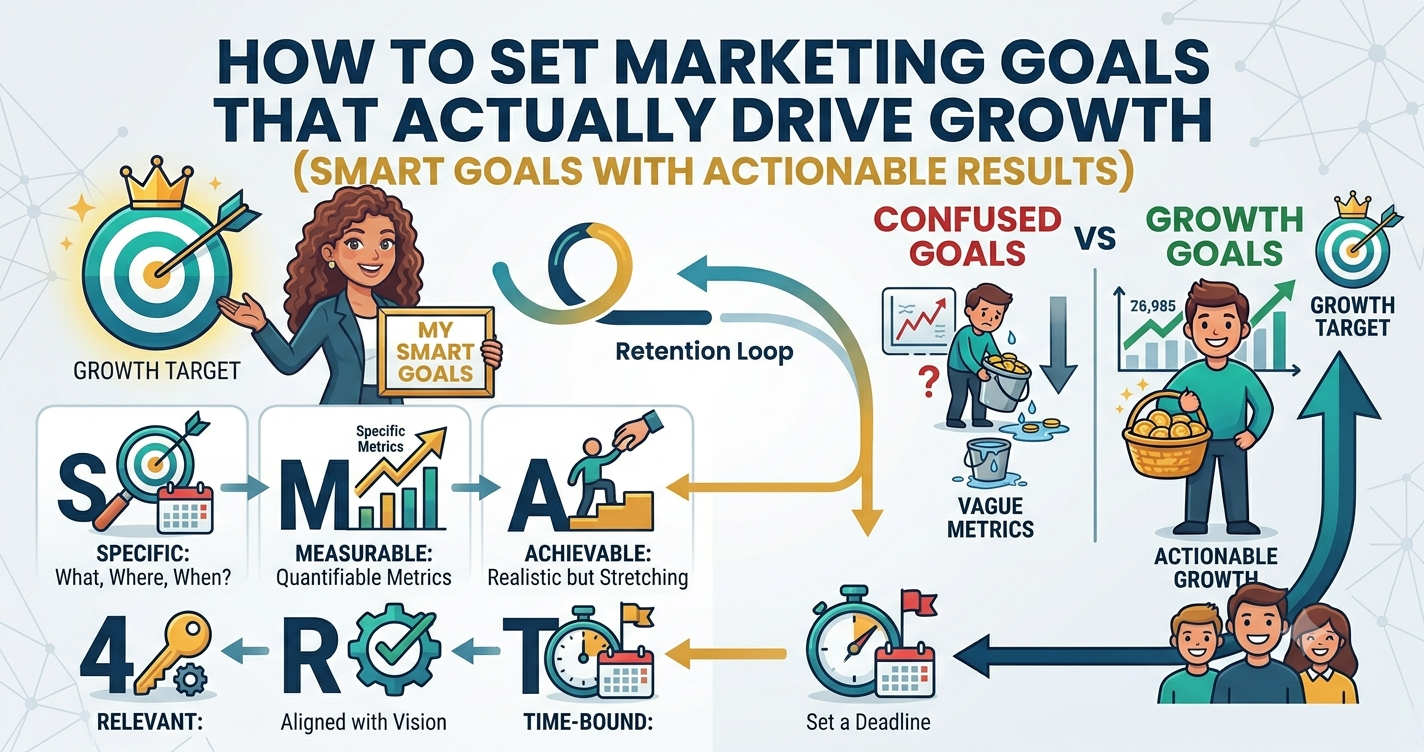
SMART marketing goals use a framework that makes objectives easier to understand, measure, and manage.
SMART stands for:
- S — Specific: Clearly define what you want to achieve.
- M — Measurable: Identify how progress and success will be measured.
- A — Achievable: Set a realistic target based on your resources and current performance.
- R — Relevant: Connect the goal to your business priorities.
- T — Time-bound: Establish a deadline or defined period.
The SMART framework is widely used in goal setting because it turns broad intentions into objectives that can guide planning and evaluation. The exact interpretation of the acronym can vary slightly across organizations; this article uses “Achievable” and “Relevant.” (See the SMART goal-setting guidance from Asana.)
Specific: Define the exact outcome
A specific marketing goal answers what you want to achieve, who or what it concerns, and which area of marketing it relates to.
For example, “improve social media performance” is too broad.
A more specific objective is “increase relevant Instagram profile visits from local customers by improving content quality and publishing consistently.”
The more clearly you define the outcome, the easier it becomes to select suitable marketing activities.
Measurable: Decide how success will be tracked
A measurable goal includes a number, percentage, conversion target, or another observable indicator.
For example, instead of saying “generate more enquiries,” set a target to increase qualified enquiries from 30 to 45 per month.
Choose metrics that reflect your actual objective. If your goal is lead generation, qualified enquiries and lead conversion rates are usually more useful than likes alone.
Achievable: Set a realistic target
Your marketing goals should challenge your business without ignoring its current performance, budget, team capacity, or market conditions.
Review historical data before deciding on a target. If your website currently generates 20 qualified leads per month, increasing that number to 25 may be a more defensible initial goal than aiming for 200 without a supporting plan.
An ambitious target can still be useful, but it should have a credible path to achievement.
Relevant: Connect marketing to business growth
A relevant goal supports a business priority.
For example, a local service provider that needs more bookings may benefit from local SEO, customer reviews, and conversion-focused landing pages. A business trying to improve repeat sales may benefit more from customer retention campaigns than from increasing its follower count.
Ask yourself whether achieving the goal would meaningfully contribute to the business.
Time-bound: Set a clear deadline
A deadline creates a point at which progress can be evaluated.
For example, “increase qualified leads by 20% within 90 days” provides a defined period for planning and measurement.
The deadline should reflect the marketing channel and buying cycle. SEO may require more time to show meaningful results than a short-term paid advertising experiment.
3. Why Are SMART Goals Important for Business Growth?
SMART goals help businesses make marketing decisions based on priorities and evidence rather than assumptions.
They create a clear direction
When a team understands the desired outcome, it can prioritize the activities most likely to contribute to it.
If the main objective is to increase qualified leads, the team can focus on landing-page improvements, relevant content, lead forms, and campaign targeting instead of pursuing unrelated activities.
They improve budget allocation
Every business has limited time and resources. Defined goals help teams decide where to invest their marketing budget.
For example, a business can compare the quality and cost of leads from SEO, Google Ads, and social media campaigns to determine where additional investment may be justified.
They make performance easier to evaluate
Without clear goals, marketing reports can become collections of numbers without meaningful context.
SMART goals establish what success should look like before a campaign begins. This makes it easier to identify progress, recognize underperformance, and decide what to change.
They encourage accountability
When objectives, deadlines, and responsibilities are clear, team members can understand their roles and report progress more consistently.
They support continuous improvement
Marketing rarely works perfectly from the beginning. Defined goals encourage businesses to review performance, test new approaches, and refine campaigns as they learn more about their customers.
4. How to Set SMART Marketing Goals in Seven Steps
Follow these seven steps to build marketing goals that are practical, measurable, and connected to business outcomes.
Step 1: Define your main business objective
Begin with the business result you want marketing to support.
Common objectives include increasing revenue, generating leads, improving customer retention, expanding into a new market, or strengthening local visibility.
Avoid choosing marketing metrics before understanding the business need.
For example, an online store may want to increase revenue from existing customers, while a professional services company may need more qualified consultation requests.
Each business requires a different marketing approach.
Step 2: Understand your current performance
Before setting a target, establish a baseline.
Review relevant information from your website analytics, advertising platforms, CRM system, email marketing software, and sales records.
Depending on your objective, examine:
- Monthly website traffic.
- Qualified leads and enquiries.
- Landing-page conversion rates.
- Cost per lead.
- Sales revenue.
- Customer acquisition cost.
- Email click-through and conversion rates.
- Repeat purchases or customer retention.
For website measurement, Google Analytics can help businesses identify important user actions as key events and use relevant conversion measurements to evaluate marketing performance. Configuration should reflect the actions that matter to your business.
Your baseline gives you a starting point for deciding what improvement is realistic.
Step 3: Identify your target audience
A marketing goal becomes more useful when you know whom you want to reach.
Define your target audience based on relevant characteristics such as location, needs, interests, industry, buying behavior, and stage in the customer journey.
For example, a local interior design company may want to generate enquiries from homeowners in its service area rather than attract website visitors from unrelated locations.
Understanding your audience helps you select suitable channels, messaging, keywords, and offers.
Step 4: Write a SMART goal statement
Combine the five SMART elements into one clear objective.
Use this template:
We will [specific outcome] from [baseline] to [target] by [deadline], measured using [metric], through [key activities].
Example:
“We will increase qualified website enquiries from 40 to 60 per month within four months by improving service landing pages, publishing targeted SEO content, and optimizing lead-generation campaigns.”
This statement defines the outcome, the baseline, the target, the deadline, the measurement method, and the intended activities.
Step 5: Choose the right KPIs
Key performance indicators (KPIs) are the metrics used to evaluate progress toward your marketing goals.
Choose a small set of meaningful indicators instead of tracking every available number.
For a lead-generation goal, useful KPIs may include:
- Number of qualified leads.
- Landing-page conversion rate.
- Cost per qualified lead.
- Lead-to-customer conversion rate.
For an SEO goal, relevant indicators may include organic clicks, search impressions, rankings for relevant queries, and conversions from organic traffic.
Your KPIs should reflect business outcomes as well as the activities that contribute to them.
Step 6: Create an action plan and assign responsibilities
A SMART goal needs a practical execution plan.
Break the objective into tasks, assign owners, set milestones, and allocate resources.
For example, a 90-day lead-generation plan might include:
Month 1: Preparation
- Review current website performance.
- Identify high-intent keywords.
- Improve landing-page messaging.
- Configure lead tracking.
Month 2: Implementation
- Publish targeted content.
- Launch or refine advertising campaigns.
- Test calls to action and lead forms.
Month 3: Optimization
- Review lead quality and campaign costs.
- Improve underperforming pages.
- Reallocate budget based on evidence.
- Compare results against the original baseline.
The activities should be adjusted to suit your actual resources and business objectives.
Step 7: Review progress and adjust when necessary
Monitor your KPIs regularly and conduct a more detailed review at planned intervals.
Ask three questions:
- Are we moving toward the target?
- Which activities are contributing to the result?
- What should we change based on the evidence?
If website traffic increases but qualified leads remain unchanged, review the relevance of the traffic, landing-page experience, offer, and conversion process.
Avoid changing your entire strategy after a small fluctuation. Use a suitable measurement period and consider factors such as seasonality, campaign maturity, and changes in demand.
5. SMART Marketing Goals Examples for Different Businesses
The following examples illustrate how businesses can turn general marketing ambitions into measurable objectives. These are hypothetical targets, not industry benchmarks or guaranteed outcomes.
| Business type | SMART marketing goal | Primary KPI |
| Local business | Increase qualified enquiries from 25 to 35 per month within 90 days | Qualified enquiries |
| E-commerce store | Increase the repeat purchase rate from 20% to 25% over six months | Repeat purchase rate |
| Digital marketing agency | Increase qualified consultation requests from 30 to 45 per month within four months | Qualified consultation requests |
| B2B company | Increase marketing-qualified leads from 40 to 50 per month within one quarter | Marketing-qualified leads |
| Content-focused website | Increase organic clicks to selected service pages by 15% over six months | Organic clicks |
Example 1: SMART SEO goal
General goal: Improve Google rankings.
SMART goal: Increase monthly organic clicks to a defined group of relevant service pages by 15% within six months, using the previous three months as a baseline and tracking performance through Google Search Console.
Action plan: Improve page content, address technical SEO issues, strengthen relevant internal links, and publish supporting content that answers customer questions.
This goal focuses on relevant organic visibility rather than promising a specific ranking position.
Example 2: SMART social media goal
General goal: Grow Instagram.
SMART goal: Increase qualified website visits from Instagram by 20% over the next 90 days, measured through website analytics and campaign tracking.
Action plan: Publish relevant short-form videos, improve calls to action, use trackable links, and review which content generates useful website visits.
Follower growth can still be monitored, but it should not replace the metric that reflects the business objective.
Example 3: SMART paid advertising goal
General goal: Get more customers through Google Ads.
SMART goal: Increase monthly qualified leads from 40 to 50 within three months while keeping cost per qualified lead within the business’s approved budget.
Action plan: Review search terms, improve ad relevance, refine audience and location targeting, test landing pages, and measure lead quality.
This approach balances volume with cost and quality rather than optimizing solely for clicks.
Example 4: SMART content marketing goal
General goal: Publish more blogs.
SMART goal: Publish eight well-researched articles over four months that address relevant customer questions, then evaluate their organic clicks, engagement, and contribution to qualified enquiries.
Action plan: Research search intent, create a content calendar, add useful internal links, and review each article’s performance after it has had sufficient time to gain visibility.
Publishing volume is an activity target. The performance review helps establish whether the content is contributing to the wider business objective.
6. Marketing Goals vs. Marketing KPIs
Marketing goals and KPIs are related, but they serve different purposes.
| Marketing goals | Marketing KPIs |
| Define the desired outcome | Measure progress or performance |
| Include targets and deadlines | Include metrics and measurement periods |
| Guide strategy and priorities | Help evaluate results |
| Example: Generate 50 qualified leads per month | Example: Qualified leads, conversion rate, and cost per lead |
A goal might be to increase qualified leads by 25% in one quarter. The associated KPIs could include lead volume, landing-page conversion rate, and cost per qualified lead.
It is also useful to distinguish outcome metrics from activity metrics. Publishing four blogs per month is an activity target; increasing relevant organic traffic or qualified enquiries is an outcome target.
Both can matter, but activity alone does not prove business growth.
7. Common Marketing Goal-Setting Mistakes
Even well-planned marketing campaigns can lose direction when objectives are poorly defined.
Setting vague goals
Goals such as “grow the brand” or “improve engagement” do not specify what success means.
Solution: Define a measurable result, a baseline, and a deadline.
Choosing unrealistic targets
Ambitious targets without supporting resources or a credible plan can lead to poor decisions.
Solution: Review historical performance, available budget, team capacity, and market conditions before setting targets.
Focusing on vanity metrics
Likes, impressions, and follower counts can provide useful context, but they may not reflect leads, sales, or customer retention.
Solution: Connect supporting metrics to a meaningful business outcome.
Tracking too many KPIs
Too many measurements can make it difficult to identify what deserves attention.
Solution: Select a few primary KPIs and supporting indicators for each goal.
Ignoring measurement setup
A business cannot reliably evaluate campaign performance if forms, calls, purchases, or other important actions are not tracked correctly.
Solution: Test analytics and conversion tracking before launching campaigns.
Failing to review progress
A goal written at the beginning of a quarter has little practical value if nobody checks progress.
Solution: Schedule regular reviews and document decisions based on the results.
Treating every marketing channel the same
SEO, paid advertising, email marketing, and social media have different timelines and measurement requirements.
Solution: Set channel-specific milestones while keeping each channel connected to the broader business objective.
8. How Digital Marketing Helps Achieve SMART Goals
Digital marketing gives businesses practical channels and measurement tools for working toward defined objectives.
Search engine optimization
SEO can support goals related to organic visibility, relevant website traffic, and enquiries from search users.
Businesses can improve their chances of reaching suitable audiences by creating useful content, improving website usability, addressing technical issues, and targeting relevant search intent.
Content marketing
Content marketing supports objectives such as educating potential customers, answering common questions, and generating relevant website visits.
Each article, guide, or video should have a clear purpose and a suitable next step for the reader.
Social media marketing
Social media can help businesses improve brand awareness, engage their target audience, and drive relevant traffic to their websites.
Measure the outcomes that match your objective, such as qualified website visits, enquiries, or sales attributed to social campaigns.
Google Ads and Meta Ads
Paid advertising can support lead-generation and sales objectives by reaching relevant audiences through targeted campaigns.
Define the intended conversion, set an appropriate budget, track campaign performance, and evaluate lead or customer quality before increasing spending.
Email marketing
Email marketing can support repeat purchases, customer engagement, event registrations, and lead nurturing.
Relevant KPIs may include clicks, purchases, qualified enquiries, and revenue attributed to email campaigns.
Website optimization and analytics
A well-structured website helps visitors understand the offer and take the next step.
Use analytics to evaluate important actions, such as form submissions, purchases, or booking requests. Google explains how businesses can identify key events in Analytics and use conversion measurements to evaluate marketing performance. See the official documentation in the resources below.
The strongest digital marketing plans connect channels to measurable objectives instead of treating each channel as an independent activity.
Frequently Asked Questions About SMART Marketing Goals
1. What are SMART marketing goals?
SMART marketing goals are objectives that are Specific, Measurable, Achievable, Relevant, and Time-bound. They help businesses define clear outcomes, measure progress, and organize marketing activities around business priorities.
2. What is an example of a SMART marketing goal?
An example is: “Increase qualified website enquiries from 40 to 60 per month within four months by improving landing pages and optimizing lead-generation campaigns.” It includes a defined outcome, a measurable target, a deadline, and a plan.
3. Why are SMART goals important in digital marketing?
SMART goals help businesses prioritize campaigns, allocate budgets, evaluate performance, and identify opportunities for improvement. They also connect metrics such as traffic, leads, and conversions with wider business objectives.
4. How many marketing goals should a business have?
There is no universal ideal number. Many businesses can start with one to three primary marketing goals for a quarter, supported by a small set of relevant KPIs. The right number depends on the team’s resources, business priorities, and marketing complexity.
5. What is the difference between a marketing goal and a KPI?
A marketing goal defines the outcome a business wants to achieve, while a KPI measures progress toward that outcome. For example, increasing qualified leads by 20% is a goal; qualified lead volume and cost per lead are supporting KPIs.
6. How often should marketing goals be reviewed?
Review important metrics weekly or monthly when appropriate, and conduct a more detailed assessment at the end of the goal period. Campaign maturity, sales cycles, and seasonality should influence review frequency.
7. Can small businesses use SMART marketing goals?
Yes. Small businesses can use SMART goals without expensive tools or large marketing teams. They can begin with simple objectives such as increasing monthly enquiries, improving local website traffic, or generating more repeat purchases, then measure progress with suitable analytics and business records.
Conclusion
Setting effective marketing goals is about more than choosing ambitious numbers. It requires understanding your business priorities, reviewing current performance, defining a realistic target, and building an action plan that can be measured over time.
The SMART framework provides a practical structure for turning broad marketing ambitions into specific objectives. Whether you want to improve SEO performance, generate qualified leads, increase online sales, or strengthen customer engagement, clearly defined goals help your team make better decisions.
Start with one important business outcome. Establish your baseline, choose the right KPIs, assign responsibilities, and review progress consistently. As your understanding of customers and campaign performance improves, refine your goals and strategy accordingly.
Remember that marketing success is not measured by activity alone. It is measured by how effectively your efforts contribute to meaningful business results.
Ready to turn your marketing plans into measurable growth?
Digipromoters helps businesses strengthen their online presence through SEO, content marketing, social media marketing, paid advertising, and lead-generation strategies.
Get in touch with Digipromoters to explore a digital marketing approach aligned with your business objectives and build a clearer path toward sustainable growth.