


Influencer marketing has moved far beyond simply paying a famous person to promote a product. In 2026, brands have more creator options than ever—from niche creators with highly engaged communities to celebrities and mega-influencers with millions of followers.
That creates an important question for marketers: Micro-influencers vs mega-influencers—who gives better ROI in 2026?
The answer depends on what a brand means by “ROI.”
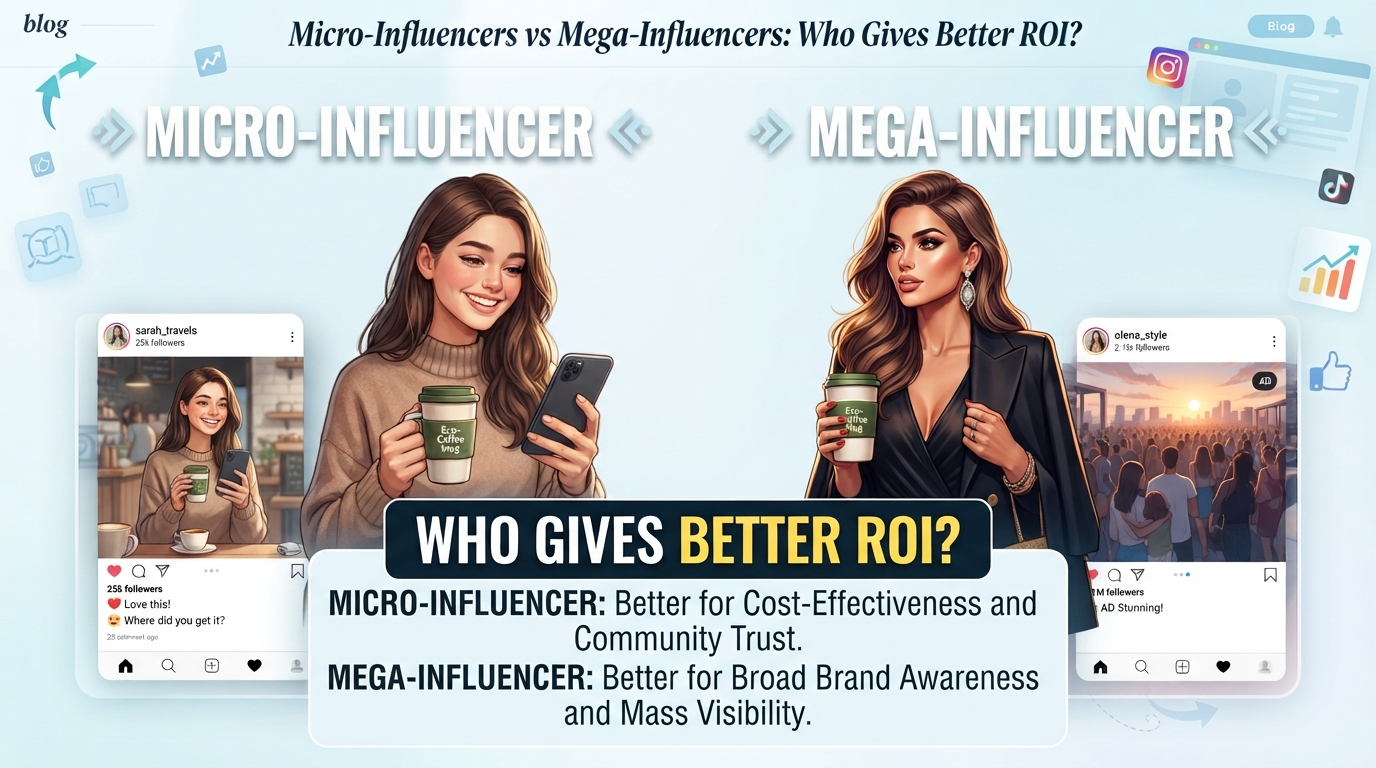
A mega-influencer can potentially deliver enormous reach and brand visibility, while a micro-influencer may offer a more focused audience, stronger engagement, and lower campaign costs. Current industry research also suggests that smaller creators often perform strongly on engagement and cost efficiency, but results vary considerably by platform, industry, audience, content quality, and campaign objective.
For brands focused on sales and measurable performance, the right creator is therefore not necessarily the one with the largest following.
This guide explains micro-influencer vs mega-influencer ROI, how each creator tier works, what factors affect influencer marketing ROI in 2026, and how businesses can build a creator strategy around their actual marketing goals.
What Is a Micro-Influencer?
A micro-influencer is generally a creator with a relatively small but focused audience. Definitions vary between platforms and agencies, but micro-influencers are commonly placed somewhere around the 10,000–100,000 follower range.
The important characteristic is not simply follower count. Micro-creators often operate within specific niches such as:
- Beauty and skincare
- Fashion
- Fitness
- Food
- Travel
- Technology
- Gaming
- Personal finance
- Parenting
- Local lifestyle
- Home décor
Because their audiences are often more concentrated around a particular interest, brands can use micro-influencer marketing to reach a more specific customer segment.
Why Do Brands Work With Micro-Influencers?
Micro-influencers can be useful when a campaign needs:
- Niche audience targeting
- Product recommendations
- Community engagement
- User-generated content
- Product demonstrations
- Local or regional reach
- Multiple pieces of content
- Cost-efficient testing
Rather than investing the entire budget in one creator, a brand can sometimes collaborate with several smaller creators and test different audiences and content styles.
What Is a Mega-Influencer?
A mega-influencer typically has a very large audience, often 1 million or more followers.
This category can include major internet personalities, celebrities, entertainers, athletes, large-scale creators, and other public figures.
The primary advantage is scale.
A mega-influencer can expose a campaign to a large audience in a relatively short period of time. This can make the creator tier relevant for campaigns focused on:
- Mass awareness
- Product launches
- Large-scale visibility
- Brand association
- Major announcements
- Entertainment-led campaigns
- Top-of-funnel marketing
However, greater reach does not automatically mean greater sales or better ROI.
A large audience can include people who are outside the brand’s target market, and the cost of reaching that audience can be significantly higher.
Micro-Influencers vs Mega-Influencers: The Key Difference
The simplest way to understand the difference is:
Micro-influencers generally offer more focused reach, while mega-influencers offer much greater scale.
But influencer marketing ROI depends on more than reach.
A brand should consider:
- How relevant the audience is
- How engaged the audience is
- How much the creator costs
- Whether the content feels credible
- Whether the creator can demonstrate the product effectively
- Whether the audience matches the target customer
- How well the campaign is tracked
- Whether the campaign goal is awareness or conversion
Research published in 2026 continues to show that smaller creator tiers can have stronger engagement and cost efficiency, although individual benchmarks vary significantly between datasets.
Micro-Influencer vs Mega-Influencer ROI in 2026
There is no universal ROI number that applies to every influencer campaign.
Some 2025–2026 benchmark reports show higher average engagement and cost efficiency among micro and nano creators, while mega-influencers remain valuable for large-scale reach. For example, one 2026 benchmark report found micro creators delivering lower cost per engagement than macro creators, while other campaign datasets show that mega creators can achieve efficient cost per view because of their enormous reach.
This is why brands should avoid judging influencer performance using follower count alone.
Engagement Is Not the Same as ROI
A creator can have a high engagement rate without generating substantial revenue.
Similarly, a creator can have relatively low engagement but still expose a new product to millions of relevant potential customers.
For example:
Creator A
- 40,000 followers
- Highly targeted audience
- Strong comments and saves
- ₹20,000 campaign cost
- 50 sales
Creator B
- 2 million followers
- Broad audience
- Lower engagement rate
- ₹5 lakh campaign cost
- 300 sales
Creator B generated more sales, but that does not automatically mean the campaign delivered better ROI.
The correct comparison requires looking at revenue relative to total campaign investment.
How to Calculate Influencer Marketing ROI
A simple ROI formula is:
Influencer Marketing ROI = (Revenue Generated − Campaign Cost) ÷ Campaign Cost × 100
For example, if a campaign costs ₹50,000 and generates ₹1,50,000 in attributed revenue:
ROI = (₹1,50,000 − ₹50,000) ÷ ₹50,000 × 100 = 200%
However, brands should define their measurement model carefully.
Campaign costs can include:
- Creator fees
- Product samples
- Shipping
- Agency fees
- Content production
- Paid amplification
- Affiliate commissions
- Discounts
- Campaign management
If these costs are ignored, the reported ROI may look better than the actual business return.
Micro-Influencers vs Mega-Influencers: Comparison Table
| Factor | Micro-Influencers | Mega-Influencers |
| Typical audience size | Around 10K–100K | 1M+ |
| Reach | Focused | Very large |
| Audience targeting | Often highly niche | Usually broader |
| Engagement potential | Often higher | Often lower relative to follower count |
| Cost | Generally lower | Generally much higher |
| Content style | Often personal and niche-focused | Usually highly produced or entertainment-led |
| Product recommendations | Strong fit for niche products | Strong for mass-market exposure |
| Brand awareness | Moderate to high | Very high potential reach |
| Conversion campaigns | Can be useful for targeted campaigns | Depends heavily on audience-product fit |
| UGC potential | Often strong | May require separate content agreements |
| Campaign scalability | Easy to build creator networks | Limited by budget and creator availability |
| Best suited for | Niche targeting and performance | Mass awareness and major launches |
| Measurement | Often easier through codes/links | Requires careful attribution at scale |
Benefits of Micro-Influencer Marketing
1. More Focused Audiences
A micro-influencer may have an audience built around a particular subject.
For example, a skincare brand may work with several creators whose audiences are specifically interested in skincare rather than choosing a celebrity whose audience has much broader interests.
This can improve audience relevance.
2. Potentially Better Cost Efficiency
Micro-creators generally cost less per collaboration than mega-influencers.
This gives brands an opportunity to distribute their budget across multiple creators.
Instead of spending an entire budget on one partnership, a business could test several creators and identify which audiences and content styles generate the strongest results.
3. Stronger Community Relationships
Smaller creators may have closer relationships with their followers because their communities are more concentrated.
That can be useful for products that require trust, explanation, or personal recommendation.
4. More Testing Opportunities
Suppose an e-commerce brand has ₹1 lakh available for influencer marketing.
Rather than committing the entire amount to one creator, the brand could test multiple micro-influencers across different niches.
This creates more data points.
The brand can then compare:
- Cost per click
- Engagement
- Website sessions
- Add-to-cart rate
- Conversion rate
- Cost per acquisition
- Revenue
- Repeat purchases
5. Useful Content for Paid Advertising
Creator-generated content can sometimes be repurposed—with the appropriate usage rights—as paid social advertising creative.
This can help brands combine influencer marketing and performance marketing instead of treating them as completely separate channels.
Benefits of Mega-Influencer Marketing
1. Massive Reach
The most obvious advantage is scale.
A mega-influencer can introduce a product to a very large audience quickly.
This can be useful for:
- New product launches
- Major campaigns
- National awareness
- Brand repositioning
- Large promotional events
2. Strong Brand Visibility
Mega-influencers can create significant attention around a campaign.
For brands entering a competitive market, large-scale visibility may be an important part of the marketing mix.
3. Suitable for Awareness Campaigns
Not every campaign is designed to generate immediate sales.
Some campaigns aim to increase:
- Brand recognition
- Search interest
- Social mentions
- Share of voice
- Product awareness
- Audience familiarity
Mega-influencers can play a role in these top-of-funnel objectives.
4. Potential for Major Campaign Moments
A celebrity or major creator can help turn a product announcement into an event.
However, brands should distinguish reach from business results. A campaign that generates millions of impressions may still require retargeting, paid media, or other conversion activity before it generates meaningful revenue.
Which Gives Better ROI: Micro or Mega?
For ROI-focused campaigns, micro-influencers can often be more cost-efficient because brands can access targeted audiences without paying the premium associated with massive reach.
Recent benchmark research has repeatedly found stronger engagement or cost efficiency among smaller creator tiers, although the exact figures differ by methodology and platform.
However, it would be inaccurate to conclude that micro-influencers always generate better ROI.
Mega-influencers can make sense when the primary objective is:
- Large-scale awareness
- Rapid reach
- Product launch visibility
- Brand association
- Mass-market exposure
The right question is therefore not:
“Which influencer has more followers?”
It is:
“Which creator can deliver the desired business outcome at an acceptable cost?”
When Should a Brand Choose Micro-Influencers?
Micro-influencers may be particularly relevant when a brand:
- Has a limited or controlled marketing budget
- Targets a specific niche
- Wants to test multiple creators
- Needs product education
- Wants authentic product demonstrations
- Is launching a niche product
- Wants measurable conversions
- Is building a creator network
- Needs user-generated content
For example, a local fitness brand might benefit more from several fitness creators with audiences in its target region than from one celebrity whose followers are spread across unrelated interests and locations.
When Should a Brand Choose Mega-Influencers?
Mega-influencers may be more relevant when:
- Brand awareness is the primary goal
- The product has mass-market appeal
- The campaign needs rapid reach
- The launch is nationally or internationally focused
- The brand has a substantial influencer budget
- Celebrity association is strategically relevant
- The campaign is designed around a major cultural or entertainment moment
A mega-influencer can therefore play a different role from a micro-influencer.
One is not necessarily a replacement for the other.
Micro vs Mega Influencers for Different Industries
Fashion
Fashion brands can use both creator tiers.
Micro-influencers can produce styling videos, outfit ideas, reviews, and niche fashion content.
Mega-influencers can create broad awareness around major launches or collections.
Beauty and Skincare
Beauty is particularly suitable for demonstration-based creator marketing.
Micro-creators can produce tutorials, routines, reviews, and educational content for highly specific audiences.
Mega-influencers can help a product reach a much larger consumer base.
Food and Beverage
Local food brands may benefit from niche or regional creators whose audiences are geographically relevant.
Larger food and beverage brands may use mega-influencers for nationwide campaigns while using smaller creators for localized content.
Technology
Technology products often require explanation and credibility.
A niche technology creator may therefore provide detailed product education, while a mega-creator can introduce the product to a broader audience.
Fitness
Micro-creators can be particularly useful for niche fitness communities, such as running, yoga, strength training, or home workouts.
The best choice depends on whether the objective is community engagement, product sales, awareness, or a combination.
How to Choose the Right Influencer for ROI
Follower count should be only one part of your evaluation.
1. Check Audience Relevance
Ask:
- Who follows this creator?
- Where are they located?
- What age groups are represented?
- What interests do they have?
- Do they match your target customer?
2. Analyze Engagement Quality
Don’t look only at likes.
Review:
- Comments
- Shares
- Saves
- Views
- Watch time where available
- Audience responses
- Comment quality
A creator with fewer followers but meaningful conversations may be more valuable for certain campaigns.
3. Review Previous Brand Partnerships
Look at how the creator handles sponsored content.
Does the promotional content feel natural?
Does the creator explain the product?
Does the content generate genuine interaction?
4. Check Audience Authenticity
Brands should review suspicious follower patterns, engagement anomalies, and audience quality before signing a creator.
Large follower numbers do not guarantee a real or relevant audience.
5. Evaluate Content Quality
The creator should be able to produce content that fits the platform and brand.
In 2026, influencer marketing is increasingly connected to short-form video, creator-led advertising, and performance marketing, making content quality an important part of campaign ROI.
6. Negotiate Usage Rights
If you want to use influencer content in paid advertisements, clarify usage rights before the campaign begins.
A creator fee and advertising usage rights may be separate considerations.
7. Track Actual Business Outcomes
Use measurable tracking methods such as:
- Unique discount codes
- UTM links
- Affiliate links
- Landing pages
- Creator-specific URLs
- Platform analytics
- Conversion tracking
This makes it easier to compare creators based on business performance rather than vanity metrics.
A Smarter Influencer Marketing Strategy for 2026
Instead of choosing between micro and mega influencers exclusively, brands can build a multi-tier influencer strategy.
For example:
Awareness Layer
Use larger creators for broad exposure when the campaign requires significant reach.
Consideration Layer
Use mid-sized and micro-creators for product education, demonstrations, reviews, and social proof.
Conversion Layer
Use niche creators, affiliates, or performance-focused creators with trackable links and promotional codes.
Retargeting Layer
Use paid social campaigns to reach people who interacted with influencer content but did not purchase.
This creates a customer journey rather than treating influencer marketing as a single post.
How to Measure Influencer Marketing ROI in 2026
A strong influencer campaign should track more than likes and followers.
Awareness Metrics
- Reach
- Impressions
- Video views
- Brand mentions
- Search interest
Engagement Metrics
- Engagement rate
- Comments
- Shares
- Saves
- Watch time
- Completion rate
Traffic Metrics
- Link clicks
- Website sessions
- Landing-page visits
- Product-page views
Conversion Metrics
- Add-to-cart rate
- Purchases
- Conversion rate
- Cost per acquisition
- Revenue
- Average order value
Financial Metrics
- ROAS
- ROI
- Customer acquisition cost
- Customer lifetime value
- Contribution margin
The most important metrics should match the campaign objective.
If the campaign is designed for awareness, immediate sales may not be the only meaningful outcome. If the objective is direct e-commerce sales, revenue and acquisition efficiency should receive greater attention.
Common Influencer Marketing Mistakes Brands Should Avoid
Choosing Creators Only by Follower Count
A million followers do not automatically equal a million potential customers.
Ignoring Audience Fit
A creator’s audience should match the people who can realistically buy your product.
Measuring Only Engagement
High engagement is useful, but it does not necessarily equal revenue.
Using the Same Brief for Every Creator
Creators understand their audiences better than brands do. Give them clear brand requirements while allowing enough creative flexibility for authentic content.
Failing to Track Conversions
Without tracking links, codes, landing pages, or other attribution methods, it becomes difficult to understand actual campaign performance.
Focusing Only on One-Off Posts
Longer-term creator relationships can provide consistency, familiarity, and multiple content opportunities.
Can Micro and Mega Influencers Be Used Together?
Yes.
A combined strategy can allow brands to use each creator tier for a different purpose.
For example:
Mega-influencer: Launches the product and generates mass awareness.
Micro-influencers: Explain the product, demonstrate how it works, and provide niche social proof.
Performance ads: Retarget people who interacted with the campaign.
E-commerce website: Converts high-intent visitors into customers.
This approach connects influencer marketing, social media marketing, paid advertising, and e-commerce marketing into one customer journey.
How DigiPromoters Can Help With Influencer Marketing
Influencer marketing works best when creator selection is connected to the wider digital marketing strategy.
DigiPromoters can help businesses approach influencer marketing as part of a broader strategy involving social media marketing, content strategy, performance marketing, paid social campaigns, and e-commerce marketing.
A structured campaign can involve:
- Identifying the target audience
- Defining campaign objectives
- Selecting relevant creator categories
- Evaluating creator-audience fit
- Developing content briefs
- Planning creator campaigns
- Tracking campaign performance
- Measuring traffic and conversions
- Repurposing creator content where rights allow
- Combining influencer campaigns with paid social advertising
The goal is not simply to find the creator with the biggest following. It is to build a creator strategy that supports measurable business objectives.
Frequently Asked Questions
Are micro-influencers better than mega-influencers in 2026?
Micro-influencers can offer strong cost efficiency and targeted engagement, while mega-influencers provide substantially greater reach. Which produces better ROI depends on the campaign objective, audience fit, creator cost, product, platform, and measurement approach.
Why do micro-influencers often have higher engagement?
Micro-influencers frequently serve more focused communities and specialized niches. This can result in stronger interaction relative to their follower count, although engagement varies considerably by creator, platform, content format, and audience.
Are mega-influencers worth the cost?
They can be, particularly when the campaign requires large-scale awareness, rapid reach, or major brand visibility. Their value should be evaluated against the campaign objective rather than judged only by direct sales.
How much does a micro-influencer cost?
There is no universal rate. Pricing depends on follower count, engagement, platform, niche, content format, audience location, deliverables, exclusivity, and usage rights. Brands should compare the total cost with expected reach and measurable business outcomes rather than relying on a generic price list.
How do you calculate influencer marketing ROI?
A basic formula is:
ROI = (Revenue Generated − Campaign Cost) ÷ Campaign Cost × 100
Brands should include relevant campaign expenses and use appropriate attribution methods to estimate revenue generated by each creator.
Should small businesses work with micro-influencers?
Micro-influencers can be a practical option for small businesses because they can provide targeted audiences and allow brands to test multiple creator partnerships without committing the budget required for a single major celebrity campaign.
Is follower count still important for influencer marketing?
Follower count still matters for estimating potential reach, but it should not be the only selection criterion. Audience relevance, engagement quality, content performance, creator credibility, cost, and conversion potential are also important.
Which influencer is better for product sales?
There is no universal answer. For highly targeted products, a relevant micro-influencer may be more efficient. For mass-market products, a mega-influencer may provide valuable reach. Actual performance should be measured using attributable traffic, conversions, revenue, and acquisition costs.
Should brands use multiple micro-influencers instead of one mega-influencer?
In some campaigns, using multiple micro-influencers can provide broader niche coverage, more content variations, and more opportunities for testing. However, a mega-influencer may be more appropriate when the primary objective is large-scale awareness.
What matters more: reach or engagement?
Neither metric should be evaluated in isolation. Reach indicates potential exposure, while engagement indicates audience interaction. For conversion-focused campaigns, brands should also measure clicks, conversions, revenue, acquisition cost, and ROI.
Conclusion
The micro-influencers vs mega-influencers debate is ultimately about matching creator scale with business objectives.
Micro-influencers can provide focused audiences, strong community engagement, flexible testing opportunities, and potentially better cost efficiency. Mega-influencers can provide exceptional reach and large-scale brand awareness.
Current 2025–2026 industry research generally supports the idea that smaller creators can be highly efficient on engagement and cost-related metrics, but the exact ROI varies by platform, industry, campaign structure, creator quality, and attribution method.
For brands focused on measurable sales, the smartest approach is to evaluate creators based on audience relevance, content quality, campaign cost, engagement, conversions, revenue, and customer acquisition cost—not follower count alone.
In many cases, the strongest strategy may not be choosing between micro and mega influencers at all. A combination of creator tiers, supported by strong content, paid social, tracking, and e-commerce optimization, can create a more complete influencer marketing funnel.
With the right strategy, DigiPromoters can help businesses turn influencer partnerships from simple promotional posts into a measurable part of their broader digital marketing, social media, performance marketing, and e-commerce growth strategy.