





When a business starts investing in SEO, one question often comes up: Should you optimize your website first, or should you start building backlinks?
The answer is important because SEO is not a collection of disconnected tasks. Your website needs a strong foundation before you start trying to build authority around it.
If you’re deciding between on-page vs off-page SEO, prioritize on-page SEO first. Then use off-page SEO to strengthen your website’s authority and visibility.
On-page SEO helps search engines understand what your pages are about and helps visitors find useful, relevant information. Off-page SEO helps build credibility and authority through activities that happen outside your website, such as earning relevant backlinks and building your brand’s presence.
The strongest SEO strategy doesn’t treat these as competing approaches. Instead, it uses them together in the right order.
What Is On-Page SEO?
On-page SEO is the process of optimizing elements on your website so that search engines and users can better understand, navigate, and interact with your content.
It includes much more than adding keywords to a page. A good on-page SEO strategy considers content quality, search intent, page structure, internal links, URLs, images, mobile usability, and technical elements that affect how a page can be crawled and understood.
Google’s SEO guidance emphasizes creating useful, well-organized, people-first content and making pages easy for both users and search engines to understand.
Important On-Page SEO Factors
1. Title Tags
The title tag helps communicate what a webpage is about and can influence the title shown in Google Search.
A good title should be descriptive, concise, unique, and relevant to the page. Google also uses other sources, including headings, when generating search-result title links.
For example:
Weak:
Services
Better:
SEO Services for Small Businesses | DigiPromoters
2. Meta Descriptions
A meta description provides a short summary of a webpage. Google may use it when generating the search-result snippet.
A useful description should accurately summarize the page and give searchers a reason to click.
3. Header Tags
Headings such as H1, H2, and H3 organize your content.
Instead of publishing one large block of text, use headings to help readers quickly find the information they need.
For example:
- H1: On-Page vs Off-Page SEO
- H2: What Is On-Page SEO?
- H2: What Is Off-Page SEO?
- H2: Which Should You Prioritize First?
- H3: Why On-Page SEO Comes First
4. Keyword Optimization
Keywords help you understand what your audience is searching for.
However, effective keyword optimization is not about repeating the same phrase dozens of times. It means naturally covering the topic, related concepts, and questions that satisfy the searcher’s intent.
Google specifically warns against keyword stuffing and unnatural repetition intended to manipulate rankings.
5. High-Quality Content
Content should answer the user’s question completely and clearly.
Instead of writing an article simply because a keyword has search volume, ask:
Does this page actually help someone solve a problem or make a decision?
Google’s people-first content guidance encourages original, useful, reliable, comprehensive content rather than content created primarily to attract search traffic.
6. URL Optimization
A clean URL can make a page easier to understand.
For example:
example.com/on-page-vs-off-page-seo
is generally clearer than:
example.com/page?id=58291
7. Internal Linking
Internal links connect one page on your website to another relevant page.
For example, this blog could link to a DigiPromoters SEO services page using descriptive anchor text such as SEO services for businesses.
Internal linking can help users discover relevant information and help search engines understand relationships between pages. Google recommends descriptive, relevant anchor text for links.
8. Image Optimization and Alt Text
Images should be relevant, properly sized, and accompanied by descriptive alt text when appropriate.
For example:
alt=”SEO professional analyzing website traffic”
is more useful than:
alt=”image123″
9. User Experience and Mobile-Friendliness
Visitors should be able to read and navigate your website easily on different devices.
Page experience is broader than a single ranking factor, but Google recommends taking an overall approach to providing a good experience, including factors such as Core Web Vitals and mobile usability.
10. Search Intent
Perhaps the most important question is:
What does the searcher actually want?
Someone searching for “what is SEO” probably wants an explanation.
Someone searching for “SEO agency for small business” may be evaluating service providers.
Your content should match that intent instead of forcing every page to sell something.
What Is Off-Page SEO?
Off-page SEO refers to activities performed outside your own website that can help build your site’s authority, credibility, visibility, and reputation.
The most commonly discussed off-page SEO activity is link building—earning relevant backlinks from other websites.
However, off-page SEO is broader than simply collecting links.
Important Off-Page SEO Factors and Activities
1. Backlinks
A backlink is a link from another website to your website.
For example, if a respected business publication mentions DigiPromoters and links to its website, that creates an external link.
The quality and relevance of the relationship matter more than simply trying to collect a huge number of links.
2. Link Building
Link building involves earning or acquiring relevant links through legitimate methods.
Examples include:
- Creating link-worthy resources
- Digital PR
- Industry partnerships
- Relevant guest contributions
- Original research
- Expert commentary
- Useful guides and tools
Google warns against link spam, including buying or selling links for ranking purposes, excessive link exchanges, automated link creation, and low-quality directory links.
3. Digital PR
Digital PR can help a business earn mentions, visibility, and potentially valuable links from relevant publications and websites.
For example, a company launching original research about digital marketing trends could pitch the findings to relevant publications.
4. Brand Mentions
People may discuss a business online without linking to it.
Brand visibility and reputation can support broader marketing efforts, although businesses should not assume that every mention automatically acts as a direct ranking boost.
5. Guest Posting
Contributing genuinely useful content to relevant websites can help businesses reach new audiences and build relationships.
The goal should be useful content and legitimate exposure—not mass-producing guest posts solely to manipulate rankings.
6. Local Citations
For local businesses, accurate business information across relevant directories and platforms can support local visibility.
Consistency in business details is particularly important when establishing a reliable local presence.
7. Online Reputation
Reviews, public mentions, customer experiences, and brand reputation all contribute to how a business is perceived online.
Off-page SEO therefore overlaps with broader digital marketing and reputation-building activities.
On-Page SEO vs Off-Page SEO: Key Differences
| Factor | On-Page SEO | Off-Page SEO |
| Definition | Optimizing elements on your website | Building authority and visibility outside your website |
| Main focus | Content, relevance, usability, structure, technical elements | Authority, reputation, backlinks, external visibility |
| Where it happens | Primarily on your own website | Primarily outside your website |
| Main objective | Help search engines understand pages and satisfy users | Build credibility and authority |
| Examples | Titles, content, internal links, URLs, alt text | Backlinks, digital PR, citations, brand mentions |
| Level of control | High | Lower |
| Best starting point | First priority | Usually after the foundation is ready |
| Long-term role | Maintains relevance and usability | Strengthens authority and reputation |
The two approaches are different, but they are not alternatives.
Think of your website as a business location.
On-page SEO improves the store itself. Off-page SEO helps more people discover, trust, and recommend it.
Which Should You Prioritize First?
On-page SEO should generally come first, followed by off-page SEO.
This doesn’t mean you need to finish every possible on-page task before doing anything externally.
It means your website should first have a strong enough foundation that the traffic and authority you build can actually benefit the business.
Imagine spending months acquiring backlinks to a website that:
- Has thin or poorly written content
- Doesn’t clearly target a search intent
- Has confusing navigation
- Loads poorly
- Isn’t optimized for mobile users
- Has weak calls to action
- Doesn’t clearly explain its products or services
You may be creating external signals for a website that isn’t ready to convert or satisfy visitors.
A better approach is:
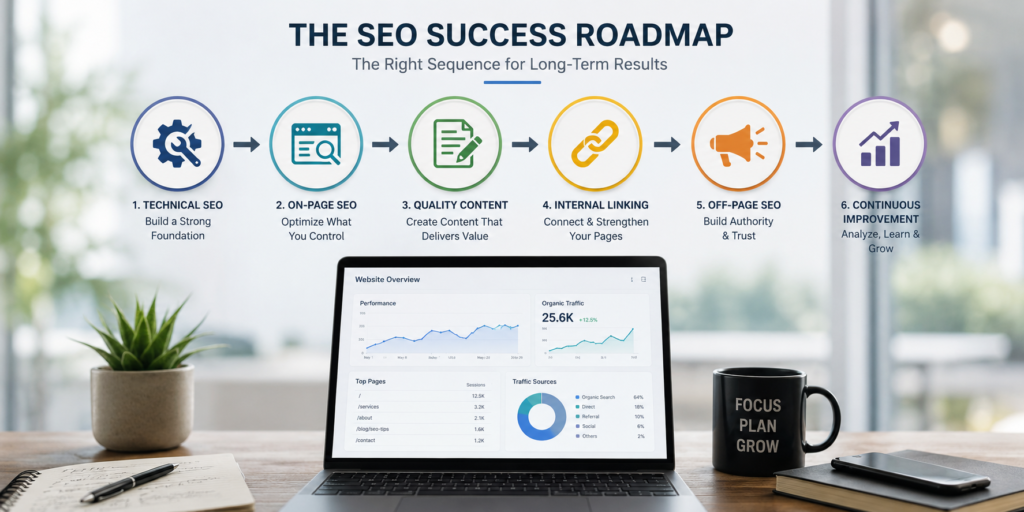
Technical foundation → On-page optimization → Quality content → Internal linking → Off-page SEO → Continuous improvement
This sequence gives your SEO efforts a clearer purpose.
Why On-Page SEO Should Come First
1. It Helps Search Engines Understand Your Pages
Search engines need to understand what your content is about.
Clear headings, descriptive titles, relevant content, internal links, and a logical site structure all help communicate the purpose and relationships between pages.
2. It Improves User Experience
SEO isn’t only about search engines.
If someone arrives from Google and cannot quickly understand your page, they may leave.
Good SEO should make the experience better—not simply make a page more attractive to algorithms.
3. It Helps You Match Search Intent
A backlink cannot fix content that doesn’t answer the searcher’s question.
Before investing heavily in off-page SEO, make sure the target page actually deserves to rank for the query you’re targeting.
4. It Gives Your Traffic Somewhere Valuable to Go
Suppose you earn a backlink that brings 100 potential visitors to your website.
If the landing page is useful, fast, relevant, and persuasive, those visitors have a reason to explore your business.
If the page is confusing or irrelevant, the opportunity may be wasted.
5. It Creates a Better Foundation for Link Building
People are more likely to reference useful resources.
Strong content can give your off-page strategy something worth promoting.
That is why content optimization and link building should work together rather than being treated as completely separate activities.
When Should You Start Off-Page SEO?
You shouldn’t wait until your website is “perfect.”
No website is ever completely finished.
Once the important technical and on-page foundations are in place, you can begin building relevant external authority while continuing to improve the website.
A practical SEO sequence looks like this:
- Technical SEO foundation
- Keyword research
- Search intent analysis
- On-page optimization
- Helpful content creation
- Internal linking
- Relevant link building and digital PR
- Performance monitoring
- Continuous content and SEO improvements
This creates a cycle rather than a one-time project.
Can You Do On-Page and Off-Page SEO at the Same Time?
Yes.
Once your website has a solid foundation, on-page and off-page SEO can—and often should—run together.
For example, a monthly SEO workflow could look like this:
Week 1: Research and Optimization
- Analyze Search Console data
- Review keyword opportunities
- Optimize important pages
- Fix technical issues
- Improve titles and content
Week 2: Content
- Publish a helpful blog
- Improve existing content
- Add relevant internal links
- Optimize images and headings
Week 3: Authority Building
- Identify relevant outreach opportunities
- Work on digital PR
- Promote useful resources
- Earn relevant backlinks
Week 4: Measurement
- Review organic traffic
- Analyze search queries
- Monitor conversions
- Check backlink quality
- Identify pages that need improvement
The process then repeats based on the data.
On-Page SEO Techniques vs Off-Page SEO Techniques
Key On-Page SEO Techniques
- Keyword optimization: Use relevant search terms naturally within useful content.
- Content optimization: Improve depth, clarity, accuracy, and usefulness.
- Title optimization: Create descriptive and relevant title tags.
- Header optimization: Structure pages using logical headings.
- URL optimization: Keep URLs clear and descriptive.
- Internal linking: Connect related pages with useful anchor text.
- Image optimization: Use relevant images, appropriate file sizes, and descriptive alt text.
- Technical SEO: Improve crawlability, indexing, site structure, and other technical foundations.
- Mobile optimization: Make pages easy to use across devices.
- Page performance: Address performance problems that negatively affect the user experience.
Key Off-Page SEO Techniques
- Relevant link building: Earn quality backlinks from appropriate websites.
- Digital PR: Promote newsworthy information, research, and expertise.
- Guest contributions: Publish useful content on relevant external platforms.
- Brand building: Increase legitimate awareness and recognition.
- Local citations: Maintain accurate business information on relevant platforms.
- Online reputation management: Monitor and improve how the business is represented online.
- Content promotion: Get useful resources in front of people and organizations that may genuinely find them valuable.
The important distinction is quality over quantity.
Ten irrelevant or manipulative backlinks are not automatically better than one genuinely useful reference.
Common SEO Mistakes to Avoid
1. Building Backlinks Before Fixing the Website
Don’t use off-page SEO to compensate for fundamental website problems.
2. Keyword Stuffing
Repeating a keyword excessively can make content difficult to read and may violate Google’s spam policies.
3. Publishing Low-Quality Content
Publishing dozens of shallow articles isn’t a substitute for creating genuinely useful resources.
Google explicitly recommends people-first content rather than content created primarily to manipulate search rankings.
4. Ignoring Search Intent
Ranking for a keyword is less valuable if your page doesn’t satisfy what the searcher actually wants.
5. Buying Spammy Backlinks
Avoid shortcuts designed solely to manipulate rankings. Google’s policies specifically identify buying or selling links for ranking purposes and other link schemes as link spam.
6. Ignoring Technical SEO
A great article won’t solve every crawling, indexing, site structure, or performance problem.
7. Neglecting Internal Links
Don’t make valuable pages difficult to discover. Connect related content where it genuinely helps users.
8. Focusing Only on Rankings
Rankings are useful, but businesses should also monitor:
- Organic traffic
- Qualified leads
- Conversions
- Engagement
- Search visibility
- Relevant queries
9. Not Tracking Results
Without measurement, it’s difficult to know which SEO activities are producing useful outcomes.
How Long Does It Take for On-Page and Off-Page SEO to Work?
There is no universal timeline for SEO.
Results can vary significantly depending on factors such as:
- Website age and history
- Industry
- Competition
- Existing authority
- Content quality
- Technical condition
- Search intent
- Backlink profile
- Consistency of SEO work
On-page improvements can sometimes produce changes relatively quickly, particularly when they address clear technical or content problems. Other improvements may take longer to influence organic visibility.
Off-page SEO can also take time because earning legitimate authority and building relationships is not an overnight process.
The right approach is to treat SEO as an ongoing investment rather than expecting guaranteed rankings by a particular date.
Google itself states that there are no secret techniques that automatically make a website rank first.
A Practical SEO Strategy for a New Website
If you’re launching a new website, here’s a practical starting framework.
Step 1: Conduct a Technical SEO Audit
Check:
- Indexing
- Crawlability
- Broken links
- Site structure
- Mobile usability
- Page performance
- HTTPS
- XML sitemap
- Canonicalization where relevant
Step 2: Perform Keyword Research
Identify the topics, questions, products, and services your target customers are searching for.
Don’t select keywords based only on volume. Consider relevance, competition, intent, and business value.
Step 3: Analyze Search Intent
For each important keyword, determine whether the user wants:
- Information
- A product
- A service
- A comparison
- A specific website or page
- A solution to a problem
Step 4: Optimize Important Website Pages
Start with pages that directly affect the business:
- Homepage
- Service pages
- Product pages
- Category pages
- Location pages where relevant
Improve their content, titles, headings, URLs, internal links, and user experience.
Step 5: Create Helpful Content
Build content around real customer questions and problems.
A strong content strategy can help a website demonstrate expertise while targeting relevant search opportunities.
Step 6: Improve Internal Linking
Connect related pages so visitors and search engines can navigate the site logically.
Step 7: Build Relevant, High-Quality Backlinks
Once valuable pages are ready, promote them through legitimate outreach, digital PR, partnerships, useful resources, and other appropriate methods.
Step 8: Monitor Rankings and Organic Traffic
Use tools such as Google Search Console and analytics platforms to understand how your website is performing.
Step 9: Update and Improve Content
SEO doesn’t end when a page is published.
Review important pages periodically and improve them when information, user needs, or business priorities change.
Frequently Asked Questions
Is on-page SEO more important than off-page SEO?
Neither is permanently “more important.” However, on-page SEO should generally be prioritized first because it creates the foundation that your off-page efforts will support.
Should I build backlinks before optimizing my website?
Usually, no. First make sure your important pages are technically accessible, relevant, useful, and optimized for their target search intent. Then build relevant backlinks and authority.
Can a website rank without backlinks?
Yes, a website can rank without having a large backlink profile, particularly for less competitive searches. However, the role of external authority varies by query, industry, competition, and other factors.
How important are backlinks for SEO?
Backlinks can be valuable because links can help search engines discover pages and can act as references between websites. However, quality, relevance, and legitimacy matter. Manipulative link-building practices can violate Google’s spam policies.
What is the difference between on-page and off-page SEO?
On-page SEO focuses on improving your own website, including content, titles, headings, internal links, URLs, images, and technical elements. Off-page SEO focuses on building authority and visibility outside your website, particularly through legitimate link earning, digital PR, brand visibility, and related activities.
How long does SEO take to show results?
There is no fixed timeline. Results depend on competition, website condition, content quality, authority, search intent, consistency, and many other factors. SEO should be measured over time rather than treated as a guaranteed short-term ranking tactic.
Do small businesses need both on-page and off-page SEO?
In most cases, yes. A small business needs a website that is useful and well optimized, while external visibility and authority can help it compete for relevant searches. The exact balance depends on the business, market, competition, and current website strength.
Conclusion: Build the Foundation, Then Build Authority
So, on-page vs off-page SEO—which should you prioritize first?
The practical answer is simple:
Start with on-page SEO. Then strengthen your website with off-page SEO.
Your website needs useful content, clear structure, good technical foundations, relevant keyword targeting, strong internal linking, and an experience that serves visitors before you aggressively invest in authority building.
Once that foundation is in place, off-page SEO can help expand your reach through relevant backlinks, digital PR, brand visibility, and other legitimate authority-building activities.
The goal isn’t to choose between on-page and off-page SEO. The goal is to understand when and how to use both.
For businesses that aren’t sure where to start, a structured SEO strategy can make the process much easier. DigiPromoters can help businesses develop a complete digital marketing approach covering SEO, on-page optimization, content strategy, technical SEO, off-page SEO, link building, and performance marketing.
If your website has traffic but isn’t generating enough leads—or you’re starting SEO from scratch—focus first on building the right foundation, then grow your authority strategically.
Good SEO isn’t about doing everything at once. It’s about doing the right things in the right order.
Suggested Internal Linking Opportunities
Add these links naturally within the article once the relevant DigiPromoters pages are available:
| Anchor Text | Suggested Destination/Page Topic |
| SEO services | DigiPromoters SEO Services page |
| professional SEO services | Professional SEO Services page |
| technical SEO | Technical SEO service or guide |
| SEO audit | SEO Audit service/page |
| content marketing | Content Marketing service/page |
| performance marketing | Performance Marketing service/page |
| digital marketing services | Main Digital Marketing Services page |
| AEO | Answer Engine Optimization (AEO) service/guide |
| GEO | Generative Engine Optimization (GEO) service/guide |
| SEO strategy | SEO Strategy/Consulting page |
Important: Don’t invent URLs until these pages actually exist. Use the final live URLs when publishing.
Recommended External Sources
For supporting factual claims and giving readers trustworthy references, prioritize official Google Search Central documentation rather than generic SEO blogs:
- Google Search Central — SEO Starter Guide — Useful for SEO fundamentals, content, links, titles, and site discoverability.
- Google Search Central — Creating Helpful, Reliable, People-First Content — Useful for content quality and people-first SEO principles.
- Google Search Central — Spam Policies — Useful for explaining keyword stuffing and manipulative link-building practices.
- Google Search Central — SEO Link Best Practices — Useful for internal linking and descriptive anchor text.
- Google Search Central — Influencing Title Links — Useful for title-tag guidance.