



Imagine someone discovers your business today. They visit your website, read a blog, follow you on social media, or click one of your ads. But they don’t buy immediately.
Maybe they need more information. Maybe they are comparing you with competitors. Maybe they are interested but not ready to make a decision yet.
This is where a sales funnel becomes important.
A sales funnel gives your business a structured way to guide potential customers from their first interaction with your brand to becoming paying customers—and eventually loyal customers. Instead of hoping that visitors will buy, you create a customer journey that helps them move toward a decision.
Whether you run a small local business, an e-commerce store, a startup, or a service-based company, understanding how a sales funnel works can help you generate better leads, improve conversions, and make your marketing more effective.
Let’s understand what a sales funnel is, how it works, and how you can create one for your business.
What Is a Sales Funnel?
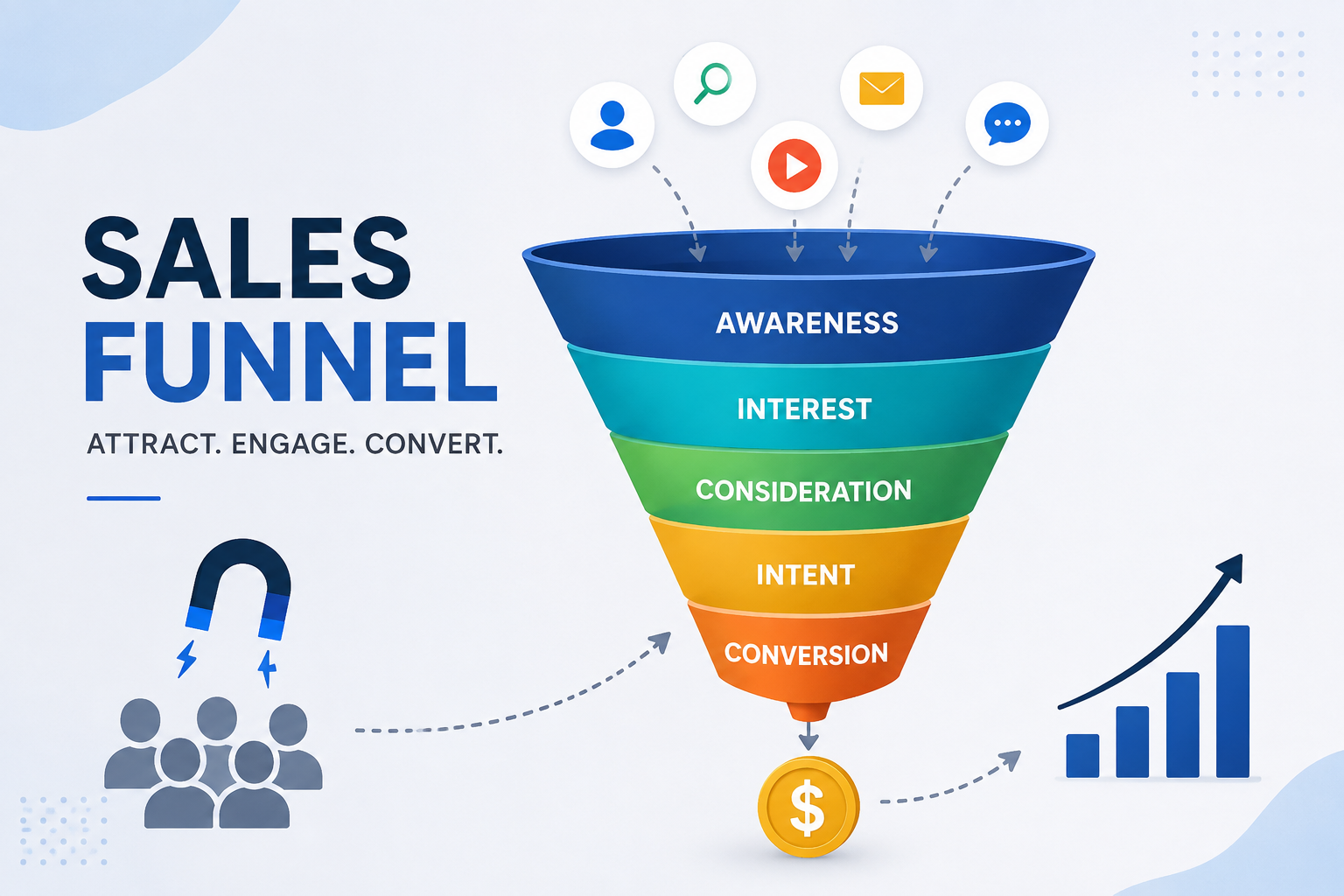
A sales funnel is the step-by-step journey a potential customer takes from first discovering a business to becoming a customer and, ideally, a loyal customer. It helps businesses understand where prospects are in the buying process and use the right marketing, content, offers, and follow-ups to move them toward conversion.
In simple terms, think of a funnel as a path:
People discover you → They become interested → They consider your offer → They decide to buy → They become customers → You retain them.
The funnel is wider at the beginning because many people may discover your business. As people lose interest or decide that your product isn’t right for them, the number of prospects becomes smaller.
For example, imagine a digital marketing agency publishes a blog about SEO. Hundreds of people may read the article. Some may download an SEO checklist. A smaller number may request a consultation, and some of those prospects may eventually become paying clients.
That entire journey is a sales funnel for business.
How Does a Sales Funnel Work?
A sales funnel works by matching your marketing and sales activities to the customer’s stage in the buying journey.
A person who has never heard of your business doesn’t usually need a sales pitch immediately. They first need to understand who you are and how you can solve their problem.
A person who has already compared different providers, however, may be ready for pricing information, a consultation, a free trial, or a product demonstration.
This is why an effective sales funnel strategy considers the customer’s needs at every stage.
The process generally looks like this:
Attract → Engage → Educate → Nurture → Convert → Retain
Marketing activities such as SEO, social media, paid advertising, and content marketing can bring people into the funnel. Landing pages, lead magnets, email campaigns, sales calls, offers, and follow-ups then help move qualified prospects toward conversion.
The Main Stages of a Sales Funnel
Different businesses may divide their funnels differently, but the following stages provide a useful framework for understanding the customer journey.
1. Awareness
At the awareness stage, a potential customer discovers your business for the first time.
They may find you through:
- Google search
- Social media
- Online advertising
- Blog content
- YouTube
- Referrals
- Local search
- Other websites
At this point, the person may not even know that they need your product or service.
What is the customer thinking?
“I have a problem. I want to learn more about it.”
What should your business do?
Focus on being useful rather than immediately selling. Create educational content, optimize your website for search, and make your brand easy to discover.
2. Interest
Once people become aware of your business, some will want to learn more.
They may explore your website, follow your social media account, read more articles, or sign up for your newsletter.
What is the customer thinking?
“This business seems relevant to my problem. I want to know more.”
What should your business do?
Provide helpful information that demonstrates your expertise. Educational blogs, videos, guides, newsletters, and social content can help build interest.
3. Consideration
At the consideration stage, prospects are actively evaluating possible solutions.
They may compare different businesses, read reviews, check pricing, study case studies, or look at your services.
What is the customer thinking?
“Which solution or business is right for me?”
What should your business do?
Give prospects reasons to choose you. Useful content may include:
- Case studies
- Customer testimonials
- Service pages
- Product comparisons
- FAQs
- Demonstrations
- Detailed guides
- Pricing information
4. Intent
Intent indicates stronger buying interest.
A prospect may request a quotation, book a consultation, add a product to their cart, sign up for a free trial, or contact your sales team.
What is the customer thinking?
“I may buy this. I just need to make my final decision.”
What should your business do?
Make the next step simple. Provide a clear call-to-action, answer common objections, make your offer easy to understand, and remove unnecessary friction.
5. Conversion or Purchase
This is the point where the prospect becomes a customer.
For an e-commerce business, conversion might mean completing an online purchase. For a digital marketing agency, it might mean signing a service agreement.
What is the customer thinking?
“I’m ready to move forward.”
What should your business do?
Make purchasing or booking as easy as possible. Keep forms simple, communicate clearly, and provide a smooth checkout or onboarding experience.
6. Retention and Loyalty
The funnel shouldn’t end after the first purchase.
A satisfied customer can make repeat purchases, upgrade services, leave positive reviews, and recommend your business to others.
What is the customer thinking?
“Was choosing this business a good decision?”
What should your business do?
Continue providing value through excellent service, customer support, personalized communication, loyalty programs, useful content, and follow-ups.
Retention can turn a one-time buyer into a long-term customer.
Why Does Your Business Need a Sales Funnel?
A sales funnel gives your marketing and sales process direction. Instead of treating every visitor the same, you can create experiences based on where someone is in their customer journey.
Better Lead Generation
A well-designed lead generation funnel can attract people who are genuinely interested in your products or services.
For example, you might offer a free guide in exchange for a visitor’s email address. You can then continue communicating with that person rather than losing the opportunity after their first website visit.
Higher Conversion Rates
Not every visitor is ready to buy immediately.
A funnel allows you to educate and nurture prospects until they are ready to take action. This can create more opportunities for lead conversion.
More Organized Marketing
A funnel helps you understand the purpose of each marketing activity.
For example:
- SEO attracts people searching for information.
- Content marketing educates them.
- Landing pages capture leads.
- Email marketing nurtures prospects.
- Sales calls or offers help convert qualified leads.
This creates a more organized marketing system.
Better Understanding of Customer Behavior
A funnel can show where prospects are dropping out.
If thousands of people visit your website but very few submit a form, there may be an issue with your landing page or offer.
If many people submit forms but very few become customers, your lead qualification, follow-up, pricing, or sales process may need improvement.
Better Follow-Ups
Some prospects need time before making a decision.
Instead of forgetting about them, you can use email campaigns, remarketing, educational content, or personal follow-ups to stay connected.
Less Marketing Waste
A funnel helps you identify which activities generate meaningful results.
Rather than spending money everywhere, you can focus your resources on channels and strategies that contribute to qualified leads and conversions.
Improved ROI
When marketing activities are connected to measurable stages, businesses can better understand what is working and where improvements are needed.
Stronger Customer Retention
A good funnel doesn’t stop at the purchase. Post-purchase communication and customer experience can help create repeat customers and brand advocates.
Sales Funnel vs Marketing Funnel
The terms sales funnel and marketing funnel are often used interchangeably, but they have slightly different focuses.
A marketing funnel generally focuses on attracting people, creating awareness, generating interest, and nurturing potential customers.
A sales funnel focuses more heavily on moving qualified prospects toward a purchase.
The two work together.
For example:
Marketing: Attracts a visitor through SEO.
Content: Educates the visitor.
Lead generation: Captures their contact information.
Lead nurturing: Builds trust.
Sales: Presents the right offer.
Conversion: Turns the prospect into a customer.
A strong digital marketing sales funnel connects these activities rather than treating marketing and sales as completely separate processes.
Sales Funnel Example
Let’s take a digital marketing agency as an example.
Suppose a business owner searches Google for:
“How to get more customers from Google?”
They discover a helpful blog published by a digital marketing agency.
At the end of the article, they see an offer for a free digital marketing consultation.
The business owner submits a form with their name, email address, and business details.
The agency then sends useful information and follows up with the prospect. During a consultation, the agency identifies problems with the business’s SEO, website, and lead generation strategy.
The agency presents a customized solution.
The prospect becomes a client.
After the project begins, the agency continues communicating with the client, reports results, identifies new opportunities, and provides ongoing support.
That’s an example of an online sales funnel:
Google Search → Blog → Landing Page → Lead → Nurturing → Consultation → Client → Retention
How to Create a Sales Funnel for Your Business
You don’t need a complicated system to build an effective funnel. Start with the basics.
Step 1: Define Your Target Audience
Understand who you want to attract.
Identify their:
- Problems
- Goals
- Needs
- Budget
- Buying behavior
- Questions
- Objections
The better you understand your audience, the more relevant your funnel will be.
Step 2: Create Awareness
Use channels where your target audience spends time.
Depending on your business, this may include SEO, social media, Google Ads, content marketing, video, local search, or referrals.
Step 3: Attract Visitors
Create useful content and experiences that answer your audience’s questions.
Your goal isn’t simply to generate traffic. You want to attract the right traffic.
Step 4: Capture Leads
Give interested visitors a reason to provide their contact information.
You could offer:
- Free consultation
- E-book
- Checklist
- Discount
- Product sample
- Free audit
- Webinar
- Newsletter
Step 5: Build Trust
People are more likely to buy when they trust a business.
Use testimonials, reviews, case studies, educational content, transparent information, and a professional website to build credibility.
Step 6: Nurture Leads
Don’t assume that every lead is ready to buy.
Use relevant emails, helpful content, retargeting, and personalized follow-ups to keep prospects engaged.
Step 7: Make the Right Offer
Your offer should match the prospect’s needs and buying stage.
A person at the awareness stage may need a free guide, while someone at the intent stage may be ready for a consultation or product offer.
Step 8: Convert Leads
Make the conversion process straightforward.
Use clear CTAs such as:
Book a Consultation
Get a Free Quote
Start Your Free Trial
Buy Now
Step 9: Follow Up
Following up is especially important for service businesses and high-value purchases.
A prospect may be interested but distracted, busy, or still comparing options.
Step 10: Retain Customers
Continue providing value after the sale.
Ask for feedback, offer support, communicate regularly, and look for opportunities to increase customer satisfaction and loyalty.
Common Sales Funnel Mistakes to Avoid
Even a well-planned funnel can fail if the fundamentals are ignored.
Not Understanding the Target Audience
If your messaging doesn’t address your customer’s actual needs, attracting traffic won’t be enough.
Sending Every Visitor Directly to a Sales Pitch
Someone who has just discovered your brand may not be ready to purchase. Give them useful information first.
Having a Weak Landing Page
A confusing headline, too much information, poor design, or unclear offer can cause visitors to leave.
No Clear Call-to-Action
Tell visitors what they should do next. Don’t make them guess.
Poor Lead Nurturing
Capturing an email address is only the beginning. Build a relationship with the lead.
Ignoring Follow-Ups
Many potential customers don’t convert during their first interaction. A thoughtful follow-up can keep the conversation alive.
Not Tracking Funnel Performance
Monitor metrics such as traffic, leads, conversion rates, cost per lead, and customer acquisition cost.
Focusing Only on New Customers
Existing customers can be valuable sources of repeat business and referrals. Include retention in your funnel strategy.
How Digital Marketing Helps Build a Sales Funnel
A successful funnel often combines multiple digital marketing channels.
SEO
SEO helps your business appear when potential customers search for problems, products, or services related to your business.
For example, informational blog content can attract prospects at the awareness stage.
Google Ads
Paid search can put your business in front of people who are actively searching for relevant products or services.
Social Media Marketing
Social platforms can help build awareness, engage audiences, demonstrate expertise, and drive traffic to your website.
Content Marketing
Blogs, videos, guides, case studies, and other content help answer questions and build trust throughout the customer journey.
Email Marketing
Email can nurture leads over time, provide useful information, promote offers, and support customer retention.
Landing Pages
A focused landing page can guide visitors toward one specific action, such as downloading a resource or booking a consultation.
Retargeting
Retargeting can reconnect with people who previously visited your website but didn’t convert.
Conversion Rate Optimization
Conversion rate optimization (CRO) involves improving pages, forms, offers, messaging, and user experiences so more visitors take the desired action.
When these channels work together, they can create a more effective conversion funnel instead of disconnected marketing activities.
How DigiPromoters Can Help Your Business
Building a sales funnel isn’t simply about adding a form to a website. An effective funnel requires the right audience, messaging, traffic sources, offers, landing pages, follow-ups, and measurement.
DigiPromoters helps businesses approach digital marketing with this bigger picture in mind.
From attracting the right audience through SEO and digital marketing to generating leads and improving conversion opportunities, the goal is to create a customer journey that supports sustainable business growth.
If your business is getting website visitors but not enough leads, or generating leads without enough conversions, analyzing your existing funnel can be a useful starting point.
The right strategy depends on your audience, industry, goals, and existing marketing channels.
Frequently Asked Questions
What is a sales funnel in simple terms?
A sales funnel is the journey a potential customer takes from discovering a business to becoming a paying customer. It helps businesses guide prospects through awareness, interest, consideration, purchase, and customer retention.
What are the 5 stages of a sales funnel?
The five commonly discussed stages are awareness, interest, consideration, intent, and conversion. Many modern funnels also include retention or loyalty after the purchase.
Why is a sales funnel important?
A sales funnel helps businesses organize their marketing and sales activities, understand customer behavior, generate leads, nurture prospects, improve conversions, and build stronger customer relationships.
How does a sales funnel generate leads?
A sales funnel generates leads by attracting relevant visitors and giving them a reason to provide their contact information. Common lead-generation methods include free consultations, downloadable resources, newsletters, discounts, and free trials.
What is the difference between a sales funnel and a marketing funnel?
A marketing funnel generally focuses on attracting and nurturing potential customers, while a sales funnel focuses more directly on converting qualified prospects into customers. In practice, they work together as part of the overall customer journey.
How do I create a sales funnel?
Start by defining your target audience, attracting relevant visitors, creating a lead capture opportunity, building trust, nurturing prospects, making a relevant offer, converting leads, following up, and retaining customers.
How long does it take to build a sales funnel?
The time depends on the complexity of the business and funnel. A basic funnel can be created relatively quickly, while a more advanced funnel involving multiple campaigns, landing pages, automation, CRM systems, and testing can take considerably longer.
Can small businesses use sales funnels?
Yes. Small businesses can benefit from simple sales funnels just as much as larger companies. A small business might use a Google search result, landing page, contact form, follow-up email, and sales call as its funnel.
Conclusion
A sales funnel gives your business a clear framework for turning strangers into prospects, prospects into customers, and customers into loyal advocates.
Instead of expecting every visitor to purchase immediately, you can understand where people are in their customer journey and provide the information, experience, and offer they need at each stage.
From SEO and content marketing to landing pages, lead nurturing, paid advertising, and follow-ups, every part of your digital marketing can contribute to the funnel.
The most important thing is to start with your customer. Understand what they need, how they search for solutions, what prevents them from buying, and what can help them make a confident decision.
If your business is struggling to generate qualified leads or convert existing traffic into customers, it may be time to look at your sales funnel.
Ready to turn more of your website visitors into customers? Start by analyzing your current customer journey and identify the biggest gap in your funnel.
SEO Information
SEO Title:
What Is a Sales Funnel? Stages, Benefits & How It Works
Meta Description:
Learn what a sales funnel is, how it works, its key stages, benefits, and how to create a sales funnel that helps generate leads and convert them into customers.
URL Slug:
sales-funnel
Primary Keyword:
sales funnel
Secondary & Long-Tail Keywords Used:
- what is a sales funnel
- sales funnel meaning
- sales funnel stages
- how does a sales funnel work
- sales funnel for business
- digital marketing sales funnel
- sales funnel strategy
- customer journey
- lead generation funnel
- conversion funnel
- online sales funnel
- marketing funnel
- sales funnel examples
- benefits of a sales funnel
- how to create a sales funnel
- sales funnel optimization
- lead conversion
- convert leads into customers
- customer acquisition
- lead nurturing
- conversion rate optimization
- sales funnel process
- sales funnel for small business
- digital marketing funnel
- customer retention
- sales and marketing funnel
Internal Linking Opportunities for DigiPromoters
1. Anchor Text: “How Long Does SEO Take to Show Results?”
Recommended Topic: SEO timeline and expectations
Placement: In the section about SEO and awareness, where readers are introduced to organic search as a funnel traffic source.
Status: Future blog/page opportunity unless an existing DigiPromoters article covers this topic.
2. Anchor Text: “Landing Page Optimization”
Recommended Topic: Landing page best practices and conversion optimization
Placement: In the “Landing Pages” section and the section discussing common funnel mistakes.
Status: Future blog/page opportunity unless an existing page exists.
3. Anchor Text: “Google Business Profile Optimization”
Recommended Topic: Google Business Profile optimization guide
Placement: In the awareness section when discussing local businesses and local search.
Status: Future blog/page opportunity unless an existing DigiPromoters article covers it.
4. Anchor Text: “On-Page vs Off-Page SEO”
Recommended Topic: On-page and off-page SEO explained
Placement: In the SEO section, where readers learn how organic search attracts potential customers.
Status: Future blog/page opportunity unless an existing article exists.
5. Anchor Text: “Lead Generation Strategies”
Recommended Topic: Lead generation methods for businesses
Placement: In the “Better Lead Generation” section.
Status: Future blog/page opportunity.
6. Anchor Text: “Cold Leads vs Qualified Leads”
Recommended Topic: How to distinguish cold, warm, and qualified prospects
Placement: In the lead nurturing and conversion sections.
Status: Future blog/page opportunity unless already published.
7. Anchor Text: “Digital Marketing Services”
Recommended Topic: DigiPromoters’ digital marketing services
Placement: In the DigiPromoters section and final CTA.
Status: Link to the existing service page if available; otherwise, create this as a future page opportunity.
External Linking Suggestions
Use external links selectively and only where they genuinely improve the reader’s understanding.
- Google Search Central — Useful for supporting SEO-related explanations and search best practices.
- Google Analytics — Useful when discussing website traffic, conversions, and measurement.
- Google Ads — Useful when explaining paid search and advertising as a funnel acquisition channel.
- HubSpot — Useful as a supporting educational resource for marketing and funnel terminology.
- Salesforce — Useful for supporting CRM, lead management, and sales-process concepts.
- Shopify — Useful for e-commerce-specific examples involving product discovery, carts, and online purchases.
- Meta Business — Useful for social media advertising and retargeting-related explanations.
Only link to the most relevant authoritative resource for a particular claim rather than adding external links simply for SEO.