



Have you ever searched for your main products or services on Google and noticed that your competitors appear above your website? You may have invested time in building your website, publishing blogs, and optimizing your pages, yet your competitors continue to receive more organic traffic and potential customers.
This is a common challenge for businesses trying to improve their online visibility. The good news is that your competitors ranking above you does not automatically mean your website is poorly built or that you need to start your SEO strategy from scratch.
Google evaluates many signals when deciding which pages to show for a search query. These include relevance, content usefulness, links, and other factors that help its systems identify suitable results. Rankings can also differ depending on the search query and the individual page being evaluated.
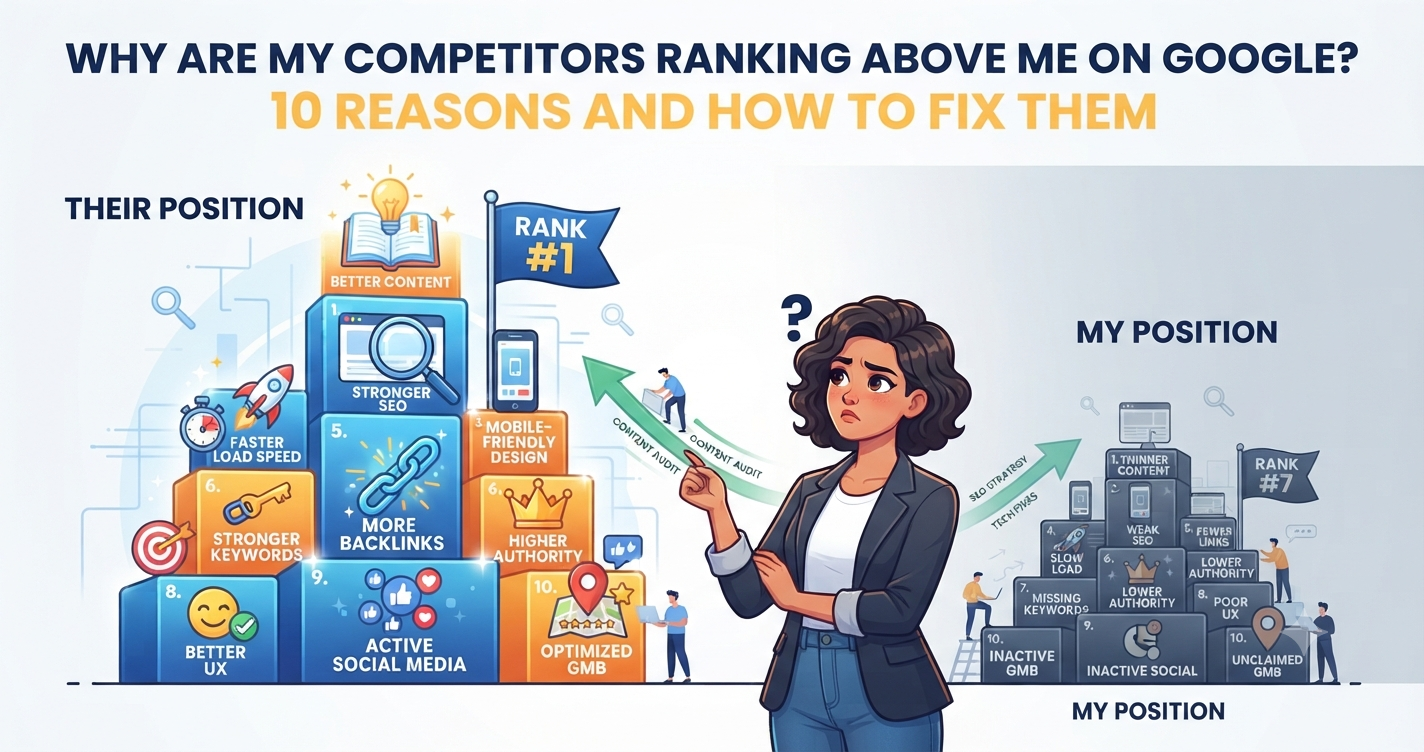
If you are wondering, “Why are my competitors ranking above me on Google?”, this guide explains the most common reasons, how to analyze competing websites, and what you can do to improve your search engine rankings with a practical SEO strategy.
Table of Contents
- Your Competitors Have Better Keyword Targeting
- Their Content Better Matches Search Intent
- Their Websites Have Stronger Backlink Profiles
- Your Website Has Technical SEO Issues
- Your Competitors Have Better On-Page SEO
- Their Websites Provide a Better User Experience
- Your Website Has Weak Topical Authority
- Your Local SEO Strategy Needs Improvement
- Your Competitors Have Stronger Brand Signals
- You Are Not Tracking the Right SEO Metrics
- How to Analyze Your Competitors’ SEO Strategy
- A 30-Day Plan to Improve Your Google Rankings
- Common SEO Mistakes to Avoid
- How Digipromoters Can Help
- Frequently Asked Questions
1. Your Competitors Have Better Keyword Targeting
One of the first things to investigate when competitors rank above your website is whether you are targeting the right keywords.
Keywords are the words and phrases people enter into search engines to find information, products, or services. If your website targets terms that are too broad, highly competitive, or unrelated to what your customers actually want, your pages may struggle to attract relevant organic traffic.
For example, a small digital marketing agency might try to rank for a broad term such as “digital marketing.” This query can be competitive and may attract people looking for many different things.
More specific searches, such as “SEO services for small businesses” or “digital marketing agency in Greater Noida,” may better match the agency’s services and target audience.
How to improve your keyword strategy
- Research the search terms your potential customers use.
- Identify relevant keywords with commercial or informational intent.
- Review which keywords competing pages appear to target.
- Assign a primary search topic to each important website page.
- Use relevant keyword variations naturally in titles, headings, and body content.
- Create dedicated service pages for distinct services when appropriate.
Tools such as Google Search Console, Google Keyword Planner, and reputable SEO research platforms can help you discover opportunities.
The objective is not to use the highest possible number of keywords. It is to make each page relevant to a clear topic and the needs of the people searching for it.
2. Your Competitors’ Content Better Matches Search Intent
Search intent refers to the reason behind a person’s search. Someone searching for information usually wants an explanation or guide, while someone searching for a service may want to compare providers or request a quotation.
Your competitors may rank above you because their pages answer the searcher’s question more effectively.
Imagine you want to rank for “why is my website not ranking on Google?” If your page mainly promotes your SEO services, while competing pages explain ranking problems and provide actionable solutions, your content may not satisfy the same search intent.
How to identify a content gap
Search for your target keyword and review the pages that appear prominently in the organic results.
Ask yourself:
- Are the top results informational guides, service pages, product pages, or local business listings?
- What questions do those pages answer?
- Do they provide examples, explanations, screenshots, or practical steps?
- What important information is missing from your own page?
- Can you provide a clearer, more useful answer?
Create content that provides more value
Improve your content by answering the main question early, organizing information with descriptive headings, and including relevant examples.
Add original insights based on your expertise. Where appropriate, include real project examples, useful checklists, original research, or practical explanations that help readers take action.
Avoid simply copying your competitors’ headings and rewriting their paragraphs. Google’s guidance recommends creating helpful, reliable, people-first content that adds value beyond what is already available. (Source: Google Search Central.)
3. Your Competitors Have Stronger Backlink Profiles
Backlinks are links from other websites that point to your website. They can help search engines discover pages and understand relationships between websites.
Google’s ranking systems include link-analysis systems, including PageRank, although modern rankings rely on many signals rather than backlinks alone.
Your competitors may have earned links from relevant publications, industry websites, professional organizations, business directories, or other reputable sources. These links can contribute to their search visibility.
However, the number of backlinks alone does not determine which website ranks first.
How to improve your backlink profile
Earn links through useful content. Publish original resources, detailed guides, industry insights, or tools that other websites may find worth referencing.
Build relevant partnerships. Connect with legitimate businesses, professional organizations, and industry publications that may have a reason to link to your resources.
Use digital PR. Share genuinely newsworthy business developments, research, or expert commentary with relevant publishers.
Review your existing links. Use reputable SEO tools to understand which pages attract links and whether your backlink profile has obvious issues.
Avoid manipulative link building. Buying links intended to manipulate rankings, participating in link schemes, and creating large numbers of low-quality links can violate Google’s spam policies.
Focus on earning relevant, editorially appropriate links rather than trying to match a competitor’s backlink count.
4. Your Website Has Technical SEO Issues
Even useful content can struggle to appear in search results if search engines cannot properly access, crawl, or index the relevant pages.
Technical SEO helps ensure that your website can be discovered and understood by search engines.
Some technical problems affect only individual pages, while others can influence large sections of a website.
Common technical SEO problems
- Important pages are accidentally blocked from crawling.
- Pages contain incorrect noindex directives.
- XML sitemaps contain outdated or irrelevant URLs.
- Broken internal links prevent users and crawlers from reaching important pages.
- Redirects lead to the wrong destinations.
- Duplicate pages create confusion about which URL should be indexed.
- Canonical tags point to unintended URLs.
- Mobile pages are difficult to use.
- Important content is not accessible in a way search engines can reliably process.
How to audit technical SEO
Start with Google Search Console.
Review the Page Indexing report to identify pages that are indexed, excluded, or experiencing problems. Inspect individual URLs to understand how Google sees specific pages.
Next, review your sitemap, robots.txt file, canonical tags, internal links, and redirects. Use a website crawler to identify broken links, redirect chains, and duplicate page issues.
Do not assume that every excluded URL is a problem. Some pages, such as intentionally redirected or duplicate URLs, should not be indexed.
Prioritize issues affecting important service pages, product pages, and other URLs that you want to appear in search results.
5. Your Competitors Have Better On-Page SEO
On-page SEO involves improving individual pages so search engines and visitors can understand their content more easily.
Your competitors may have clearer page titles, more descriptive headings, better internal links, and content that more directly addresses their target searches.
If your page title is vague or your content does not clearly explain the service you provide, both users and search engines may have difficulty understanding its relevance.
On-page SEO elements to review
Title tags: Give each important page a unique, descriptive title that accurately represents its content.
Meta descriptions: Write useful summaries that encourage relevant users to visit your page. Google may generate a different search snippet, and meta descriptions are not a direct ranking guarantee.
Headings: Organize your content using a clear H1 heading and logical H2 and H3 subheadings.
Content quality: Explain your subject thoroughly without unnecessary repetition or keyword stuffing.
Image optimization: Use appropriate image formats, descriptive filenames, and useful alt text where images convey information.
Internal linking: Connect relevant blog posts, service pages, and supporting resources with descriptive anchor text.
URL structure: Use understandable URLs that accurately reflect the page’s topic.
For example, a page titled “SEO Services for Small Businesses | Digipromoters” is more descriptive than a generic title such as “Our Services.”
Remember that on-page SEO is not about inserting a keyword into every heading. It is about making the page clear, relevant, useful, and easy to navigate.
6. Your Competitors Provide a Better Website Experience
Website experience can influence how easily visitors access information and complete tasks. A confusing layout, slow-loading pages, intrusive pop-ups, or difficult mobile navigation may discourage visitors from engaging with your business.
A technically sound website is not automatically the highest-ranking website, however. Google considers many signals, and a good user experience alone does not guarantee better rankings.
Website experience improvements to consider
- Make your website responsive across desktop, tablet, and mobile devices.
- Compress oversized images and remove unnecessary scripts.
- Ensure important content is visible and readable.
- Make navigation intuitive.
- Use clear calls to action on service and landing pages.
- Secure your website with HTTPS.
- Avoid intrusive elements that prevent visitors from accessing content.
- Test forms, buttons, and contact links regularly.
Use PageSpeed Insights to review performance and Core Web Vitals. Pay attention to loading performance, interaction responsiveness, and layout stability.
These improvements can make your website easier to use while supporting your broader SEO and conversion goals.
7. Your Website Has Weak Topical Authority
Topical authority is a useful SEO concept describing how thoroughly and credibly a website covers a subject. It is not a single score that you can directly optimize to guarantee higher rankings.
Your competitors may have published a more developed collection of relevant articles, guides, service pages, and supporting resources. This can help users find answers to related questions and discover their expertise.
For example, a digital marketing agency might publish content covering:
- Technical SEO audits.
- Keyword research.
- On-page SEO.
- Local SEO.
- Link building.
- Content marketing.
- SEO reporting and measurement.
These articles can link to relevant service pages and to one another where appropriate.
Build a useful content cluster
Start with a central page covering a broad topic, then publish supporting articles that answer specific questions related to it.
For example, a main SEO services page could link to guides about keyword research, technical SEO, and local SEO. Each supporting article should provide independent value and link back to the main service page when relevant.
Avoid creating dozens of near-identical articles just to target slightly different keyword variations. Focus on meaningful questions and topics your audience genuinely needs help with.
8. Your Local SEO Strategy Needs Improvement
If your business serves a specific city or region, your competitors may appear above you because they have a stronger local search presence.
Local search results can include Google Maps listings, business profiles, and organic website results. The factors affecting these different result types are not identical.
Google explains local results primarily in terms of relevance, distance, and prominence.
How to improve local SEO
Optimize your Google Business Profile. Ensure your business information is accurate and complete, with appropriate categories, hours, services, and genuine photographs.
Keep business information consistent. Maintain accurate contact details across your website and relevant business listings.
Earn genuine customer reviews. Encourage customers to share honest feedback and respond professionally.
Create useful local landing pages. If you serve multiple locations, publish genuinely useful pages for the areas you serve rather than creating thin pages that only swap city names.
Strengthen your website’s local relevance. Mention your service area naturally where relevant and provide useful local information.
For example, a business serving Greater Noida can clearly describe its service area and provide relevant information for customers in that market.
Do not create fake locations or keyword-stuffed business names. Local SEO should accurately represent your real business and the areas you serve.
9. Your Competitors Have Stronger Brand Recognition
People may be more familiar with competing businesses because they have been operating longer, have greater visibility in their industry, or are frequently referenced by other organizations.
Brand recognition can contribute indirectly to online performance by encouraging people to search for a business by name, visit its website, recommend its content, or link to its resources.
However, brand awareness is not a guaranteed or standalone ranking advantage.
How to strengthen your online presence
- Publish useful, consistent content under your business name.
- Maintain accurate business information across relevant platforms.
- Share original insights that demonstrate your expertise.
- Participate in relevant industry events and communities.
- Build genuine relationships with customers and partners.
- Publish authentic case studies with permission and verifiable results.
- Make your business’s expertise and contact information easy to find.
The goal is to make your business more recognizable and trustworthy to the people you serve.
10. You Are Not Tracking the Right SEO Metrics
You cannot accurately diagnose a ranking problem without understanding what is happening across your website.
A competitor appearing above you for one keyword does not necessarily mean your entire SEO strategy is failing. You need to evaluate performance across relevant queries, pages, and time periods.
Key SEO metrics to monitor
Organic clicks: The number of clicks your website receives from unpaid search results.
Impressions: How often your pages appear in search results.
Average position: A Search Console metric summarizing the position of your highest result for recorded impressions; it can vary across queries and circumstances.
Click-through rate (CTR): The percentage of impressions that result in clicks.
Indexed pages: The pages Google has indexed from your website.
Organic conversions: Leads, purchases, calls, or other valuable actions attributed to organic traffic.
Engagement and landing-page performance: Indicators that help you understand what visitors do after reaching your website.
Use Google Search Console to identify queries where your pages receive impressions but relatively few clicks, and queries where competitors appear to have greater visibility.
Use Google Analytics or another suitable analytics platform to understand what happens after visitors arrive.
If impressions are increasing but clicks are not, investigate search intent, page titles, snippets, and the search results appearing around your page. If clicks are increasing but enquiries remain low, review the landing page, offer, and conversion process.
11. How to Analyze Your Competitors’ SEO Strategy
A structured competitor analysis helps you identify specific improvements instead of guessing why another website ranks higher.
Step 1: Identify your real SEO competitors
Search Google for your most important commercial and informational keywords. Record the websites that repeatedly appear above yours.
Your SEO competitors may differ from your direct business competitors. Focus on the pages competing for the searches you want to win.
Step 2: Compare the pages, not just the domains
For each important keyword, compare your page with the pages ranking above it.
Review their titles, headings, content coverage, search intent, internal links, and relevant external links.
Step 3: Identify content gaps
Look for questions your page does not answer, important details you have omitted, and areas where your explanation is less useful.
Do not assume a longer article is automatically better. The objective is to satisfy the searcher’s needs more effectively.
Step 4: Review technical differences
Check whether your important pages are indexed and accessible. Compare mobile usability, page performance, navigation, and internal linking.
Step 5: Prioritize improvements
Create a list of actions based on business importance, the likely impact of the issue, and the effort required to fix it.
For example, fixing a blocked service page may be more urgent than adjusting a minor heading on a blog that already performs well.
Step 6: Measure changes over time
Record baseline performance before making substantial changes. Review relevant Search Console metrics regularly and allow enough time for Google to crawl, index, and reassess updated pages.
Google does not guarantee that a particular change will improve rankings, and results can take time to appear.
12. A 30-Day Plan to Improve Your Google Rankings
Use this practical schedule to organize your initial SEO improvements.
Week 1: Diagnose the problem
- Identify your five to ten most important search queries.
- Review competing organic results.
- Check Google Search Console for indexing issues.
- Compare your key service pages with competing pages.
- Record current impressions, clicks, average position, and conversions.
Goal: Identify the most important gaps affecting your website.
Week 2: Fix on-page and technical issues
- Correct important crawling, indexing, canonical, or redirect problems.
- Improve page titles and main headings.
- Strengthen internal links.
- Improve mobile usability and performance where needed.
- Review duplicate or thin pages.
Goal: Ensure important pages are accessible and clearly communicate their purpose.
Week 3: Improve content and authority
- Update one or two priority pages with genuinely useful information.
- Address important questions that competitors answer better.
- Add original examples, relevant evidence, and practical advice.
- Publish a supporting article if it fills a genuine content gap.
- Identify relevant opportunities to earn legitimate backlinks.
Goal: Make your most important pages more useful and competitive.
Week 4: Review performance and plan next steps
- Inspect updated URLs in Search Console.
- Review changes in impressions, clicks, and relevant queries.
- Check whether organic visitors are converting.
- Investigate remaining technical and content issues.
- Prepare the next round of improvements based on the data.
Goal: Establish a repeatable SEO improvement process.
Thirty days is a useful period for implementing and reviewing initial changes, not a promise that rankings will improve within that time.
13. Common SEO Mistakes to Avoid
When trying to outrank competitors, avoid tactics that waste resources or risk damaging your search visibility.
Keyword stuffing: Repeating the same phrase unnaturally makes content harder to read and may violate spam policies.
Copying competitor content: Rewriting competing pages without adding meaningful value does not create a compelling reason for users to choose your page.
Buying manipulative backlinks: Link schemes can create policy risks rather than sustainable authority.
Publishing low-quality content in bulk: More pages do not automatically mean better rankings.
Ignoring technical problems: A content strategy cannot compensate for important pages that search engines cannot access or index.
Changing URLs unnecessarily: Poorly managed URL changes can disrupt existing visibility and links.
Expecting instant results: SEO requires ongoing work, measurement, and adjustment.
Measuring only rankings: Better positions are useful only in context. Also measure relevant traffic, enquiries, conversions, and business outcomes.
14. How Digipromoters Can Help Improve Your Google Rankings
If your competitors consistently rank above your website, a structured SEO audit can help identify where your strategy needs improvement.
Digipromoters helps businesses strengthen their online visibility through relevant digital marketing services, including SEO, content marketing, website optimization, local SEO, and digital marketing strategy.
Depending on your website’s needs, an SEO improvement plan may include:
- Competitor SEO analysis: Identify the pages, search queries, and content opportunities that matter to your business.
- Keyword research: Find relevant search terms aligned with your audience and services.
- Technical SEO audits: Investigate crawling, indexing, site structure, and other technical issues.
- On-page SEO: Improve titles, headings, internal links, and content relevance.
- Content strategy: Plan useful articles and service pages that answer real customer questions.
- Local SEO: Improve your local search presence when your business serves specific areas.
- Performance tracking: Monitor organic visibility, relevant traffic, and conversion opportunities.
The right approach depends on your website, competition, industry, and current SEO performance. A competitor analysis should identify specific gaps and prioritize the actions most relevant to your business rather than promise a particular ranking.
Want to understand why your competitors rank above you on Google?
Contact Digipromoters to discuss an SEO strategy tailored to your website, target keywords, and business goals.
15. Frequently Asked Questions
1. Why are my competitors ranking higher than my website on Google?
Your competitors may have more relevant content, better search intent alignment, stronger link profiles, clearer on-page SEO, or fewer technical issues. The actual reason depends on the query and pages involved. Compare the competing pages and review your own performance data before deciding what to fix.
2. How can I find out why my website is not ranking on Google?
Start with Google Search Console. Review indexing reports, URL inspection results, queries, impressions, clicks, and average positions. Then evaluate your content, keyword targeting, internal links, technical SEO, and relevant competitors. This helps distinguish indexing problems from broader ranking and visibility challenges.
3. How long does it take to outrank competitors on Google?
There is no fixed timeline. It depends on the competition, website history, content quality, technical condition, and the improvements required. Some changes may be reflected relatively quickly after crawling and indexing, while more competitive searches may require sustained work over a longer period. No agency can guarantee a particular ranking date.
4. Do backlinks help websites rank higher on Google?
Links are part of Google’s ranking systems and can help search engines discover content and understand relationships between pages. However, backlinks are not the only factor that matters. Prioritize relevant, naturally earned links and avoid schemes intended to manipulate rankings.
5. Does publishing more blog posts improve Google rankings?
Publishing useful articles can help your website answer more relevant questions and build a stronger content offering. However, publishing more pages alone does not guarantee better rankings. Prioritize originality, accuracy, audience relevance, and meaningful coverage rather than producing content solely to increase page count.
6. Can technical SEO issues prevent my website from ranking?
Yes. Important crawling or indexing problems can prevent pages from appearing in search results. Incorrect directives, broken internal links, canonical errors, and other technical issues may also interfere with search visibility. Not every technical warning is critical, so prioritize problems affecting important pages.
7. Should I use the same keywords as my competitors?
You can target relevant keywords that your competitors rank for, but your strategy should reflect your own services, audience, and business goals. Look for gaps and relevant opportunities rather than copying their entire keyword list. Choose terms based on search intent, relevance, and realistic business value.
8. Can an SEO agency help my website rank above competitors?
An SEO agency can help audit your website, analyze competing pages, prioritize improvements, and develop a strategy based on your business objectives. Results depend on execution, competition, website quality, and many other factors. Choose an agency that explains its recommendations, reports meaningful metrics, and avoids guaranteed-ranking claims.
Conclusion
If you are asking, “Why are my competitors ranking above me on Google?”, the answer is rarely as simple as one missing keyword or one technical setting.
Your competitors may be doing a better job of matching search intent, providing useful content, earning relevant links, maintaining a technically accessible website, or meeting the needs of local searchers.
The best way forward is to investigate your website systematically. Identify the queries that matter, compare the actual competing pages, fix important technical issues, improve your content, and monitor results over time.
SEO is an ongoing process of understanding your audience, improving your website, and responding to evidence rather than guessing.
Ready to improve your website’s search visibility? Contact Digipromoters to explore SEO services and develop a practical strategy to compete more effectively on Google.