




Social media has changed the way people discover, evaluate, and buy from brands. A professionally produced advertisement can still look impressive, but looking impressive is no longer enough to stop someone from scrolling.
Increasingly, audiences want content that feels human, useful, relatable, and relevant to their everyday lives. This is one reason authentic content on social media has become such an important part of modern marketing.
From creator-style Reels and customer reviews to behind-the-scenes videos and employee-generated content, brands are finding new ways to show the people and experiences behind their products.
This does not mean polished advertising is dead. Instead, it means brands need to understand when professional production adds value and when a more natural approach creates a stronger connection.
In this article, we will explore why real content is gaining attention, how it differs from traditional polished advertising, what businesses can learn from creators and customers, and how to build authenticity into a practical social media content strategy.
What Does “Real” Content Mean on Social Media?
“Real” content does not necessarily mean low-quality content.
It means content that feels natural, human, and believable rather than something that looks like it was created only to sell.
Authentic social media content can include:
- A founder explaining why they started a business
- An employee showing how a product is used
- A customer sharing their experience
- A creator demonstrating a product in their normal environment
- Behind-the-scenes footage
- A quick phone-recorded Reel
- A before-and-after transformation
- A common customer problem explained in simple language
- A product demonstration without an elaborate advertising setup
- A business responding naturally to questions and comments
The important distinction is perception, not production quality.
A professionally shot video can still feel authentic if it tells a genuine story. Likewise, a shaky smartphone video can feel artificial if it is heavily scripted or deliberately pretending to be spontaneous.
In other words, authenticity is about how the content feels and whether it matches the brand’s actual experience.
Why Are Audiences Responding to More Authentic Content?
Social media users are exposed to an enormous amount of promotional content every day. As a result, people have become better at recognizing when something feels like a traditional advertisement.
At the same time, social platforms increasingly operate as discovery environments rather than simple channels for following brands.
Sprout Social’s 2026 Social Media Content Strategy Report found that consumers surveyed across the US, UK and Australia identified human-generated content as the top priority for brands on social media. The study surveyed more than 2,300 consumers and 1,200 marketers.
That does not mean every brand should abandon professional creative work. It suggests that businesses should make room for content that gives audiences a stronger sense of the people, expertise, personality, and reality behind the brand.
People Want Something They Can Relate To
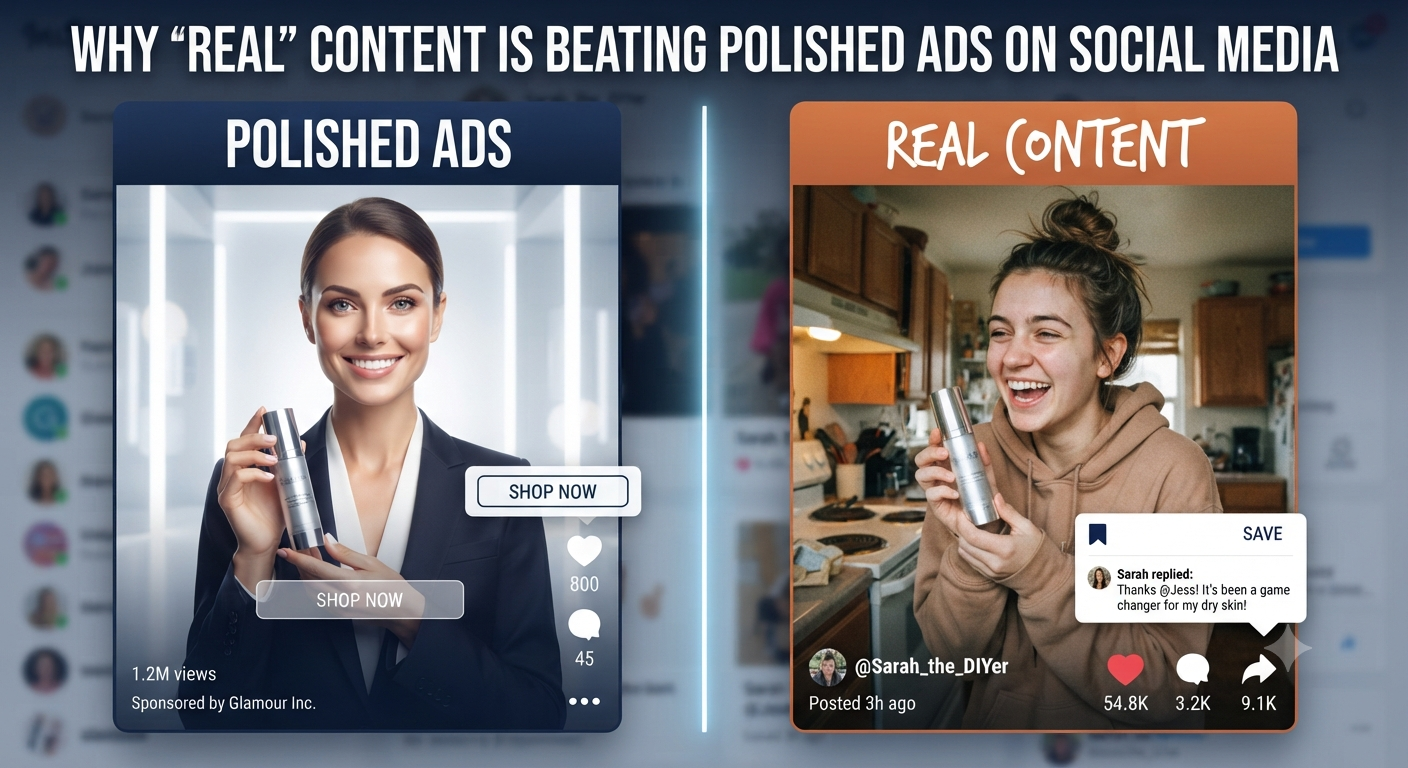
Imagine two videos selling the same skincare product.
Video A:
A professional model stands in a perfect studio while the product rotates around her with cinematic lighting.
Video B:
A creator records herself in her bathroom explaining how she uses the product as part of her morning routine.
Both can communicate the product’s benefits.
But the second format may feel more like something the viewer could actually experience themselves.
That feeling of familiarity is valuable because social media is fundamentally personal. People are not opening Instagram or TikTok only to watch advertisements. They are looking for entertainment, information, recommendations, conversations, and ideas.
Real Content vs Polished Ads: What’s the Difference?
The debate is not really about whether one format is universally better.
It is about using the right creative format for the right objective.
| Polished Advertising | Authentic/Real Content |
| Highly controlled production | More natural production |
| Strong visual consistency | Strong human connection |
| Carefully scripted | Often conversational |
| Professional studio or setup | Real-life environments |
| Brand-led storytelling | People-led storytelling |
| Product-focused | Experience-focused |
| Designed for controlled presentation | Designed to feel native to the platform |
A polished advertisement can be extremely useful for:
- Brand launches
- Premium products
- Product demonstrations
- Major campaigns
- Brand awareness
- High-quality product photography
- Retargeting campaigns
- Website and landing-page creative
Authentic content can be especially useful for:
- Reels and short-form videos
- Testimonials
- Creator collaborations
- User-generated content
- Behind-the-scenes storytelling
- FAQs
- Educational content
- Community building
- Product discovery
The strongest social media content strategy often combines both.
Why Authentic Content Can Increase Social Media Engagement
Authentic content gives audiences more opportunities to see themselves in the story.
Instead of saying:
“Our product is the perfect solution for your problem.”
A brand can show:
“Here is the problem we noticed customers were struggling with, and here is how we solved it.”
That small change makes the communication more specific and human.
Authentic content can encourage:
- Comments
- Shares
- Saves
- Direct messages
- Questions
- Product discussions
- Recommendations
- Repeat engagement
The goal should not simply be to collect likes. Meaningful social media engagement can create conversations that help a business understand what its audience actually wants.
Sprout Social’s research has also highlighted authenticity and relatability as important characteristics of brand content, while its 2026 research specifically points toward human-generated content as a priority.
The Rise of Creator-Style Content
One of the biggest changes in social media marketing is the growing influence of creators.
Creator-style content does not necessarily require a celebrity or major influencer.
A creator can be:
- A niche expert
- A local influencer
- A customer
- An employee
- A founder
- A professional in a particular industry
- A content creator with a small but relevant audience
This is important because follower count is not the only factor that determines the usefulness of a creator partnership.
Sprout Social’s 2026 influencer marketing research found that only 17% of surveyed consumers check a creator’s follower count before deciding whether to engage. The research instead highlights relevance and content style as important considerations.
That creates opportunities for smaller brands.
A local restaurant may benefit more from a food creator whose audience lives nearby than from a celebrity with millions of followers but little connection to the restaurant’s market.
User-Generated Content Is Becoming More Valuable
User-generated content (UGC) is content created by customers or users rather than directly by the brand.
Examples include:
- Customer review videos
- Unboxing videos
- Product demonstrations
- Before-and-after content
- Customer photographs
- Testimonials
- “How I use this product” videos
- Customer stories
UGC works because it provides a different perspective from traditional brand advertising.
Instead of the business saying:
“Our product works.”
A customer can demonstrate how they use it.
However, brands should never manufacture fake customer experiences or disguise paid advertising as independent customer opinion. Transparency matters because trust is one of the foundations of authentic marketing.
Employees Can Become Powerful Brand Voices
Authenticity does not always require hiring influencers.
Your employees already understand your products, customers, workplace, and industry.
For example:
A digital marketing agency could create content where an SEO specialist explains one common SEO mistake in 30 seconds.
An interior design company could show a designer choosing materials for a client’s living room.
A restaurant could show the chef preparing a signature dish.
A SaaS company could let a product specialist answer three frequently asked questions.
These videos can feel much more personal than a generic corporate advertisement.
Sprout Social’s 2026 influencer marketing research reports that 40% of surveyed consumers discover new products or services through employee-generated content monthly, while also finding frontline employees more authentic than polished brand accounts.
Why Short-Form Video Fits Authentic Marketing
Short-form video has become one of the most important formats for social media content.
Reels, TikTok videos, YouTube Shorts, and similar formats allow brands to communicate an idea quickly without requiring a large production.
A 20-second video can answer a question, demonstrate a product, show a transformation, or tell a quick story.
This is particularly relevant in India, where Meta reported in 2026 that short-form video and creators are playing an increasing role in product discovery. Meta’s research also reported that 97% of surveyed Indian consumers watched short-form video daily. These figures come from Meta and its research partners, so they should be interpreted in that specific research context rather than as a universal measure of every Indian consumer.
Examples of Authentic Short-Form Video Ideas
A business can create videos such as:
“3 mistakes customers make before buying…”
Useful educational content can establish expertise without directly pushing a sale.
“Come with us behind the scenes…”
Show the actual process behind the product or service.
“A customer asked us…”
Turn a real customer question into a short educational video.
“POV: You finally…”
Use a relatable scenario that reflects a genuine customer problem.
“What nobody tells you about…”
Address misconceptions or overlooked details within your industry.
“Before vs after”
Show the actual transformation produced by your product or service.
These formats can be simple while still being strategically planned.
How Brands Can Look Authentic Without Looking Unprofessional
This is where many businesses make a mistake.
They hear “authentic content” and assume it means:
- Bad lighting
- Poor audio
- Random posting
- No branding
- No planning
- Low-quality visuals
- Improvised messaging
That is not authenticity.
A better approach is professional strategy with natural execution.
Keep Your Brand Identity Consistent
Your content can be casual without becoming visually chaotic.
Maintain consistency through:
- Brand colors
- Logo usage
- Typography
- Tone of voice
- Key messaging
- Visual identity
The individual video can feel natural while the overall account still looks like a professional brand.
Write Talking Points Instead of Full Scripts
Instead of forcing an employee or creator to memorize every sentence, give them three or four points to cover.
For example:
Topic: Why businesses need local SEO
Talking points:
- Customers search locally before visiting.
- Google Business Profile helps businesses appear in local searches.
- Reviews influence customer confidence.
- Consistent local SEO improves discoverability.
The speaker can explain these naturally.
The result usually feels more conversational.
Show Real Environments
A beauty brand does not always need a studio.
A restaurant does not always need a cinematic commercial.
An interior design company can show an actual project site.
A digital marketing agency can record a strategist explaining something from their desk.
The environment itself can become part of the storytelling.
Authentic Does Not Mean “Unplanned”
One of the biggest misconceptions about authentic social media marketing is that genuine content must happen spontaneously.
In reality, the most effective content often has a strategy behind it.
A brand can plan:
- The topic
- Target audience
- Objective
- Hook
- Key message
- CTA
- Format
- Platform
- Publishing schedule
- Performance metrics
What changes is how the message is delivered.
Instead of making every piece of content feel like a commercial, the brand adapts the presentation to the way people naturally consume content on that platform.
How to Build an Authentic Social Media Content Strategy
Authenticity works best when it is part of a broader content marketing strategy.
Here is a practical framework.
1. Identify What Your Audience Actually Cares About
Look at:
- Customer questions
- Sales objections
- Reviews
- Search queries
- Comments
- DMs
- Competitor discussions
- Frequently asked questions
Your customers are already giving you content ideas.
2. Create Content Around Real Problems
Instead of constantly promoting your product, answer problems.
For example, a digital marketing agency could create:
- “Why your Instagram posts get views but no leads”
- “What local businesses should know about Google Business Profile”
- “SEO mistakes small businesses make”
- “How much content should a business post?”
This establishes expertise while remaining useful.
3. Build Content Pillars
A business can divide its content into several categories.
For example:
Educational:
Tips, guides, mistakes, explanations.
Relatable:
Industry humor, common customer experiences, POV content.
Human:
Team members, founders, workplace moments.
Proof:
Reviews, case studies, testimonials, results.
Promotional:
Offers, products, services, launches.
A healthy social media content strategy does not need every post to sell.
4. Mix Professional and Native Content
Do not completely abandon polished creative.
Instead, create a content mix.
For example:
- 30% educational content
- 20% relatable content
- 20% creator/UGC content
- 15% behind-the-scenes content
- 15% promotional content
These percentages are not a universal formula. Your mix should be adjusted based on your industry, audience, platform, and performance data.
5. Measure Business-Relevant Results
Do not judge authenticity only by views or likes.
Track:
- Engagement rate
- Saves
- Shares
- Comments
- Profile visits
- Website clicks
- Leads
- Sales
- Cost per lead
- Conversion rate
- Customer acquisition cost
- Repeat purchases
This helps connect social media activity with actual social media ROI.
Authentic Content and Social Media Advertising Can Work Together
There is no need to choose between organic social media content and paid advertising.
In fact, they can support each other.
For example:
- A brand publishes a creator-style Reel organically.
- The video receives strong engagement.
- The business identifies the strongest audience response.
- The creative is adapted for a paid campaign.
- The advertisement reaches a larger relevant audience.
- Retargeting campaigns encourage interested users to take action.
This approach allows brands to combine the human feel of creator content with the targeting capabilities of social media advertising.
CreatorIQ reported in 2026 that creator content accounted for an average 44% of brands’ paid-media creative assets among the marketers and executives surveyed, showing how creator-style content is increasingly being incorporated into advertising rather than kept separate from it.
Real Content Can Support Conversions — But It Still Needs Strategy
Authenticity alone does not guarantee sales.
A relatable Reel may generate thousands of views and zero customers if the audience does not understand what to do next.
That is why authentic content needs a conversion path.
For example:
Reel → Profile → Service page → Lead form → Consultation
Or:
Creator video → Product page → Purchase
Or:
Educational post → Website article → Email signup
The content creates attention and trust.
The rest of the marketing funnel gives that attention somewhere to go.
This is where authentic content becomes part of a complete digital marketing strategy rather than simply a social media trend.
Common Mistakes Brands Make When Trying to Look “Real”
Authenticity can easily become another marketing performance if brands approach it incorrectly.
Mistake 1: Pretending to Be Casual
If a highly scripted advertisement is deliberately filmed to look spontaneous, audiences may notice the disconnect.
Mistake 2: Copying Every Viral Trend
Not every trend fits every business.
Sprout Social’s 2025 research found that although consumers value brands keeping up with online culture, simply jumping onto viral trends can backfire.
A trend should support your brand or audience—not exist merely because everyone else is using it.
Mistake 3: Overusing Slang
Trying too hard to sound young or trendy can make a brand feel less authentic.
Use language your actual audience understands.
Mistake 4: Making Every Post Promotional
If every Reel ends with “Buy now,” people quickly understand the account’s only purpose.
Give people reasons to follow you even when they are not ready to purchase.
Mistake 5: Using Fake Testimonials or Reviews
Never manufacture customer experiences.
Authenticity depends on trust, and fake social proof can damage that trust.
Mistake 6: Ignoring Comments
Authenticity is not only about publishing content.
It is also about how the brand responds.
Questions, complaints, compliments, and conversations are part of the social experience.
Does Authentic Content Mean Brands Should Stop Making Polished Ads?
No.
Polished advertising still has an important role.
A premium product launch may require professional photography.
A luxury brand may need carefully controlled visual storytelling.
A product catalogue may need consistent photography.
A large campaign may require professional production.
The better question is:
Where should our brand be polished, and where should it be personal?
A strong modern brand can have both.
Your website may look highly polished.
Your product photography may be professionally produced.
Your paid campaigns may have carefully designed creatives.
And your Instagram Reels may feature employees answering questions from their desks.
These approaches are not contradictory.
They can create a more complete brand experience.
What Social Media Marketing Trends in 2026 Tell Us
Several developments point toward a more human-centered social media environment.
Human-Created Content Is Becoming More Important
Sprout Social’s 2026 research specifically identifies human-generated content as the top content priority consumers want brands to focus on.
Creator Content Is Moving Into Paid Advertising
Creator content is increasingly being used not only for influencer campaigns but also as paid-media creative.
Smaller and More Relevant Creators Matter
Research from Sprout Social indicates that consumers do not necessarily judge creators primarily by follower count, highlighting the importance of relevance and content style.
Short-Form Video Remains Important in India
Meta’s 2026 India research points to strong daily consumption of short-form video and a growing role for creators in product discovery.
Together, these developments suggest that brands should think beyond traditional advertisements and create content designed for the way people actually use social platforms.
How DigiPromoters Can Help Your Brand Build a More Authentic Social Presence
Creating authentic content sounds simple until a business has to produce it consistently.
The challenge is not just recording videos.
It is deciding:
- What should we post?
- Who are we creating it for?
- Which platform should we prioritize?
- Which topics can establish expertise?
- What should be organic?
- What should be promoted?
- Should we work with creators?
- How can we turn customer experiences into content?
- Which posts are actually generating business results?
At DigiPromoters, our approach to social media marketing focuses on connecting creative content with a clear business objective.
That can include:
- Social media strategy
- Content planning
- Short-form video concepts
- Creator and influencer content
- User-generated content campaigns
- Social media advertising
- Content calendars
- Audience research
- Performance tracking
- Brand positioning
- Conversion-focused social campaigns
The goal is not to make every post look less professional.
The goal is to make your brand more human without losing its identity.
FAQs
What is authentic content on social media?
Authentic content is social media content that feels genuine, human, relatable, and relevant rather than overly promotional or artificially produced. It can include customer stories, creator videos, employee content, behind-the-scenes posts, and natural product demonstrations.
Why is authentic content important for brands?
Authentic content can help brands communicate more naturally with their audiences, encourage conversations, demonstrate real experiences, and build trust. It is particularly useful when audiences are exposed to large volumes of traditional promotional content.
Is authentic content better than polished advertising?
Not necessarily. Both formats serve different purposes. Polished advertising can be useful for brand campaigns and premium visual communication, while authentic content can be particularly effective for relatable storytelling, creator marketing, education, and community engagement.
How can a brand create more authentic social media content?
Brands can feature employees, customers, creators, founders, real product demonstrations, behind-the-scenes footage, customer questions, and educational videos. The content should remain strategically planned while allowing the presentation to feel natural.
What is the difference between UGC and influencer marketing?
User-generated content is generally created by customers or users, while influencer marketing involves partnering with creators who have an established audience. A creator can produce UGC-style content for a brand even when they are being paid for the collaboration.
Does authentic content work for small businesses?
Yes. Small businesses can use authentic content to showcase their people, products, processes, customers, expertise, and local community without requiring the production budget of a large advertising campaign.
How can authentic content improve social media engagement?
Relatable and human content can give audiences reasons to comment, share, save, or start conversations. However, engagement depends on factors such as relevance, creative quality, audience fit, platform, topic, and consistency.
Should businesses use authentic content in paid ads?
Yes. Creator-style and UGC-style creative can be adapted for paid social advertising. The important factors are transparency, audience targeting, clear messaging, strong creative, and a relevant conversion path.
Final Thoughts: Real Content Is About Trust, Not Just Trends
The shift toward authentic content on social media is not simply a rejection of professional advertising.
It is a change in what audiences expect from brands.
People want to see useful information, real experiences, relatable situations, genuine expertise, and people they can connect with.
That is why the strongest social media strategies increasingly combine professional branding with human storytelling.
Use polished creative when it adds value.
Use creator-style content when a personal voice works better.
Use customer stories when social proof matters.
Use behind-the-scenes content when people want to understand the business.
And use data to determine what actually contributes to engagement, leads, sales, and loyalty.
The future of social media marketing is not necessarily “less polished.”
It is more relevant, more human, and more intentional.
If your business is struggling to turn social media activity into meaningful engagement and business growth, DigiPromoters can help you build a social media content strategy that combines authentic storytelling, creative content, and performance-focused marketing.
Ready to make your brand more human on social media? Connect with DigiPromoters and build a content strategy designed to attract, engage, and convert the right audience.